
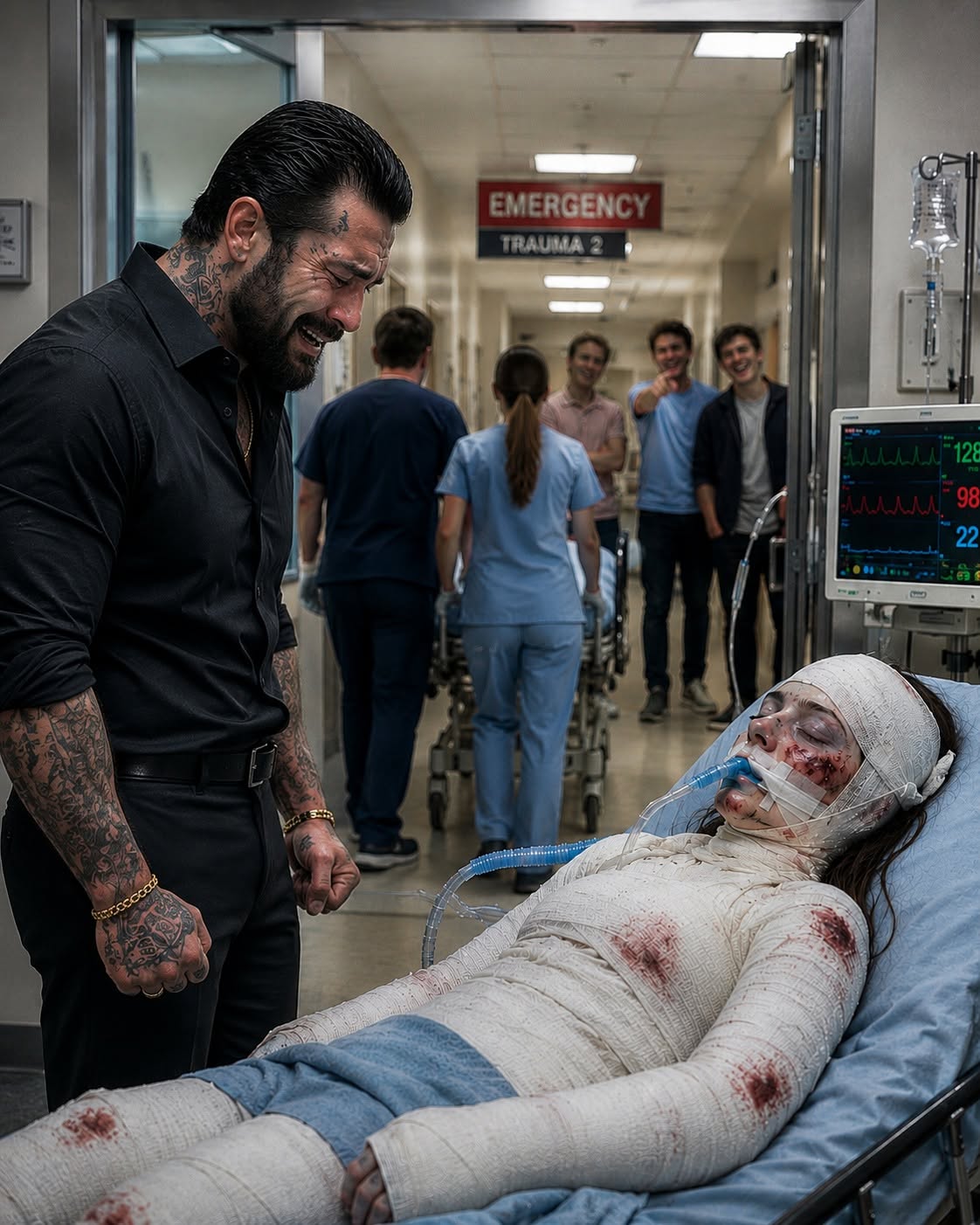
Lily had drifted into a medicated sleep. A nurse was adjusting the line at her wrist while the heart monitor traced its patient green rhythm across the screen.
“Bad enough.”
Vincent did not offer sympathy. He knew me too well for that.
Instead, he asked, “What do you need?”
“Information. Nothing more.”
“That’s what you always said before something became more.”
“I’m not asking you to hurt anyone.”
“Good.”
His answer came too quickly.
I lowered my voice. “You sound relieved.”
“I am.”
“Why?”
“Because you have a daughter now.”
The words irritated me, though I knew why he had said them.
Vincent remembered the man I had been. He also understood that certain doors, once opened, did not close simply because a person regretted stepping through them.
“I want facts,” I said. “Who those boys are. What happened tonight. Who is protecting them.”
“And after that?”
“I decide.”
“No,” Vincent said. “You and Lily decide.”
I tightened my grip on the phone.
“She can’t speak.”
“That doesn’t mean she doesn’t have a voice.”
Before I could answer, he ended the call.
For several seconds, I stood alone in the corridor with the silent phone in my hand.
Nineteen years earlier, no one would have hung up on me.
The surprising thing was that I did not feel anger.
I felt shame.
Vincent was right.
This was not my war.
It was Lily’s life.
And I had already made too many decisions for her without asking.
—
By morning, the swelling around Lily’s face had worsened.
The doctor explained that the fractures would heal, though recovery would be slow. She would need surgery, weeks of liquid meals, and careful monitoring. He spoke gently, but his eyes kept returning to me, as though he expected outrage.
I gave him none.
Rage had always been easiest when expressed. A raised voice. A broken table. An order delivered without hesitation.
The rage I felt now had nowhere to go.
It settled behind my ribs like wet cement.
When the doctor left, Lily opened her eyes.
For a moment, she looked confused. Then memory returned, and fear moved through her face.
I leaned closer.
“You’re safe.”
Her gaze shifted toward the door.
“No one is coming in,” I said. “There’s an officer outside.”
That did not seem to comfort her.
I picked up the small whiteboard the nurse had left beside the bed and placed the marker in Lily’s hand.
Her fingers trembled.
Slowly, she wrote two words.
NOT POLICE.
I read them twice.
“Why?”
She erased the board with the side of her palm and began again.
THEY KNEW.
“Who knew?”
She looked toward the hallway.
“The campus police?”
A small nod.
I kept my expression still, though every instinct inside me sharpened.
“Did you report something before tonight?”
Lily’s eyes filled.
She wrote:
NOT ABOUT ME.
I sat back.
“You were helping someone.”
Another nod.
“Who?”
This time she held the marker above the board but did not write.
Her breathing became faster.
I reached for her hand.
“You don’t have to tell me now.”
She shook her head urgently and wrote one name.
MAYA.
I knew Maya Chen.
She and Lily had met during freshman orientation. Maya was studying environmental engineering and had a habit of bringing too much food whenever she visited our house. The two of them spent long evenings at our kitchen table, laughing over private jokes and complaining about professors.
“Was Maya hurt?”
Lily closed her eyes.
Tears slid silently toward her ears.
I felt something cold move through me.
“Where is she?”
Lily wrote:
I DON’T KNOW.
Then, beneath it:
THEY THINK I DO.
—
Vincent arrived at the hospital shortly after noon.
He looked older than I remembered.
His hair had gone gray at the temples, and he wore reading glasses suspended from a cord around his neck. He had once been built like a dockworker, thick through the shoulders and hard in every movement. Now he walked with a slight stiffness in his left leg.
But his eyes were the same.
Calm. Measuring. Impossible to surprise.
He stopped outside Lily’s room.
For a moment, neither of us spoke.
Then he held out his hand.
I ignored it and pulled him into an embrace.
He went rigid.
“So retirement made you sentimental,” he murmured.
“It made me tired.”
“That too.”
When we stepped apart, he looked through the glass at Lily.
“She looks like her mother.”
“More every year.”
Vincent’s expression softened, but only briefly.
He handed me a thin folder.
“That’s not everything,” he said. “It’s what I could confirm quickly.”
I opened it.
The first pages contained photographs and short profiles.
Ethan Cole, twenty-one. Business major. Two prior disciplinary complaints, both withdrawn.
Brandon Hale, twenty. Political science. One arrest for reckless driving, charges dismissed.
Tyler Whitmore, twenty-one. Economics. No criminal record. Two sealed university conduct cases.
“The names on the paper were written by Lily,” I said.
“You’re sure?”
“I know her handwriting.”
“Then she wanted someone to find it.”
“She may have written it before the attack.”
Vincent pointed to the report. “There’s more. All three boys belong to a private campus society called the Bellweather Club.”
“I’ve never heard of it.”
“Most people haven’t. It isn’t officially recognized by the university. Sons and daughters of donors, politicians, executives. It has no website, no public roster, no meeting hall.”
“What does it do?”
“Officially? Nothing.”
“And unofficially?”
Vincent removed his glasses.
“It creates loyalty.”
I understood what he meant.
Not friendship. Not community.
Obligation.
“What happened with Maya?”
“We’re still looking.”
“You said ‘we.’”
“A few people owe me favors.”
“I told you I wanted information only.”
“And I’m gathering information.”
“Vincent.”
His eyes hardened. “No one has been threatened. No one has been followed into a dark alley. No one has disappeared. You called me because your old methods still exist in your head. I came because I intend to make sure they stay there.”
I almost smiled.
“You rehearsed that?”
“For nineteen years.”
He took the folder back and flipped to the final page.
“Maya Chen filed a confidential complaint with the university’s Office of Student Conduct six weeks ago.”
“What kind of complaint?”
“The details are sealed.”
“Can you unseal them?”
“Legally?”
I stared at him.
Vincent sighed. “I deserved that.”
He continued. “Maya also met twice with a student journalist named Noah Bennett. Three days ago, Noah’s laptop was stolen from the university library.”
“Convenient.”
“Yes.”
“Where is Noah?”
“Still on campus. Scared, according to the person who spoke with him.”
“Then I’ll speak with him.”
“No.”
The speed of his answer caught me off guard.
“Why not?”
“Because you still look like a man who expects people to answer.”
“I’m her father.”
“That gives you a reason to ask. It doesn’t give you the right to frighten a frightened student.”
I closed the folder.
“You came here to lecture me?”
“I came here because you once had hundreds of men who obeyed you. Now you have one injured daughter who needs you to listen.”
My jaw tightened.
He looked at me without flinching.
Then Lily tapped softly on the glass.
We turned.
She was awake, watching us.
Vincent straightened his coat.
“Does she know who I am?”
“No.”
“What have you told her?”
“That you’re an old business associate.”
“Technically true.”
He entered the room first.
Lily studied him with cautious curiosity.
“Hello, Lily,” he said. “I’m Vincent. Your father and I used to work together.”
She lifted the whiteboard.
WHAT KIND OF WORK?
Vincent glanced at me.
“Importing,” I said.
Lily looked from him to me, unconvinced.
Vincent pulled a chair closer.
“Your father has always been bad at explaining his job.”
I gave him a warning look.
Lily wrote:
HE SAYS SHIPPING.
“He also says he can cook,” Vincent replied. “Some lies are harmless.”
Despite the wires in her jaw, Lily made a small sound that might have been a laugh.
It was the first glimpse of my daughter I had seen since the phone call.
My anger eased for one precious second.
Then Lily wrote another question.
DID YOU FIND MAYA?
Vincent’s expression changed.
“Not yet.”
Lily looked at me.
I moved to the bedside.
“We know she filed a complaint. We know she spoke to a reporter.”
Lily gripped the marker.
YOU LOOKED INTO HER?
“I asked Vincent to help.”
Her eyes narrowed.
“You wanted us to find her.”
She erased the board so forcefully that the marker slipped from her hand.
I picked it up.
She wrote:
NOT LIKE THIS.
“Then tell me how.”
Her gaze held mine.
Something passed between us—fear, disappointment, and a distance I had not known existed.
She wrote:
YOU DON’T KNOW WHAT THIS IS.
“Then help me understand.”
Lily hesitated.
Finally, she wrote:
MAYA FOUND MONEY.
“What money?”
She erased the sentence.
IN THE LAB.
“What lab?”
She wrote:
DR. KESSLER’S.
I knew the name. Adrian Kessler was one of the university’s most celebrated faculty members, a biochemist whose research had attracted millions in grants.
“What kind of money?”
Lily shook her head.
Not now.
Not with Vincent in the room.
The message was clear.
Vincent saw it too.
He stood.
“I’ll find Noah Bennett,” he said. “And I’ll do it without scaring him.”
Before leaving, he paused beside me.
“Let her lead.”
Then he walked away.
—
The police detective assigned to Lily’s case arrived that afternoon.
Her name was Elena Ruiz. She was in her early forties, with tired eyes and a plain navy suit that seemed chosen to discourage attention.
She did not begin with questions.
She introduced herself to Lily, pulled a chair beside the bed, and explained every step of the process: how the interview would work, what Lily could refuse to answer, and who would have access to her statement.
“You are in control of this conversation,” Detective Ruiz said.
I watched Lily’s shoulders loosen slightly.
Ruiz noticed the whiteboard and asked, “Would typing be easier?”
Lily nodded.
The detective gave her a tablet and turned the screen toward her.
“Your father can stay, or he can wait outside. That is your choice.”
Lily looked at me.
For the first time in her life, I was afraid of what my daughter might decide.
She typed slowly.
HE STAYS.
Relief moved through me, followed quickly by guilt.
Ruiz began with basic questions.
Where had Lily been before the attack?
Had she seen the attackers clearly?
Did she know them?
Lily answered that she had left the science building shortly after eleven. Ethan, Brandon, and Tyler had been waiting near the service road. They demanded to know where Maya had hidden a flash drive.
When Lily refused to answer, they blocked her path.
Ruiz kept her voice even. “Did they say why they wanted it?”
Lily typed:
THEY SAID IT BELONGED TO THEIR FAMILIES.
Ruiz looked at me, then back at Lily.
“Did all three assault you?”
Lily’s fingers stopped over the screen.
The room seemed to contract around us.
Finally, she typed:
I DON’T REMEMBER EVERYTHING.
“That’s all right,” Ruiz said. “Trauma can affect memory. You don’t need to force it.”
Lily swallowed painfully.
Ruiz continued. “Did anyone else see what happened?”
Lily typed:
A SECURITY CAR CAME.
My hands closed into fists.
“What did the officer do?” Ruiz asked.
Lily stared at the screen for nearly a minute.
Then:
HE TURNED OFF HIS LIGHTS.
Ruiz’s face remained composed, but she stopped taking notes.
“Did you recognize him?”
NO.
“Did he speak?”
Lily typed:
HE SAID, “NOT HERE.”
A silence followed.
Ruiz leaned back.
“Lily, I need to ask you something difficult. Did the officer participate in the assault?”
Lily’s eyes widened.
She shook her head and typed quickly.
NO. HE TOLD THEM TO MOVE ME.
My chair scraped against the floor as I stood.
Ruiz turned toward me.
“Mr. Walker.”
I forced myself to sit again.
She returned her attention to Lily.
“Where did they take you?”
Lily’s breathing became shallow.
Ruiz set down her pen.
“We can stop.”
Lily shook her head.
Her fingers hovered over the keyboard.
Before she could type, the door opened.
A uniformed officer stepped in.
“Detective, I need you outside.”
Ruiz’s eyes sharpened. “I’m in an interview.”
“It’s Captain Morris.”
“I’ll call him later.”
“He says now.”
The officer glanced at Lily, then at me.
Something about the look was too careful.
Ruiz noticed it too.
She stood and placed her card beside Lily’s bed.
“Do not discuss your statement with anyone,” she said. “Not campus security. Not university representatives. No one except your attorney or me.”
“We don’t have an attorney,” I said.
“You should.”
Then she followed the officer into the hallway.
Through the glass, I watched her argue with a heavyset man near the nurses’ station. He never looked toward Lily’s room.
He did not need to.
His body was angled away, but his attention was on us.
A few minutes later, Ruiz returned.
Her expression had become unreadable.
“We’ll continue tomorrow.”
“Why not now?” I asked.
“Because I’ve been instructed to transfer the case.”
“To whom?”
“I haven’t been told.”
Lily began typing.
Ruiz glanced at the screen.
Then she turned off the tablet.
“I’m sorry,” she said quietly.
“Detective—”
She looked directly at me.
“Get an attorney, Mr. Walker.”
Then she left.
—
By evening, the university had released a statement.
I watched it on the television mounted above Lily’s bed.
A woman with perfectly arranged silver hair stood behind a podium bearing the university seal.
“We are deeply concerned by reports of an incident involving one of our students,” she said. “The university is cooperating fully with local authorities. At this time, there is no confirmed evidence connecting other students to the event, and we urge the community to avoid speculation.”
No confirmed evidence.
Lily’s written statement existed.
Her injuries existed.
The names in her own blood existed.
Yet the university had already begun converting facts into rumors.
A reporter asked whether Ethan Cole, Brandon Hale, and Tyler Whitmore had been suspended.
The woman’s smile did not change.
“We do not comment on individual student matters.”
Another reporter asked whether security cameras near the science building had malfunctioned.
“We are reviewing all relevant systems.”
The broadcast cut to footage of the campus.
Students crossed the quad beneath autumn trees, carrying backpacks and coffee cups. Life continuing, indifferent and orderly.
Lily reached for the remote and turned off the television.
Her phone had been returned from evidence processing that afternoon. The screen was cracked, but it still worked.
Messages filled it.
Friends asking what happened.
Classmates sending heart emojis.
Unknown numbers demanding proof.
One message read:
Stop lying about them.
Another:
You’re ruining three lives.
Lily stared at the words.
I took the phone from her.
“Don’t read those.”
She held out her hand.
“No.”
Her eyes flashed.
I realized immediately what I had done.
Not protected her.
Controlled her.
I placed the phone back in her palm.
“I’m sorry.”
She looked down at the screen.
Then she typed a note and showed it to me.
YOU ALWAYS DO THAT.
“Do what?”
DECIDE.
The word struck a place in me that anger could not defend.
“I’m your father.”
YOU DON’T TELL ME THINGS.
I looked away.
The hospital room seemed suddenly full of every lie I had told her.
The vague answers about my childhood.
The locked drawer in my office.
The nights she had heard me speaking Italian on the phone even though I claimed not to know the language.
She had noticed far more than I allowed myself to believe.
“I wanted you to have a normal life.”
SHE typed:
NORMAL ISN’T THE SAME AS TRUE.
I sat down slowly.
Outside the window, the city was darkening. Streetlights flickered on one by one, each reflected in the glass like distant candles.
“What do you want to know?”
Lily looked at me.
I felt the old instinct rise—to tell her only what was necessary, to shape the truth into something safer.
But truth shaped too carefully was only another lie.
“My name wasn’t always Daniel Walker,” I said.
She did not move.
“I knew Vincent before you were born. We ran an import business, but it wasn’t the kind I told you about.”
Lily typed:
ILLEGAL?
“Yes.”
Her eyes stayed on mine.
“What kind of illegal?”
I breathed in.
“Smuggling at first. Then protection. Bribery. Fixing contracts. Paying people to look the other way.”
Her fingers moved.
WERE YOU MAFIA?
The word looked strange on the screen. Too simple. Too cinematic for the life I remembered.
“Yes.”
Lily stared at me as though trying to recognize the face she had known since birth.
I continued before cowardice could stop me.
“I was in charge of people who did terrible things. Sometimes because I ordered them. Sometimes because I created a world where they thought I wanted them to.”
DID YOU KILL PEOPLE?
The room went silent except for the soft pulse of the monitor.
“I was responsible for deaths.”
Her eyes filled, but she did not look away.
“Some I ordered,” I said. “Some I failed to prevent.”
She turned her face toward the window.
I wanted to reach for her.
I did not.
For years, I had imagined this conversation. In every version, I explained myself so well that she understood. She might cry, she might become angry, but eventually she would see that I had changed for her.
Now I understood the selfishness of that fantasy.
Confession did not guarantee forgiveness.
Truth did not erase consequence.
After a long while, Lily typed:
WHY DID YOU STOP?
“You.”
She looked at me again.
“When you were born, I held you, and for the first time I understood that everything I had built could reach beyond me. I could accept danger for myself. I couldn’t accept it for you.”
She read my face carefully.
THAT SOUNDS LIKE YOU BLAME ME.
“No.”
I leaned forward.
“No, Lily. You didn’t save me because that was never your responsibility. I stopped because loving you showed me what I had refused to see.”
Her hands trembled.
“Your mother wanted us to leave long before you were born,” I added. “I kept telling her I needed time. More money. More leverage. One final arrangement.”
Lily typed:
SHE KNEW?
“Yes.”
My throat tightened.
“She knew everything.”
The heart monitor continued its steady rhythm.
Lily looked down at her hands.
For years, I had told her that her mother, Anna, died in a car accident when Lily was six months old.
That much was true.
But not all of it.
I could feel the remaining truth pressing against my teeth.
Before I could speak, Lily’s phone vibrated.
A message appeared from an unknown number.
She opened it.
The text contained only an address and a sentence.
MAYA IS SAFE. COME ALONE IF YOU WANT TO KNOW WHY SHE DISAPPEARED.
I reached for the phone, then stopped myself.
Lily saw the movement.
This time, I waited.
She turned the screen toward me.
“What do you think?” I asked.
Her expression shifted.
For the first time since waking, she did not look frightened.
She looked determined.
She typed:
I THINK THEY EXPECT YOU TO COME.
“Me?”
SHE NEVER TOLD ANYONE ABOUT YOU.
A chill traveled through me.
The message had been sent to Lily’s phone, yet the wording had been chosen for the person beside her.
Someone knew I was here.
Someone knew enough about us to expect that I would act.
I called Vincent.
He answered immediately.
“I’m looking at the same message,” he said.
“How?”
“I cloned Lily’s phone after it was returned.”
“You what?”
“Be angry later. The address belongs to an abandoned faculty residence near the north edge of campus.”
“Who owns it?”
“The university. It’s scheduled for demolition.”
“Can you trace the number?”
“Disposable.”
“Then it’s a trap.”
“Probably.”
I looked at Lily.
She typed:
OR MAYA.
Vincent heard the clicking of the keyboard through the phone.
“Is Lily awake?”
“Yes.”
“Ask her whether Maya ever mentioned the Bellweather Club.”
I repeated the question.
Lily nodded.
“What did she say?”
She typed:
SHE SAID THEY DIDN’T START IT.
Vincent went quiet.
“Who did?”
Lily’s fingers moved again.
THE PROFESSORS DID.
—
An hour later, Vincent stood in the hospital parking garage beside a dark blue sedan.
He had brought an attorney named Evelyn Shaw, a composed woman with close-cropped hair and a leather briefcase. She specialized in institutional misconduct cases and had represented students against universities, corporations, and government agencies.
Unlike Vincent, she did not know my history.
At least, I hoped she did not.
She listened as I described Lily’s statement, Detective Ruiz’s removal from the case, the Bellweather Club, and the message from the unknown number.
When I finished, she asked, “Does Lily want you to go to that address?”
“She thinks Maya may be there.”
“That wasn’t my question.”
I looked through the glass doors toward the hospital elevators.
“She wants answers.”
“Does she want you to get them?”
I resented the distinction because it mattered.
“I don’t know.”
“Then ask her.”
Vincent leaned against the car.
“I like her,” he said.
Evelyn ignored him.
“We are not going to an abandoned building,” she continued. “We are not contacting the accused students or their families. We are preserving evidence, arranging independent security for Lily, and filing an emergency request preventing the university from deleting records.”
“What if Maya is in danger?”
“Then we notify law enforcement.”
“The same law enforcement that just removed the detective?”
“We notify several agencies at once and create a written record. Cover-ups survive in darkness. They become harder when too many people receive the same facts.”
It was not how I had once solved problems.
Perhaps that was precisely why I needed to listen.
Vincent opened the car door and removed a laptop bag.
“There may be another option.”
He placed the laptop on the hood.
“I found Noah Bennett.”
“Where?”
“At his parents’ house. He left campus yesterday.”
“Did he speak to you?”
“Not directly. But he sent this.”
Vincent opened an audio file.
Static filled the garage.
Then a young man’s nervous voice began to speak.
“My name is Noah Bennett. I’m recording this because I don’t know who I can trust.”
There was a pause, followed by the sound of a door closing.
“Six weeks ago, Maya Chen contacted me about irregularities in research funding at the university. She worked as a student assistant in Dr. Kessler’s laboratory. She found invoices for equipment that never arrived, grant payments routed through consulting firms, and scholarship funds transferred into private accounts.”
Evelyn leaned closer.
Noah continued.
“At first, Maya thought it was theft. Then she found names. Trustees, faculty members, local contractors, and parents of students in the Bellweather Club. The club wasn’t just a social group. It was a way to bring their children into the system. Internships, recommendations, sealed disciplinary complaints. Everyone protected everyone.”
The recording crackled.
“Maya copied the files onto a flash drive. She gave it to Lily Walker because Lily was the only person she trusted.”
I looked toward the hospital.
Lily had told the boys she did not know where the drive was.
Had that been a lie?
Noah’s voice became quieter.
“Three days ago, someone broke into my dorm room. They took my laptop, but I had already backed up part of Maya’s material. I tried to reach her. Her number was disconnected.”
A long silence followed.
Then Noah said something that changed the shape of the entire case.
“Maya told me she wasn’t most afraid of the students. She was afraid of the person who had been helping her.”
The recording ended.
Vincent closed the laptop.
“Helping her how?” I asked.
“We don’t know.”
Evelyn folded her arms.
“It means the person sending the message may be the same individual.”
“Or the person Maya feared,” Vincent said.
My phone rang.
Detective Ruiz.
I answered.
“Mr. Walker, are you alone?”
I looked at Vincent and Evelyn.
“No.”
“Are you with your daughter?”
“No.”
“Good.”
Her voice sounded strained.
“I’m not supposed to contact you.”
“What happened?”
“My transfer was rescinded. Then I was placed on administrative leave.”
“For what reason?”
“Failure to follow supervisory instructions.”
“Which instructions?”
“To classify Lily’s assault as an incident with unidentified suspects until further evidence could be reviewed.”
I felt the old anger return, quieter and more dangerous.
Ruiz continued. “I refused.”
“Why are you calling me?”
“Because the campus security officer on duty last night was identified.”
I waited.
“His name is Samuel Price,” she said. “He worked private security before joining the university. Nineteen years ago, he was employed by a company called Meridian Harbor Services.”
The name pulled the air from my lungs.
Vincent’s expression changed when he heard it.
Meridian Harbor had been one of mine.
A legitimate company on paper, used to manage docks, warehouses, and men who asked no questions.
Ruiz went on.
“I assume that means something to you.”
“Where is Price now?”
“Missing. His apartment was emptied this morning.”
“Did anyone else work for Meridian Harbor?”
“Several people. Most records were sealed after a federal investigation collapsed.”
She paused.
“Your name appears nowhere, Mr. Walker. But a photograph does.”
“What photograph?”
“I’m sending it.”
The call ended.
A moment later, my phone vibrated.
The image was grainy, taken outside a warehouse nearly two decades earlier.
Vincent stood near the loading bay.
Beside him was Samuel Price, younger but unmistakable.
And beside Price stood Anna.
My wife.
Lily’s mother.
She was not merely passing through the frame.
She was holding a Meridian Harbor ledger in one hand and speaking to Price as though giving instructions.
Evelyn studied the photograph.
“You said your wife knew about your business.”
“She did.”
Vincent said nothing.
I turned toward him.
“What aren’t you telling me?”
He removed his glasses and wiped them slowly with the edge of his shirt.
“Anna worked with us.”
“I know she handled accounts.”
“She did more than that.”
“How much more?”
Vincent replaced his glasses.
“She designed the system that allowed you to disappear.”
The parking garage seemed to tilt beneath my feet.
“What does that have to do with Price?”
“Anna recruited him.”
“For what?”
Vincent looked toward the hospital elevators.
“To watch over Lily.”
I stepped closer.
“You told me every person connected to my old life was gone.”
“I told you every enemy was gone.”
“Price was following her?”
“Not continuously. He sent reports when something seemed wrong.”
“For nineteen years?”
“For nineteen years.”
My voice dropped.
“You had my daughter watched.”
“Anna arranged it before she died.”
The words landed with the weight of a verdict.
“Why didn’t you tell me?”
“Because she made me promise.”
“I was her husband.”
“And you were the one person she believed would refuse.”
I stared at the photograph again.
Anna’s face was turned slightly away from the camera. Her hair moved in the harbor wind. She looked young, focused, alive.
The ache of losing her had never disappeared. I had simply built routines around it.
“What did she think Lily needed protection from?” Evelyn asked.
Vincent’s answer was almost a whisper.
“Daniel.”
For several seconds, no one moved.
He looked at me steadily.
“Not because she thought you would hurt Lily. Because she knew what you would become if anyone else did.”
My phone vibrated again.
Another message from the unknown number.
This time, it included a photograph.
Maya sat in a small room beside a window. She appeared frightened but unharmed. A newspaper lay on the table in front of her, its date visible.
Today.
Beneath the image were seven words.
ASK VINCENT WHO REALLY CAUSED ANNA’S ACCIDENT.
I raised my eyes.
Vincent had already read the message over my shoulder.
For the first time since I had known him, all the calm left his face.
Behind us, the elevator doors opened.
Lily stood inside in a wheelchair, a nurse at her side.
She held her phone in both hands.
The same photograph of Maya glowed on her screen.
But beneath it, Lily had received a different message.
She turned the phone toward me.
YOUR MOTHER LEFT THE FLASH DRIVE FOR YOU.
Lily stared at Vincent.
Then she looked at me.
Her fingers moved slowly across the screen.
MY MOTHER DIED BEFORE MAYA WAS BORN.
No one answered.
The elevator doors remained open behind her.
The nurse shifted uneasily.
On Lily’s screen, a final message appeared.
YOU WERE NEVER TOLD WHEN ANNA WALKER REALLY DIED.
END OF PART 2 – LIKE, SHARE AND COMMENT “”THE ENTIRE STORY”” IF YOU WANT TO READ THE FULL STORY.