If someone had told me that the happiest day of my life would also be the day my entire reality fractured, I would have called them crazy. But trauma rarely announces its arrival; it simply kicks the door down.
The air in the delivery room at St. Jude’s Medical Center was thick with sweat, sterile iodine, and the frantic energy of impending life. My wife, Anna, was gripping my hand so hard I thought my knuckles would shatter. We had fought a brutal, silent war to get to this room. Five years of negative tests, three devastating miscarriages that left invisible, jagged scars on our marriage, and countless nights where I would find Anna sitting on the bathroom floor, sobbing into a towel so she wouldn’t wake me.
But here we were. The monitors beeped in a rapid, encouraging rhythm.
Standing in the corner of the room, like a hawk surveying its territory, was my mother-in-law, Eleanor. She was a woman carved from Boston’s old money—impeccably dressed even in a hospital, her posture rigid, her expression locked in a perpetual state of quiet judgment. She had insisted on being present, claiming it was her “matriarchal duty,” though Anna had begged me in whispers to keep her away.
“One more push, Anna! You’re doing incredible!” Dr. Evans shouted over the din.
With a final, guttural cry that seemed to tear from the very depths of her soul, our first son entered the world. A tiny, slippery, wailing miracle. He had pale skin, a dusting of light hair, and pink cheeks.
“A boy,” I choked out, tears instantly blinding me. I kissed Anna’s sweat-drenched forehead. “He’s beautiful, honey.”
“Don’t stop,” the doctor commanded, his tone shifting back to business. “Baby number two is right behind him.”
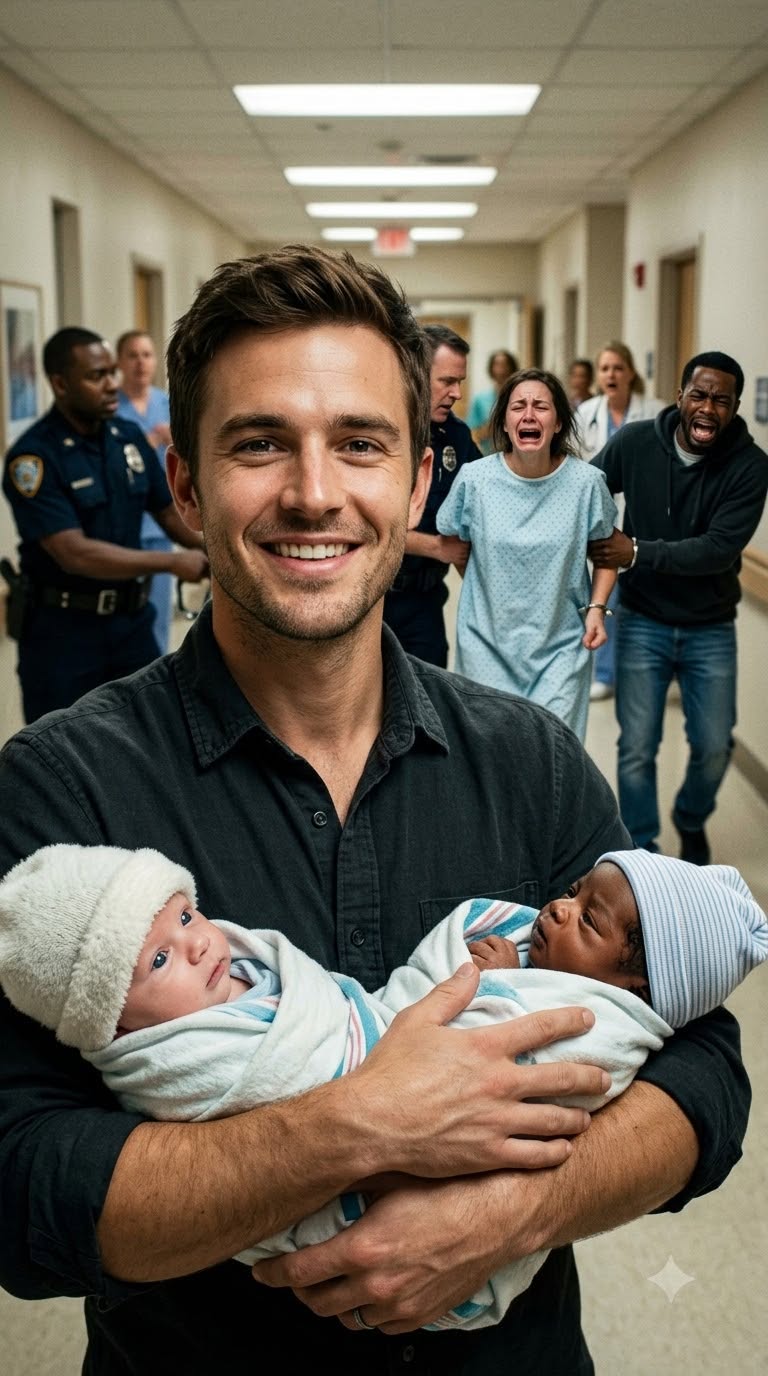
Minutes later, the second cry pierced the room. But as the nurse cleared the infant’s airways and held him up, the atmosphere in the room shifted so violently it felt as if the oxygen had been sucked out through the vents.
Our second son was just as beautiful, just as loud. But his skin was a rich, deep brown, and thick, dark curls crowned his tiny head.
I blinked, my brain struggling to process the visual contrast. Before I could even formulate a thought, a sharp, ragged gasp echoed from the corner.
Eleanor lunged forward, her manicured hands practically shoving the nurse aside. Her face had drained of all color, replacing her usual aristocratic composure with a mask of pure, unadulterated horror.
“What is this?” Eleanor hissed, her voice venomous and shaking. She spun toward Dr. Evans. “This hospital is a disgrace! You’ve switched the children! My daughter did not birth this… this mistake!”
“Ma’am, step back,” the doctor ordered firmly. “There is no mistake. These are fraternal twins. They just came directly from your daughter.”
Eleanor’s head snapped toward Anna, her eyes narrowing into slits of pure disgust. Anna, exhausted and bleeding, was trembling violently. She reached out, weakly grabbing her mother’s wrist, but Eleanor snatched her arm away as if she had been burned.
“You filthy little liar,” Eleanor whispered, leaning over her daughter. The cruelty in her tone made my blood run cold.
“Mom, please,” Anna sobbed, her chest heaving as panic set in. She turned her tear-streaked face to me, her eyes wide with a terror I had never seen before. “Ethan, don’t look at them. Please, don’t look at his skin. Don’t let her say it. I swear to you, Ethan, I swear on my life!”
I stood paralyzed. My wife was begging for my mercy, my newborn sons were wailing in the arms of strangers, and my mother-in-law was looking at us as if we had brought a plague into her pristine world.
“I will fix this,” Eleanor sneered, pulling her designer coat tighter around her shoulders. She locked eyes with me. “If you have an ounce of self-respect, Ethan, you will demand a paternity test. And then, you will leave her.”
Before I could speak, Eleanor turned on her heel and marched out of the room, leaving behind a heavy, suffocating silence that not even the cries of my newborn children could break.
We named them Leo and Miles.
Leo, the pale-skinned boy who mirrored my reflection. Miles, the dark-skinned, curly-haired boy who felt like a beautiful, unsolved mystery.
Bringing them home should have been a triumph, but our house felt like a quarantine zone. The shadow of Eleanor’s accusation hung over us like a guillotine. Despite my absolute trust in Anna’s character, the biological impossibility clawed at the back of my mind. How? It defied basic genetics. It defied logic.
Anna shrank into herself. She was a ghost walking the halls of our home. At night, I would find her sitting in the nursery rocking chair, holding Miles against her chest in the dark, whispering frantic, tearful apologies to a baby who couldn’t understand the world’s cruelty.
When I took the boys to the park, the stares felt like physical blows. The awkward pauses from neighbors. The hushed whispers from the other mothers at the pediatrician’s office.
“Are they both yours?”
“Did you adopt the little guy?”
“Oh, wow. They certainly don’t look like brothers.”
To silence the whispers, and mostly to silence the poisonous doubt Eleanor had planted, we did the DNA test. The results were clear: I was the biological father of both Leo and Miles. Fraternal twins from the same father, displaying wildly different phenotypes. It was a one-in-a-million genetic lottery.
I thought that would be the end of it. I slammed the medical report on Eleanor’s mahogany dining table the next day.
“They are both mine,” I told her, my voice hard. “You owe your daughter an apology.”
Eleanor barely glanced at the paper. She sipped her tea, her eyes cold and calculating. “Genetics can be manipulated, Ethan. Or perhaps it’s simply a fluke of nature. Regardless, that… child… does not fit into this family. He is a stain on our portrait.”
She made good on her word. For the next six months, Eleanor and the rest of Anna’s affluent family treated Miles as if he were invisible. They sent gifts for Leo. They asked for photos of Leo. At family gatherings, they would physically turn their backs when Anna entered carrying Miles.
The stress was destroying my wife. But the true nightmare hadn’t even begun.
Just after their six-month birthday, Miles developed a persistent fever. He grew lethargic, his skin taking on a grayish pallor. What we thought was a severe flu quickly escalated into a frantic rush to the emergency room at Boston Children’s Hospital.
After days of agonizing tests and sleepless nights pacing the sterile corridors, the pediatric oncologist sat us down in a cramped, windowless office.
“Miles has a rare form of aplastic anemia,” the doctor said softly, the words hitting me like physical strikes to the chest. “His bone marrow is failing to produce enough new blood cells. He needs a transplant, and he needs it soon. As parents, you are his best chance for a match.”
We didn’t hesitate. They drew our blood immediately.
Three days later, I was sitting by Miles’s crib, watching his tiny chest rise and fall, when my phone rang. It was the hospital. The transplant coordinator asked me to come down to the office alone. A cold dread coiled in my gut.
When I sat across from the doctor, he didn’t look at his notes. He just looked at me with a mixture of profound confusion and deep pity.
“Ethan,” he started, choosing his words with agonizing care. “You are a partial match for Miles. You are definitively his father.”
“Thank God,” I exhaled, burying my face in my hands. “Take whatever you need. Take it today.”
“Wait,” the doctor said, holding up a hand. “There is an anomaly with your wife’s results. We ran the panel three times to be absolutely sure.”
“An anomaly? Is she sick?”
“No,” the doctor replied softly. “Ethan… Anna’s DNA does not match Miles’s DNA in any capacity. According to this bloodwork, she shares zero genetic material with the boy.”
I stared at him, the buzzing of the fluorescent lights suddenly deafening.
“That’s impossible,” I stammered. “I was there. I watched him come out of her.”
“I know,” the doctor said, leaning forward. “And medically speaking, it opens up a terrifyingly small window of possibilities. We need to run more invasive tests on Anna immediately. But you need to prepare yourself, Ethan. Because on paper, your wife is not the mother of the child she just gave birth to.”
My reality shattered. The drive home was a blur of traffic lights and suffocating panic. How could a woman give birth to a child she wasn’t related to? Was Eleanor right? Had there been some horrific IVF mix-up? Had a rogue clinic implanted someone else’s embryo alongside ours?
When I pulled into our driveway, I noticed a sleek black Mercedes parked near the porch. Eleanor’s car.