
PART 2
The doctor’s question hung in the corridor like a door opening onto a life I had never imagined.
“Which one of you is the baby’s father?”
Madison turned toward me slowly. Her face had lost all color, but I barely registered her expression. All I could see was the blood on the doctor’s gloves and the controlled urgency in his eyes.
“I am,” I said.
The words came before doubt could stop them.
The doctor looked at me sharply. “Name?”
“Adrian Ashford.”
He checked the tablet in his hand. “The patient listed no father and no emergency contact. Are you certain?”
My throat tightened. “The timing fits.”
“That is not the same as certainty.”
“No,” I admitted. “But I need to know whether she’s alive.”
His expression softened slightly, though his voice remained firm. “Elena is alive. For now. Her heart is struggling to pump effectively, and the pregnancy is placing additional stress on it. We may need to deliver the baby tonight.”
“Tonight?” I stared at him. “She’s only thirty-four weeks.”
“That is why we are moving carefully. But if we wait too long, we could lose them both.”
The floor seemed to tilt beneath me.
Madison made a small sound behind me, but I did not turn around.
“What do you need from me?” I asked.
“At the moment, nothing. Since you are not legally her husband and she has not identified you as an authorized decision-maker, you cannot consent on her behalf.”
“I understand.”
The doctor studied me, perhaps expecting an argument.
A year earlier, I would have given him one. I would have called hospital administrators, board members, donors, anyone whose influence might have forced those doors open. I would have treated access like another problem money could solve.
But Elena was beyond those doors, fighting to breathe. This was not a boardroom, and her life was not a contract.
“Can you tell her I’m here?” I asked.
“If she becomes stable enough to speak.”
“When,” I corrected quietly. “When she becomes stable.”
The doctor gave a restrained nod and disappeared through the doors.
Silence settled around us.
Then Madison said, “You knew.”
I finally faced her.
She stood beneath the harsh corridor lights, one hand pressed against her stomach. The pain that had brought her to the hospital appeared forgotten.
“I didn’t,” I said.
“But you ran after her.”
“Because I recognized her.”
“You looked at that baby and immediately said it was yours.”
“I counted the months.”
Madison’s eyes filled, though her tears did not fall. “So there was overlap.”
“No.”
“You were with her while you were with me.”
“I met you after the divorce.”
“After the papers were signed,” she said bitterly. “That doesn’t mean you had let her go.”
I could not answer, because we both knew the truth.
I had never let Elena go. I had only buried everything beneath work, noise, and a relationship that demanded little honesty from me.
Madison looked toward the operating-room doors. “Did she leave because she was pregnant?”
“I don’t know.”
“What do you know, Adrian?”
The question was quieter than her anger, and more difficult to face.
“I know our marriage ended because I was never there when she needed me,” I said. “I know she stopped asking me to come home because she got tired of being disappointed. I know the last night we spent together happened after the divorce hearing, and neither of us planned it.”
Madison folded her arms around herself.
“And I know,” I continued, “that if Elena believed she had to go through this alone, then I gave her reasons to believe it.”
For once, Madison did not respond immediately.
Jonas stood several feet away, pretending to study the vending machines. My security team had withdrawn to the far end of the hall, their dark suits drawing uneasy looks from passing nurses.
Madison took a slow breath. “I should leave.”
“You came here because you were in pain.”
“The nurse said it was probably a stomach virus. She was arranging tests before you ran away.”
“I’ll make sure someone stays with you.”
“I don’t want one of your employees.”
“Then I’ll call your sister.”
She looked at me as if searching for something that might persuade her to stay. Whatever she hoped to find was not there.
“Were you ever going to love me?” she asked.
The question landed without accusation.
That made it worse.
“I cared about you.”
“That isn’t what I asked.”
I glanced at the doors again.
Madison gave a sad, knowing smile. “There’s my answer.”
She removed the slim gold bracelet I had given her two weeks earlier and placed it on the reception counter.
“I hope she survives,” she said. “I mean that. But after tonight, don’t call me.”
She walked away before I could offer an apology too small to matter.
Jonas approached once the elevator doors closed behind her.
“That could have gone worse,” he said carefully.
I looked at him.
He sighed. “Not the time.”
“No.”
He sat beside me. For nearly fifteen years, Jonas Hale had worked as my chief of security, adviser, and occasional conscience. He had seen me make decisions that frightened everyone else in the room, but he had never hesitated to tell me when I was wrong.
Tonight, even he seemed uncertain.
“Did you know?” I asked.
“About the pregnancy? No.”
“But you knew where Elena was.”
His gaze shifted.
The movement was slight, almost invisible, but I had known him too long.
“Jonas.”
“I knew she was in Chicago.”
My pulse changed. “Since when?”
“Three months after the divorce.”
I stood so quickly the chair scraped across the floor.
“You found her?”
“She contacted me.”
The anger rose instinctively, hot and familiar, but I forced myself to lower my voice.
“Why?”
“She needed help with something.”
“What kind of help?”
Jonas looked toward the nurses’ station. “This is not the place.”
“This is exactly the place.”
He rubbed a hand across his jaw. “She asked whether your security team was still monitoring her accounts.”
“I stopped that after the divorce.”
“I know. I told her.”
“And then?”
“She asked me not to tell you where she was.”
The words struck deeper than betrayal. “You agreed?”
“She sounded afraid.”
“Of me?”
“No.” Jonas’s answer came quickly. “Not of you.”
That stopped me.
“Then who?”
“She wouldn’t say. She only asked whether anyone connected to Ashford Holdings had tried to locate her.”
I stared at him. “Did they?”
“Not through my department.”
“That is not an answer.”
“It is the only answer I had.”
Before I could press him further, the emergency doors opened again. A nurse stepped into the corridor and called my name.
I crossed the distance immediately.
“Elena is conscious,” she said. “Only briefly. She asked for you.”
The relief was so sharp it hurt.
The nurse pointed toward the security team. “Only you. And you must remain calm. Her condition is unstable.”
“I understand.”
She led me through a maze of bright hallways. Machines sounded behind curtains. Nurses moved with practiced speed, speaking in clipped phrases that seemed both urgent and strangely ordinary.
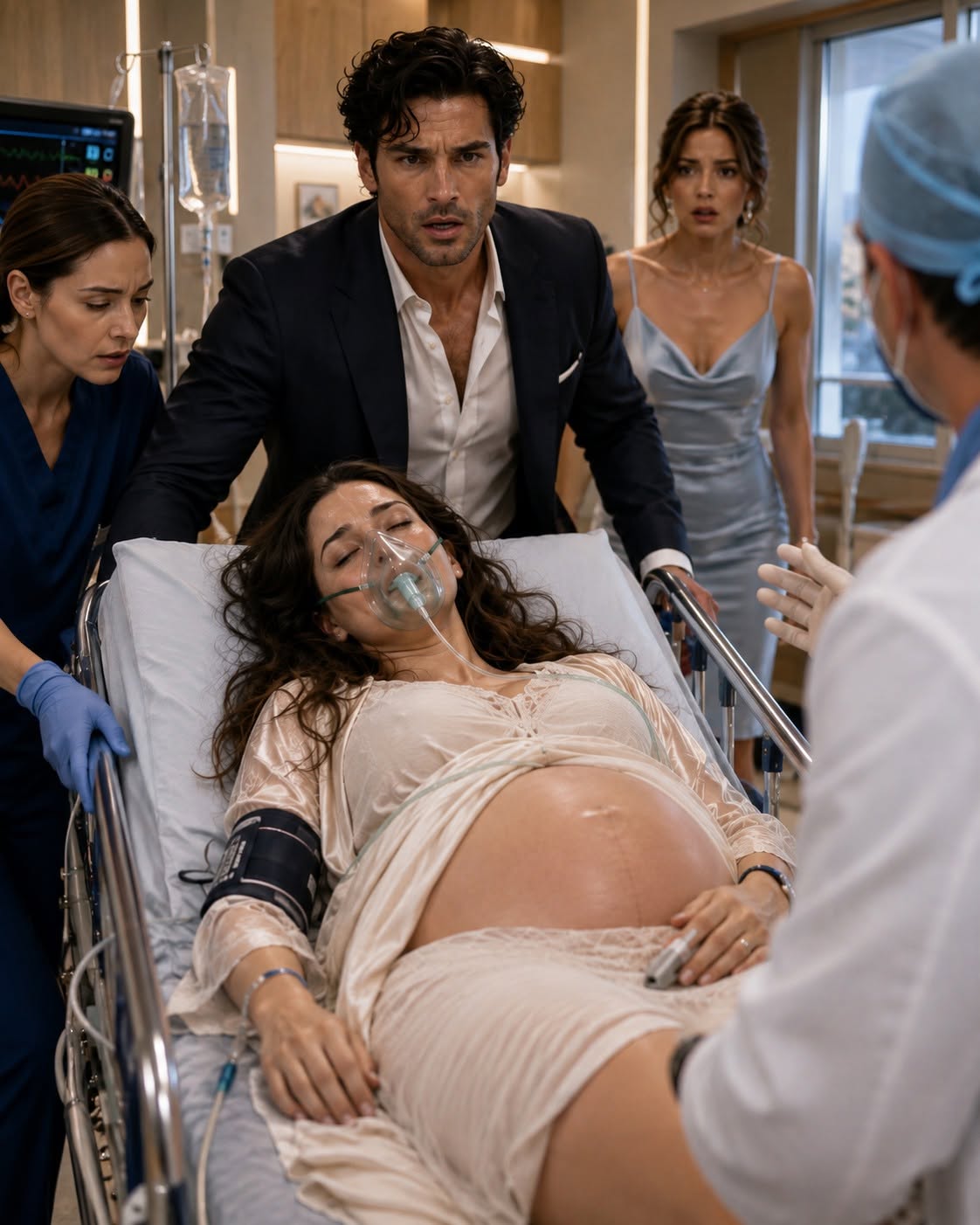
Elena lay in a private trauma room surrounded by equipment.
For a moment, I could not move.
The woman I remembered had always carried warmth with her. Even when she was angry, even when she stood across from me in a courthouse wearing the blue dress she had once worn on our anniversary, there had been life in her face.
Now she looked almost translucent against the white pillows.
An oxygen mask covered her mouth and nose. Wires disappeared beneath her gown. Her stomach rose beneath the blanket, round and undeniable.
Her eyes found mine.
“Adrian.”
The mask blurred the sound, but I heard my name.
I stepped closer. “I’m here.”
Fear moved across her face. Not fear of me. Fear for the child.
“You shouldn’t be.”
“I saw them bring you in.”
She closed her eyes briefly. “Of course you did.”
The nurse adjusted a monitor and then withdrew to the doorway, giving us the illusion of privacy.
I stood beside the bed, afraid to touch her.
“Is the baby mine?” I asked.
Elena’s eyes opened again.
For several seconds, she simply looked at me. In that silence, I saw eight years of marriage, countless unfinished conversations, and every apology I had postponed because I believed there would always be another day.
“Yes,” she whispered.
The answer broke something inside me.
I gripped the bed rail to steady myself. “Why didn’t you tell me?”
Her gaze moved toward the ceiling. “I tried.”
“When?”
“The morning I left.”
“There was no message.”
“I came to your office.”
I shook my head. “You didn’t.”
“I sat in the lobby for almost two hours.”
Memory surfaced reluctantly.
The morning after our final night together, I had awakened alone in the hotel suite. My assistant had called about an emergency acquisition meeting. By noon, I was behind sealed conference-room doors while two companies fought over a merger worth hundreds of millions.
“I never knew,” I said.
“Elise said you refused to see me.”
My assistant.
The room suddenly felt colder.
“Elise told you that?”
“She said you wanted all personal matters handled through attorneys.”
“I never gave that instruction.”
Elena’s breathing quickened. A monitor changed rhythm.
The nurse took a step forward, but Elena lifted one hand weakly.
“I left a letter,” she continued.
“With Elise?”
“Yes.”
“I never received it.”
Her eyes searched mine, and I watched certainty give way to confusion.
“She called me afterward,” Elena said. “She said you had read it.”
“What exactly did she say?”
“That you believed the pregnancy was an attempt to stop the divorce. That you wanted proof before you would discuss anything.”
“I didn’t know you were pregnant.”
The monitor sounded again.
The nurse approached the bed. “We need to stop this conversation.”
Elena turned her head away, tears gathering at the corners of her eyes.
I leaned closer, keeping my voice steady. “Whatever happened, I did not reject you or our child. I swear to you.”
She looked back at me. “Then why would Elise lie?”
“I don’t know.”
That frightened me more than any answer.
The nurse placed a hand on my arm. “You must leave now.”
“Elena,” I said. “You are not alone.”
Her fingers moved across the sheet.
I took her hand carefully.
It was cold.
“You don’t get to make promises you can’t keep,” she whispered.
“I know.”
“Not anymore.”
“I know.”
Her grip tightened with surprising strength. “Save the baby.”
“We’re going to save both of you.”
“If they ask you to choose—”
“No.”
“Adrian.”
“No,” I repeated. “Do not ask me that.”
Her expression softened with exhausted sadness. “You always hated choices you couldn’t control.”
“And you always knew when I was afraid.”
The faintest shadow of her old smile appeared.
Then the monitor alarmed.
The room filled instantly. A doctor entered, followed by two nurses. Someone pulled me away as Elena’s eyes closed.
“Her oxygen saturation is dropping.”
“Prepare the operating room.”
“We’re delivering now.”
I was pushed into the hallway as the doors shut between us.
This time, I did not shout or demand answers.
I stood there holding the memory of her hand.
Jonas found me ten minutes later outside the surgical wing.
“They’re performing an emergency cesarean,” I told him.
He nodded, his expression grave.
“Elise lied to Elena.”
“What?”
“She told her I had rejected the pregnancy. She intercepted a letter and kept Elena out of my office.”
Jonas stared at me. “Are you certain?”
“Elena told me herself.”
He reached for his phone.
“Don’t call Elise yet,” I said.
“Why not?”
“Because I want to know what else she has hidden before she realizes we know.”
Jonas lowered the phone.
For years, Elise Monroe had controlled access to my schedule, correspondence, travel, and private meetings. She had been efficient, discreet, and seemingly loyal. I had trusted her with information I had never shared with friends.
Elena had disliked her from the beginning.
I had dismissed it as jealousy.
The realization tasted bitter.
“Check every communication from the month before the divorce until now,” I said. “Emails, visitor logs, deleted calendar entries, office cameras, everything.”
“That could take time.”
“Start with the morning Elena came to see me.”
Jonas nodded and moved away to make calls.
I remained outside the surgical wing.
Minutes lost their shape. Every time the doors opened, I looked up. Every footstep became a verdict. I thought about the nursery Elena and I had once planned in the east wing of our house, years before doctors told us natural conception was unlikely.
We had tried for three years.
Appointments, procedures, hopeful mornings followed by silent evenings. Elena had cried in locked bathrooms because she did not want me to see. I had responded by working longer hours, convincing myself that financial security was the same as comfort.
Eventually, she stopped mentioning children.
I assumed she had accepted it.
Now I understood she had simply learned to grieve without me.
At 1:06 in the morning, the surgeon emerged.
His mask hung loosely around his neck. Exhaustion lined his face.
I stood.
“The baby?” I asked.
“A boy. Four pounds, eleven ounces. He is breathing with assistance and has been transferred to the neonatal intensive care unit.”
A son.
The word did not feel real yet, but it opened something vast within me.
“And Elena?”
The surgeon hesitated.
My relief disappeared.
“She survived the delivery,” he said. “However, her cardiac function remains severely reduced. We have stabilized her, but the next twenty-four hours are critical.”
“Can I see her?”
“Not yet.”
“The baby?”
“A neonatal nurse can take you to him, provided you follow every instruction.”
I thanked him, though the words seemed inadequate.
The neonatal intensive care unit was quieter than I expected. Its soft lighting and muted alarms created a world separate from the hospital’s frantic corridors.
A nurse named Priya helped me wash my hands and put on a protective gown.
“Premature babies can look fragile,” she warned gently. “Try not to be alarmed by the equipment.”
I followed her to a clear incubator near the end of the room.
My son lay beneath a small knitted cap.
He was impossibly tiny. A breathing device covered part of his face, and sensors dotted his chest. One hand rested near his cheek, the fingers curled tightly as though holding on to something invisible.
I had negotiated with ministers and billionaires without trembling.
Standing beside that incubator, I could not control my hands.
“Can he hear me?” I asked.
“Probably. Babies recognize familiar voices, especially their mother’s. He may not recognize yours yet, but speaking softly can still comfort him.”
I moved closer.
“Hello,” I whispered.
The word sounded foolishly formal.
Priya smiled but pretended not to notice.
“I’m your father,” I continued. “I should have known about you sooner. That isn’t your fault. It isn’t your mother’s either.”
His fingers shifted.
I placed one finger through the opening in the incubator. His hand closed weakly around it.
Everything in me went still.
No business victory had ever felt like this. No possession had ever made me so aware of how little I truly controlled.
“I’m not going anywhere,” I told him.
The promise frightened me because Elena had been right. I had made promises before and mistaken intention for action.
This one would have to become a decision repeated every day.
Priya allowed me several minutes before guiding me away.
Outside the unit, Jonas waited with a tablet in his hand and a look I had rarely seen on his face.
“What did you find?”
“The visitor records confirm Elena entered your building at nine twelve that morning.”
“And left?”
“Eleven twenty-seven.”
“Did Elise meet her?”
“Yes. Lobby footage shows them speaking twice.”
He turned the tablet toward me.
The grainy image showed Elena sitting in a corner of the marble lobby, clutching a white envelope. She looked tired and uncertain. In the next frame, Elise stood beside her.
The final image showed Elena walking toward the exit without the envelope.
“Where is the letter?” I asked.
“We don’t know. But there’s more.”
Jonas opened another file.
“Elise accessed your private office after the acquisition meeting began. She remained inside for fourteen minutes.”
“That was not unusual.”
“No. But she also deleted a visitor notification from your internal account. Our backup server preserved it.”
The message was brief.
ELENA ASHFORD IS WAITING IN THE LOBBY. SHE SAYS IT IS URGENT AND PERSONAL.
My chest tightened.
The time stamp showed I had been sent the notification at 9:19.
“I never saw this.”
“It was marked as read from Elise’s terminal.”
“Why?”
Jonas’s expression hardened. “That is what we need to determine.”
I looked through the glass doors toward the neonatal unit.
“This was not about protecting my schedule.”
“No.”
“What else?”
“We checked outgoing calls from Elise’s office. She contacted Elena six times over the next month using an unregistered company line.”
“Elena changed her number after the divorce.”
“Elise apparently had the new one.”
I thought of Elena asking Jonas whether anyone connected to Ashford Holdings was tracking her.
“She believed someone was watching her.”
“It appears someone was.”
A familiar urge rose inside me: immediate confrontation, absolute answers.
But anger had already cost me too much.
“Do not approach Elise,” I said. “Restrict her access quietly. Copy every file she can reach. Find out whether she acted alone.”
Jonas studied me. “You’ve changed.”
“No. I’m trying to.”
A nurse appeared at the far end of the hall.
“Mr. Ashford?”
I went to her.
“Elena is awake,” she said. “She is asking about the baby.”
“Tell her he’s alive.”
“You can tell her yourself. Only for a minute.”
Elena had been moved to intensive care. She looked even smaller without the curve of pregnancy beneath the blankets.
When I entered, her eyes moved immediately to my face.
“The baby?”
“He’s alive,” I said. “A boy.”
Her lips parted in relief.
“He needs help breathing, but the nurse said he is stable. He held my finger.”
Tears slipped silently into her hair.
“He did?”
“Yes.”
“I wanted to name him Noah.”
I sat beside the bed. “Noah.”
“Do you hate it?”
“No. It’s perfect.”
She studied me. “You mean that?”
“I do.”
Her gaze drifted toward the window. Beyond it, Chicago glowed beneath a dark sky, indifferent to the lives changing inside the hospital.
“I had a room ready for him,” she said. “Not much. A crib from a secondhand shop. Yellow curtains. There are stars painted above the window.”
“I want to see it.”
“You don’t have to pretend.”
“I’m not pretending.”
“You have a life, Adrian.”
“So do you. So does Noah. I’m asking whether there is room for me in it.”
She closed her eyes.
“I don’t know.”
The answer hurt, but it was honest.
“I will earn the answer,” I said.
Her eyes opened again. “You cannot arrive with lawyers and schedules and decide what happens next.”
“I won’t.”
“You cannot move us into your house because it is convenient.”
“I understand.”
“And Madison?”
“It’s over.”
A flicker of guilt crossed her face. “Because of me?”
“Because I should never have begun something when I was still living inside the ruins of our marriage.”
Elena was silent.
Then she whispered, “I didn’t leave only because of Elise.”
I leaned forward.
“What happened?”
She glanced toward the door. “After I found out I was pregnant, someone entered my apartment.”
“Were you hurt?”
“No. Nothing valuable was taken.”
“What did they want?”
“They moved things. Opened drawers. Searched through papers.”
“Did you call the police?”
“Yes. They said there was no sign of forced entry.”
“Who had a key?”
“Only the landlord and me.”
Her breathing grew shallow, and I forced myself not to overwhelm her.
“What were they searching for?”
“I don’t know. But the next day, I received an envelope.”
“What was inside?”
“A copy of my medical report confirming the pregnancy.”
Cold unease settled through me.
“Was there a message?”
She nodded.
“What did it say?”
Her voice was barely audible.
“It said, ‘This child will destroy everything he built.’”
I kept my face calm for her sake.
“Do you still have it?”
“In a bank deposit box.”
“Why didn’t you tell Jonas?”
“I didn’t know whom to trust.”
“You could have trusted me.”
Her eyes met mine.
“Could I?”
I had no defense.
A nurse entered and announced that Elena needed rest.
I stood, but Elena caught my wrist.
“There is something else.”
The nurse glanced at the monitor. “Briefly.”
Elena swallowed. “The doctors told us years ago that your chances of fathering a child naturally were almost nonexistent.”
“I remember.”
“After I learned I was pregnant, I went to a specialist. I needed to understand how it happened.”
“And?”
“He repeated the tests.”
A strange tension gathered in her expression.
“What did he find?” I asked.
“Nothing was wrong with you, Adrian.”
I stared at her.
“That’s impossible.”
“He said your old laboratory results could not have been accurate. The numbers were too different. He believed the original sample might not have been yours.”
The room seemed to narrow around us.
Our marriage had begun breaking under the weight of those results. Years of disappointment had shaped every decision that followed.
“Which clinic performed the original tests?” I asked, though I already knew.
Elena’s eyes held mine.
“The Ashford Foundation Medical Center.”
My family’s hospital.
The hospital my late father had controlled.
The nurse stepped between us. “She must rest now.”
I left the room carrying questions too large for the corridor.
Jonas was waiting near the elevators.
I told him about the break-in, the message, and the conflicting medical results.
For once, he had no immediate response.
Finally, he said, “Your father personally appointed the director of that fertility clinic.”
“My father died two years before the divorce.”
“But Elise worked for him before she worked for you.”
I looked at Jonas.
That connection had always seemed ordinary. Elise had served as my father’s executive assistant before transferring to my office after his death. She knew the Ashford family better than almost anyone.
“Find the original laboratory records,” I said.
“I already tried.”
“And?”
“They were removed from the electronic archive three days after your father died.”
“By whom?”
“The authorization code belonged to Elise.”
The elevator chimed, but neither of us moved.
My phone rang from an unknown number.
Only a handful of people had the replacement Jonas had arranged after mine shattered.
I answered cautiously.
No one spoke.
Then I heard breathing.
“Who is this?”
A man’s voice finally said, “Congratulations on your son.”
The line went dead.
Jonas immediately began tracing the call, but I remained frozen.
The caller had known before any public announcement, before even most hospital staff knew my connection to Noah.
Through the glass wall, I could see Elena asleep beneath the glow of the monitors.
Beyond another set of doors, my son fought for every breath.
Jonas looked up from his screen.
“The call was routed through several private networks. But there was a background sound before he spoke.”
“What sound?”
“A hospital announcement.”
I turned toward the crowded corridor.
The caller had not been watching from across the city.
He was somewhere inside Northwestern Memorial.
Then a neonatal nurse hurried toward us, carrying a sealed envelope.
“This was found beneath Noah’s incubator,” she said. “It has your name on it.”
My hands felt numb as I opened it.
Inside was a photograph of my father standing beside a young pregnant woman I had never seen before.
On the back, someone had written a single sentence:
Before you claim Noah as your miracle, ask your mother why you were never supposed to have children.
END OF PART 2 – LIKE, SHARE AND COMMENT “THE ENTIRE STORY” IF YOU WANT TO READ THE FULL STORY