
PART 2
For nearly ten years, Julian and I had built our lives around the idea that success could protect us from the past.
We were wrong.
Success did not erase old fears. It merely furnished them with better rooms.
Our first apartment had one cracked window, a radiator that clanged through winter nights, and a kitchen table Julian found beside a dumpster. We worked there until dawn, drinking cheap coffee and arguing over everything from product design to whether we could afford groceries.
Those arguments had never frightened me.
Back then, Julian listened.
He listened when I told him investors would trust a founder who admitted uncertainty more than one who performed invincibility. He listened when I warned him against expanding too quickly. He listened when I said that lonely people were not data points.
But wealth changed the rhythm of our marriage.
At first, it happened quietly.
Meetings replaced dinners. Assistants answered questions I had asked him directly. Decisions we once made together appeared in press releases before Julian remembered to mention them to me.
Whenever I protested, he kissed my forehead and told me I was tired.
Whenever I persisted, he told me I was afraid of change.
And whenever I reminded him that I had helped build the company, he smiled with a tenderness that somehow made the dismissal worse.
“You built me,” he would say.
Not us.
Me.
By the seventh year of our marriage, Julian had become the face of Duval Technologies, while I existed in the footnotes of old interviews. I still reviewed contracts, solved communication crises, and advised him before major negotiations, but my title remained vague.
Strategic consultant.
Special adviser.
Wife.
The last word swallowed all the others.
Then came the fertility appointments.
For three years, we tried to have a child. Specialists examined me beneath harsh lights, discussed my body in cautious voices, and handed me charts full of percentages that felt like verdicts.
Julian came to the first appointments.
Then fewer.
Eventually, none.
The night our final treatment failed, I sat on the bathroom floor holding a test I already knew was negative. Julian was at an industry dinner. He returned after midnight smelling of expensive cologne that was not mine.
I asked him whether there was someone else.
He looked at me for a long time.
Then he said, “I don’t know who I am when I’m with you anymore.”
Three months later, he filed for divorce.
Two weeks after that, photographs of him and Dalia Fontaine appeared online.
She was newly crowned Miss Continental Star, smiling beside Julian at a foundation luncheon in Beverly Hills. The articles called their romance unexpected. Fresh. Hopeful.
They called me his difficult first wife.
The settlement negotiations took place in a conference room overlooking Los Angeles. Julian arrived with four lawyers. I brought one.
He offered me more money than I had ever imagined owning.
I refused most of it.
What I asked for instead was simple: the rights to several early patents I had helped develop, a percentage of the educational platform I had designed, and control of a dormant research division Julian considered worthless.
He agreed immediately.
His attorney looked surprised.
Julian did not.
He assumed I was choosing sentiment over power.
He had always underestimated things that could not be photographed.
Within six months, I moved to New York and renamed the research division Meridian Bridge.
It had begun years earlier as my proposal for using ethical technology to connect rural hospitals with specialists. Julian had dismissed it as unprofitable. I saw something else: a system that could help families like mine, people whose lives could be transformed by access instead of charity.
For the first year, I worked anonymously.
I rented a modest apartment in Brooklyn, cut my hair, stopped reading gossip sites, and spent twelve-hour days with engineers, physicians, and public health advisers.
No one called me Mrs. Duval.
No one lowered their voice when I entered a room.
No one asked how I felt about Dalia’s latest magazine cover.
They asked what I thought.
The answer changed my life.
Gabriel Lancaster entered it during a January storm.
Meridian Bridge was seeking funding, and every major investor had offered the same response: worthy idea, difficult margins.
Gabriel requested a meeting after reading our technical report.
He arrived without an entourage, wearing a charcoal coat dusted with snow. He sat across from me in a narrow conference room and read every page of our proposal before asking a single question.
“Why did you hide your name?” he asked.
“I didn’t hide it.”
“You removed it from every public document.”
“That isn’t the same thing.”
He studied me thoughtfully. “Isn’t it?”
I expected another wealthy man who enjoyed turning conversations into contests.
Instead, Gabriel closed the folder.
“My mother died in a county hospital,” he said. “The nearest specialist was four hours away.”
I stopped defending myself.
He funded the pilot that afternoon.
Our relationship developed slowly, almost reluctantly. Gabriel never treated rescue as romance, and I never mistook gratitude for love.
We worked.
We disagreed.
We learned each other’s silences.
He discovered that I could not sleep before major presentations. I discovered he called his older sister every Sunday, no matter where he was in the world.
When my father needed another spinal surgery, Gabriel did not offer to arrange a private jet or summon a famous surgeon. He simply drove me to the airport at five in the morning and carried my suitcase without making the moment about him.
Months later, after the surgery succeeded, I kissed him in the rain outside my apartment.
He laughed softly against my forehead.
“I’ve been trying very hard not to do that first.”
“Why?”
“Because you needed someone who could wait.”
The memory steadied me now as we stood behind the ballroom doors.
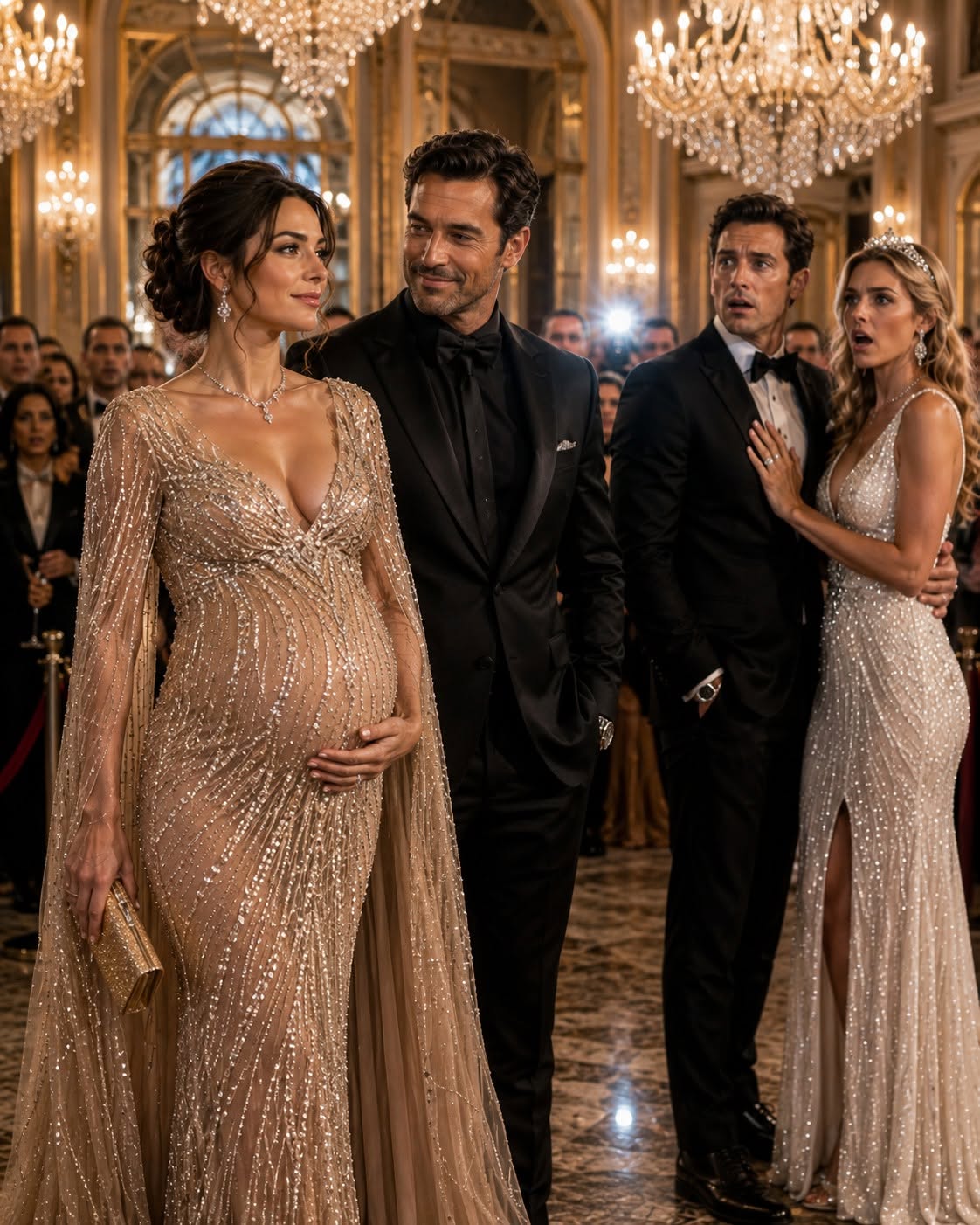
Beyond them, Julian and Dalia continued greeting donors beneath the chandeliers. The event benefited pediatric cardiac programs across three states. Meridian Bridge had recently joined the initiative, though my role had not been publicly announced.
Gabriel adjusted his cuff links.
“You’re trembling,” he said.
“I’m angry that I’m trembling.”
“That doesn’t make it weakness.”
“It feels like weakness.”
He placed his hand over mine, careful and warm.
“Then let it be courage that happens to tremble.”
A coordinator approached, headset pressed to one ear.
“Mr. Lancaster, Ms. Bennett, they’re ready for you.”
The doors opened.
Conversation faded in widening circles.
I saw recognition move across the room like weather.
First my face.
Then my stomach.
Then Gabriel.
Cameras turned toward us.
I had imagined this moment too many times during sleepless nights. In some versions, I smiled brilliantly. In others, I ignored Julian completely.
But when our eyes met, none of those rehearsed reactions appeared.
I saw the man who had once slept beside me on a mattress on the floor because we could not afford a bed frame. The man who knew I hated thunderstorms and loved old jazz records. The man who had held my hand after the first failed treatment, before disappointment taught him to retreat.
For one dangerous second, grief replaced anger.
Then Julian looked at Gabriel’s hand resting protectively near my back, and his expression changed.
Dalia noticed.
Her smile remained flawless, but her fingers tightened around Julian’s arm.
Gabriel led me forward.
The event chair, Celeste Armand, hurried to greet us. She kissed my cheek warmly.
“Khloe, you look radiant.”
“Thank you for inviting us.”
“Inviting you?” Celeste laughed. “The evening would not exist without Meridian Bridge.”
A nearby reporter lifted her microphone.
“Ms. Bennett, is it true Meridian Bridge is tonight’s anonymous lead donor?”
Celeste looked at me, silently asking permission.
I nodded.
“Yes,” she announced. “Meridian Bridge has committed thirty million dollars to expand remote pediatric diagnostics.”
Applause rose through the ballroom.
I did not look at Julian immediately.
When I finally did, he appeared less wounded than confused.
He had known I controlled the abandoned division. He had not known what it had become.
The applause ended, and music returned. Guests moved closer, eager for introductions. Gabriel remained beside me without claiming the moment.
Dalia approached first.
Up close, she seemed younger than her photographs. Not childish, simply carefully composed, as though every gesture had been practiced before a mirror.
“Khloe,” she said. “What a surprise.”
Her voice held no warmth, but neither did it contain the triumph I remembered from interviews.
“Dalia.”
Her gaze lowered briefly to my stomach.
“Congratulations.”
“Thank you.”
Julian stepped beside her. “How far along are you?”
The question was too intimate for the room between us.
“Five months.”
He calculated automatically. I saw it happen.
Our divorce had been final for nearly two years. There was no question of paternity, yet something in his face suggested the timeline still offended him.
“And you two are…” He glanced at Gabriel.
“Together,” Gabriel said calmly.
Dalia’s smile sharpened. “That must be convenient.”
Gabriel’s expression did not change. “What must?”
“Finding an investor who believes in more than your company.”
Julian murmured her name in warning.
I studied her carefully. The comment sounded rehearsed, but the anxiety beneath it did not.
“I didn’t come here to compete with you,” I said.
Dalia blinked.
“Whatever story you’ve been told about me,” I continued, “I’m not interested in taking anything from you.”
Her gaze flicked toward Julian.
That was the first moment I understood.
She did not trust him either.
Before she could answer, Celeste called Gabriel toward the stage. He touched my elbow.
“Will you be all right?”
“Yes.”
He looked toward Julian, then back at me.
“I’ll be nearby.”
After he left, silence settled among the three of us.
Julian spoke first. “Can we talk privately?”
“No.”
“Khloe.”
“You don’t get to use that tone anymore.”
His face tightened, not with anger, but with the discomfort of being reminded that familiar doors were closed.
Dalia lifted her chin. “Maybe you should speak. There are clearly things neither of us knows.”
Julian looked at her. “This isn’t the place.”
“That is what you always say when you don’t want to answer.”
A photographer approached, and Dalia instantly shifted into a graceful pose. Julian joined her, smiling for the camera.
The transformation was so polished that it made my chest ache.
I had performed that marriage too.
When the photographer moved away, Dalia excused herself and walked toward the powder room.
Julian watched her leave before turning to me.
“Are you happy?” he asked.
The simplicity of the question surprised me.
“Yes.”
He nodded, but his eyes remained on my stomach.
“I thought the doctors said—”
“They said pregnancy would be unlikely.”
“You told me impossible.”
“No, Julian. You heard impossible.”
The distinction hung between us.
He looked away.
“How long have you known Lancaster?”
“More than a year.”
“Is the baby his?”
I almost laughed, but there was something painfully sincere in his face.
“Yes.”
His shoulders lowered slightly, as though he had been holding a breath he had no right to hold.
“I see.”
“No,” I said. “I don’t think you do.”
The lights dimmed before he could respond. Celeste welcomed guests to their tables and introduced Gabriel as the principal sponsor.
I took my seat near the stage. Julian and Dalia sat two tables away.
Throughout dinner, I caught Julian watching me.
Not constantly.
Only in unguarded moments.
When Gabriel made me laugh.
When a physician thanked me for helping her clinic.
When I rested my palm over the baby after feeling a small movement beneath my ribs.
I had once imagined that being seen by Julian again would give me closure.
Instead, it revealed how little closure depended on him.
After the main course, Gabriel delivered his speech.
He spoke about the distance between invention and access, and about children whose futures depended on whether technology served them or merely profited from them.
Then he looked toward me.
“Meridian Bridge exists because one person refused to accept that compassion and ambition are opposites. Its founder understood that the most important systems are not those that make powerful people feel larger. They are those that ensure vulnerable people are not made invisible.”
The spotlight found me.
Applause filled the room again.
My eyes stung.
Not because Gabriel praised me, but because he named what Julian had spent years reducing to sentimentality.
After the speech, I slipped onto a balcony for air.
Snow had begun falling over Manhattan, softening the city’s edges. Cars moved below like streams of light.
The baby shifted.
“You liked the applause, didn’t you?” I whispered.
The balcony door opened.
I expected Gabriel.
Dalia stepped outside instead.
She wrapped her bare arms around herself. Without the cameras, her confidence seemed thinner.
“I owe you an apology,” she said.
I turned toward her.
“For the comment earlier?”
“For several things.”
She approached the railing but kept space between us.
“Julian said you hated public events after the divorce. He said you became unstable when the treatments failed.”
The words landed quietly.
“He told you that?”
“He said you refused help. That you blamed him for everything. That you threatened to ruin his company.”
I stared through the falling snow.
Julian had allowed the world to believe many things, but hearing the private version was different.
“What else?”
Dalia hesitated.
“He said you took money from the company before you left.”
I looked at her sharply.
“That never happened.”
“I know.”
“How?”
“Because I found the audit.”
The balcony seemed suddenly colder.
“What audit?”
“An internal review from the year before your divorce. It showed no missing funds. But there was another account. Payments approved by Julian, routed through a consulting firm.”
“Which firm?”
“Halcyon Strategies.”
The name meant nothing to me.
Dalia studied my face. “You really don’t know.”
“Know what?”
Before she could answer, the door opened again.
Julian stood there.
His expression remained controlled, but his hand was clenched around the door handle.
“Dalia,” he said. “Inside.”
She did not move.
“We’re talking.”
“I can see that.”
His gaze shifted to me.
“You shouldn’t be standing in the cold.”
The concern was automatic, almost absurdly domestic.
“I’m fine.”
Dalia faced him. “Tell her about Halcyon.”
Something passed across Julian’s face.
Not guilt.
Fear.
He recovered quickly.
“This is neither the time nor the place.”
“You’ve had months to choose a time and place,” Dalia said.
“Lower your voice.”
“No one can hear us.”
“I can,” I said.
Julian stepped onto the balcony and closed the door behind him.
For several seconds, the three of us stood beneath the snow-muted glow of Manhattan.
Then Julian looked at Dalia.
“You went through my files.”
“I found them while looking for our wedding contracts.”
“That doesn’t give you permission.”
“You told me Halcyon handled public relations.”
“They did.”
“Then why did you pay them four million dollars before your divorce?”
My breath caught.
Julian glanced toward me.
“It was a corporate matter.”
“Was it?” Dalia asked. “Because the invoices mention narrative containment, reputational redirection, and medical-source coordination.”
The city sounds below seemed to disappear.
I turned fully toward Julian.
“Medical-source coordination?”
His face had gone pale.
“Khloe, there are things you don’t understand.”
“Then explain them.”
He rubbed one hand across his jaw.
“Not here.”
“You said that two years ago when I asked why details from my fertility appointments appeared online.”
His eyes met mine.
The memory returned with brutal clarity.
A gossip site had published an article claiming I had undergone multiple unsuccessful procedures and that Julian desperately wanted children. The information had been specific enough that someone must have seen my records.
Julian had blamed a clinic employee.
I had believed him.
Dalia looked between us. “You told me she leaked those stories herself for sympathy.”
I almost spoke, but no words came.
Julian’s voice hardened. “You’re misinterpreting business records you had no right to read.”
“What business required details about my body?” I asked.
He looked toward the ballroom door, calculating who might interrupt.
That familiar instinct—to manage exposure before truth—answered more than words could.
I stepped closer.
“Did you hire that firm to discredit me?”
“No.”
The reply came quickly.
Too quickly.
“Did they speak to reporters about me?”
He hesitated.
“They advised the company during a difficult transition.”
“Our divorce was a corporate transition?”
“You were identified with the brand. Investors were concerned.”
“So you protected the company.”
“I protected thousands of employees.”
“By making me appear unstable?”
“I never approved that language.”
“But you paid the people who used it.”
His silence settled into the spaces where our marriage had once lived.
Dalia removed her engagement ring.
Julian stared at it in her palm.
“Don’t be dramatic,” he said quietly.
She flinched as though the phrase were familiar.
“I’m not ending anything tonight,” she replied. “I’m asking you to tell the truth.”
“I have told you the truth.”
“No. You’ve told each of us the version that kept us where you wanted us.”
A burst of applause rose inside the ballroom.
Through the glass, guests faced the stage, unaware that the evening’s most important conversation was happening beyond the curtains.
Julian turned to me.
“I made mistakes.”
“That sentence is not an explanation.”
“The company was preparing for an acquisition. Your public absence, the fertility rumors, the divorce—everything created uncertainty. Halcyon recommended separating your identity from mine.”
“You mean erasing me.”
“I mean protecting what we built.”
“What we built,” I repeated. “You finally remembered the word.”
His face tightened.
“I gave you the patents.”
“You gave me what you thought was worthless.”
“And you proved me wrong.”
There was something almost admiring in his voice.
It angered me more than contempt would have.
“This isn’t about winning.”
“Isn’t it?” Julian glanced toward Gabriel through the glass. “You entered this room with him knowing exactly what people would think.”
“I entered because Meridian Bridge funded the program.”
“You could have sent a representative.”
“I spent two years disappearing for everyone else’s comfort. I’m finished doing that.”
The balcony door opened once more.
Gabriel stepped outside, his expression calm until he saw our faces.
“What happened?”
“Ask Julian about Halcyon Strategies,” Dalia said.
Gabriel became completely still.
The reaction lasted less than a second, but I saw it.
So did Julian.
“You know the name,” I said.
Gabriel looked at me, and for the first time since I had met him, he seemed uncertain how to answer.
“Yes.”
A new uneasiness unfolded beneath my ribs.
“How?”
“Halcyon approached my foundation eighteen months ago.”
“About what?”
He looked toward Julian.
“About Meridian Bridge.”
The snow continued falling between us and the skyline.
Julian’s expression shifted from fear to disbelief.
“That isn’t possible.”
Gabriel ignored him.
“They offered to sell us information suggesting Meridian’s technology had been developed using disputed intellectual property.”
I felt as though the balcony had tilted.
“Why didn’t you tell me?”
“Because the claim was unsupported. Our legal team investigated and found no violation.”
“That doesn’t answer my question.”
His eyes held mine.
“I didn’t want to drag you back into Julian’s orbit without evidence.”
“You decided that for me?”
“Yes,” he said quietly. “And I may have been wrong.”
The honesty did not erase the hurt, but it kept it from becoming something worse.
Dalia looked at Julian. “Were you trying to stop her company?”
“No.”
“Then who was?”
Julian shook his head slowly.
“I ended the Halcyon contract after the divorce.”
Gabriel’s voice was cool. “Someone continued using their services.”
“Not through Duval Technologies.”
“How can you be certain?”
“Because I investigated them last year.”
I stared at him. “Why?”
Julian looked toward the glass doors, then lowered his voice.
“Someone began buying shares in Duval through shell companies. At the same time, confidential documents were leaked to regulators. I traced several transactions to Halcyon.”
Dalia folded her arms. “You told the board those leaks came from a former employee.”
“That was what we believed.”
“And now?”
“Now I think someone has been using the divorce, Meridian, and possibly Dalia’s pageant contracts to pressure all of us.”
The words sounded too convenient.
Yet Julian’s fear no longer seemed performed.
Gabriel stepped nearer. “Who benefits?”
“I don’t know.”
“Who hired Halcyon originally?” I asked.
Julian’s gaze moved to the city.
“Our chief legal officer recommended them.”
“Name?”
“Martin Vale.”
I knew Martin. He had attended our wedding, negotiated Julian’s first acquisition, and once brought my mother soup when she became ill during a visit.
“He retired,” I said.
“Six months after our divorce.”
“Where is he now?”
“No one knows.”
The answer chilled me more than the snow.
The balcony door opened, and a young event assistant appeared.
“Ms. Bennett, I’m sorry to interrupt. There’s a delivery for you.”
“At the gala?”
“It was marked urgent.”
Gabriel frowned. “From whom?”
“There’s no name.”
He immediately said, “Have security examine it.”
“They already did. It’s only an envelope.”
I followed the assistant inside, aware of Julian, Dalia, and Gabriel behind me.
The envelope waited at our table.
Plain cream paper.
No return address.
My name written by hand.
KHLOE BENNETT.
Not Duval.
I sat slowly.
Gabriel remained beside me while Julian and Dalia stopped several feet away, unwilling to attract attention.
Inside was a single photograph.
It showed Julian and me leaving a fertility clinic three years earlier.
The image had been taken from across the street. Julian’s hand rested at my back. My face was turned downward.
A date was printed in the corner.
On the reverse, someone had written:
Ask Julian why your final treatment failed.
My fingers went cold.
Gabriel read the sentence over my shoulder.
“Khloe,” he said gently, “we don’t know what this means.”
I looked at Julian.
He had not seen the message, but he saw the photograph.
His face changed.
Not recognition.
Something deeper.
I stood and crossed the distance between us.
“What happened during our last treatment?”
His eyes dropped to the envelope.
“Where did you get that?”
“Answer me.”
Guests nearby began noticing the tension, though the music continued.
Dalia moved closer.
“What does it say?”
I handed her the photograph.
She read the message and looked at Julian.
He seemed surrounded now, not by enemies, but by the consequences of all the conversations he had avoided.
“I never interfered with your treatment,” he said.
The precision of the wording alarmed me.
“That isn’t what I asked.”
He swallowed.
“After the procedure, the clinic contacted me.”
“Why you?”
“They said there had been an irregularity.”
“What kind?”
“I don’t know.”
“Julian.”
“They asked me to come in alone.”
The ballroom disappeared around us.
“You went?”
“Yes.”
“And you never told me?”
“I was going to.”
“What did they say?”
His gaze shifted toward Gabriel, then Dalia.
“The embryo transfer records did not match the laboratory log.”
I could hear my heartbeat.
“What does that mean?”
“They said there was a possibility the wrong embryo had been transferred.”
Dalia covered her mouth.
Gabriel’s hand tightened around the back of my chair.
I forced myself to remain standing.
“What happened next?”
“The clinic repeated the bloodwork. The pregnancy test was negative. They said no viable pregnancy had occurred, so there was no continuing medical risk.”
“No continuing risk,” I repeated faintly.
“I thought telling you would only cause more pain.”
“You thought?”
“I had watched you collapse after every failure.”
“So you hid it.”
“Yes.”
The word was barely audible.
Anger rose, but underneath it was something more disorienting: the realization that a piece of my own history had been removed without my consent.
“Did you sign anything?”
Julian hesitated.
“A confidentiality agreement.”
“Why?”
“The clinic offered to refund the treatment and cover future procedures.”
“We never had future procedures.”
“By then, our marriage was already—”
“Already what? Convenient to abandon?”
He closed his eyes.
“No.”
A server approached, saw our expressions, and quietly turned away.
Gabriel took the photograph from Dalia.
“The clinic name isn’t visible.”
“I remember it,” Julian said. “Westbridge Reproductive Center.”
Gabriel looked at me.
I knew what he was thinking.
Westbridge had closed eighteen months after my treatment following a private merger. Its records had supposedly transferred to another network.
“Who requested the confidentiality agreement?” he asked.
“The medical director.”
“Name?”
Julian answered slowly.
“Dr. Elaine Mercer.”
Gabriel’s expression changed again.
This time, I recognized the emotion.
He knew her.
“How?” I asked.
He did not respond immediately.
“Gabriel.”
“My foundation funded a maternal health project she led in Boston.”
“When?”
“Last year.”
Julian stared at him. “That can’t be a coincidence.”
Dalia returned the ring to her finger, not as reconciliation, but perhaps because she did not want the room to notice its absence.
“What exactly is happening?” she whispered.
Gabriel turned the photograph beneath the light.
“There’s writing under the printed date.”
He angled it toward me.
A faint sequence of numbers appeared along the edge.
Not a date.
A patient identification code.
My old patient identification code.
I remembered it from appointment forms and prescription labels.
But the final two digits were wrong.
Mine ended in forty-seven.
The photograph showed forty-one.
“That isn’t my number,” I said.
Julian took the photograph.
“Yes, it is.”
“No. Mine was forty-seven.”
He looked at me with growing uncertainty.
“I signed the refund documents. The file number was forty-one.”
We stared at each other.
Two different numbers.
Two different records.
Gabriel removed his phone and called someone from his legal team.
“Find every archived document connected to Westbridge Reproductive Center, Dr. Elaine Mercer, and patient identifiers ending in forty-one or forty-seven,” he said. “Tonight.”
He ended the call.
Across the ballroom, Celeste announced the final auction. Guests applauded as though the world remained orderly.
I sat down again, suddenly aware of the child moving within me.
A gentle flutter.
Life insisting on the present.
Gabriel crouched beside my chair.
“We can leave.”
I looked at him.
“Did you know Dr. Mercer worked at Westbridge?”
“No.”
“Did you know she treated me?”
“No.”
“Are you certain?”
Pain crossed his face, but he did not look away.
“Yes.”
I believed him.
Not because love required blind faith, but because Gabriel had just admitted the mistake of withholding Halcyon’s approach when a simpler lie would have protected him.
Trust was not certainty.
It was the decision to keep asking questions where honesty remained possible.
“I want to go home,” I said.
He nodded.
Julian stepped forward. “Khloe, I’ll send you everything I have.”
“You should have done that years ago.”
“I know.”
For once, he did not defend himself.
Dalia touched my arm lightly.
“I’ll give you the Halcyon files.”
Julian looked at her.
“All of them,” she added.
Something changed between them in that moment. Not a dramatic ending, but the quiet fracture that occurs when one person discovers the relationship they entered was built on edited history.
As Gabriel helped me into my coat, Julian said my name.
I turned.
“There’s one more thing.”
His voice had become unsteady.
“When the clinic called me, they said the irregularity had been reported by an embryologist. She disappeared before the internal review.”
“What was her name?”
“I don’t remember. It should be in the agreement.”
We left through the private entrance.
Outside, snow gathered along the pavement. Gabriel’s driver opened the car door, but before I entered, my phone vibrated.
An unknown number.
A message appeared.
Do not trust the Westbridge records. They were changed after you left.
A second message followed immediately.
I am the embryologist who reported what happened.
My breath stopped.
Then a photograph loaded beneath the words.
It showed a hospital nursery dated three years earlier.
Inside one bassinet lay a newborn child wearing a bracelet labeled:
BABY BENNETT — PATIENT 2047.
And beneath the photograph, one final message appeared.
Your treatment did not fail.
END OF PART 2 – LIKE, SHARE AND COMMENT “THE ENTIRE STORY” IF YOU WANT TO READ THE FULL STORY