
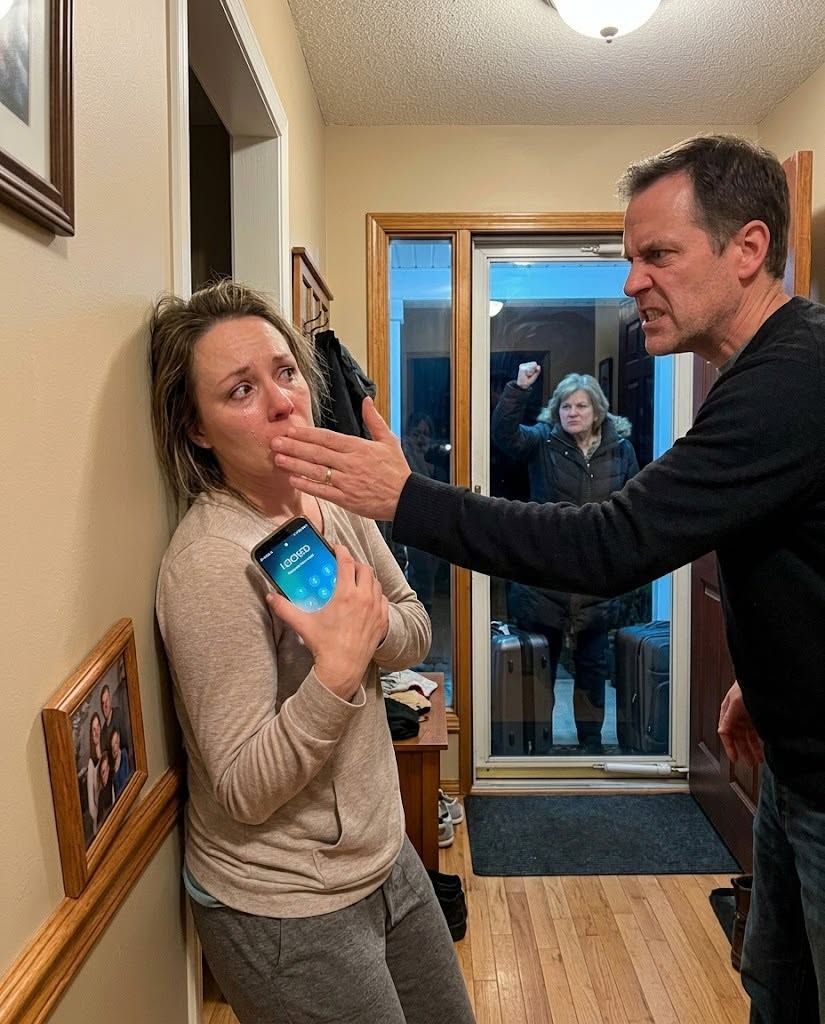
My husband lost his temper because I refused to let his mother into the house. The next morning, he placed a makeup bag beside me and said, “My mother’s here for lunch. Freshen up and smile.” But when he returned at midday, he found every piece of his clothing scattered across the garden… because that house had never belonged to him. It was mine.
The first time Daniel completely lost his temper, the sound was quieter than I expected.
A sharp crack echoed through the hallway while his mother pounded relentlessly on my front door.
“Open it,” he said.
I touched the sore spot near my mouth. “No.”
For a second, Daniel simply stared at me.
His expression changed—not with anger alone, but with something almost more revealing.
Disbelief.
He genuinely could not believe I had refused him.
For six years, Daniel had mistaken my patience for obedience.
That distinction had taken me far too long to understand.
When we first married, I thought compromise meant overlooking small things. A comment here. An intrusion there. A holiday rearranged because his mother preferred another day. A dinner changed because Gloria did not like what I had planned to cook.
None of it seemed large enough, by itself, to justify a war.
So I kept making room.
Gloria noticed.
She criticized my cooking as if I were an employee who needed retraining. She moved things in my kitchen because she claimed Daniel liked them better another way. She rearranged furniture without asking. Once, I came home and found the framed photograph from my father’s last birthday moved from the living room to a shelf in the hallway because, according to Gloria, it made the room “too sentimental.”
I put it back without arguing.
She opened mail that was not hers.
She walked through my bedroom without knocking.
And she constantly referred to the property as “Daniel’s house.”
The first few times, I corrected her.
“My house,” I would say lightly.
She would smile as if I had made a joke.
What made it especially insulting was that Gloria knew the truth.
I had purchased the house three years before I ever met Daniel.
My name was on the deed.
My father had helped me understand the paperwork when I bought it, and before he died, he had insisted that I keep certain things protected no matter how much I trusted the person I eventually married.
At the time, I had teased him for being overly cautious.
Years later, I would understand exactly why he had been so careful.
Daniel knew the house was mine, too.
But somewhere along the way, he stopped behaving like a man living in his wife’s home and started behaving like the final authority over it.
Gloria encouraged that illusion every chance she got.
If she complimented the backyard, she told Daniel he had done well for himself.
If she disliked a curtain or lamp, she told him what he should replace.
If I objected, she would say, “I’m only trying to help my son with his home.”
Daniel rarely corrected her.
At first, I told myself it was easier for him to avoid conflict.
Then I started noticing something worse.
He liked it.
He liked being treated as though everything I had built before him somehow proved his success.
He liked the assumption that the house, the land, the furniture, the stability—all of it flowed through him.
And because I loved him, I spent years telling myself that his ego was not dangerous.
I was wrong.
The night everything changed, Gloria arrived without warning.
I saw her through the front window first, dragging two suitcases across the porch.
Not an overnight bag.
Not a purse and a small case for a weekend visit.
Two full suitcases.
Daniel walked toward the front door as though the arrangement had already been decided.
“She’s staying indefinitely,” he announced.
I looked from him to the shadow of his mother outside.
“No,” I said.
He frowned.
It was almost strange how calm I felt saying it.
Not because I was unafraid of the fight that would follow, but because the answer itself required no debate.
Gloria had threatened me the week before.
She had called me barren trash and told me she would make Daniel divorce me.
Those were not words exchanged during some mutual screaming match.
She had said them directly and deliberately.
I had told Daniel what happened.
He had minimized it.
“She was upset.”