As if every offer was a box with a lock inside.
“No one will hurt you there,” he added.
Her mouth trembled.
“Everybody says that.”
Elias had no answer for that.
Some sentences are so ruined by other people that a good man cannot fix them by saying them better.
He took off his coat and held it out first.
She flinched anyway.
“Easy,” he said.
He waited until she saw that he was not reaching for the cloth.
Only then did he bend, slide one arm beneath her shoulders and one beneath her knees, and lift her.
She was lighter than she should have been.
Not simply thin.
Depleted.
Like hunger, cold, and fear had been taking turns with her for years.
She made one small sound when he set her in front of him on Buck.
Elias felt her stiffen when his arm came around her to hold the reins.
“I’ve got you,” he said.
The sentence felt foolish as soon as he spoke it.
He had no proof.
Only a saddle, an old horse, and a house too cold to count as comfort.
But he turned Buck toward home and rode slowly, keeping one hand steady at Lydia’s side so she would not fall.
The Turner ranch sat alone among brown hills and leaning fence posts.
It was a practical place.
A barn.
A corral.
A woodpile.
A house built square and stubborn against weather.
There had been laughter in it once, though Elias rarely let himself remember that.
His mother had kept a blue cup by the stove and sang while she kneaded bread.
His father had believed silence was a tool, not a punishment, and he used it for both.
After they were gone, Elias stopped setting the table for anyone but himself.
He kept the roof mended.
He kept the fences passable.
He kept the animals alive.
That was not the same as living, but it had been enough.
Until that morning.
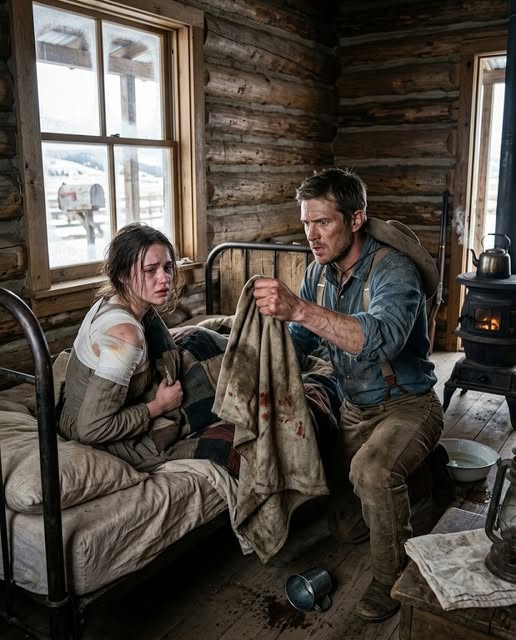
He carried Lydia inside and laid her on his bed because it was the only clean place ready.
The room smelled of cold sheets, dust, and the faint smoke of the fire he had not yet lit.
He got the stove going with hands made clumsy by urgency.
Kindling caught.
Smoke lifted.
The first heat moved through the room like a cautious animal.
Lydia watched everything.
His boots.
His hands.
The door.
The window.
The rifle over the pegs.
When Elias reached for a dented kettle, she startled.
When he set a bowl on the table, she startled again.
He learned quickly to tell her what he was about to do before he did it.
“I’m warming water.”
“I’m putting broth here.”
“I’m going to step outside and bring more wood.”
Each announcement made her fear move differently, but it did not leave.
He prepared broth and placed it where she could reach without him standing over her.
She did not touch it until he moved back across the room.
Even then, she lifted the spoon as if someone might punish her for eating too fast.
The cloth stayed wrapped around her shoulders.
It was not heavy enough to warm her.
It was not clean enough to comfort her.
Still, she held it like a shield.
Elias saw the blood on it.
He saw the way her breath caught if she shifted her weight.
He saw that one sleeve of her dress was torn at the seam and one shoe was nearly worn through.
What he did not see was the truth underneath.
Not yet.
That day passed in small movements.
Water warmed.
Fire fed.
Broth cooled and was reheated.
Outside, the wind dragged dust against the window glass.
Inside, Lydia fought sleep like sleep might hand her back to whoever she had escaped.
By evening, Elias had moved a chair near the door.
He sat there with the rifle across his knees.
He did not make a show of it.
He did not tell her he was protecting her.
He simply stayed between the bed and the only way in.
Sometime after dark, Lydia spoke.
“Why?”
Elias turned his head.
“Why what?”
“Why help me?”
He looked toward the stove, where the fire had settled into red coals.
Because his mother would have.
Because the sound of her voice by the bridge had put a hand around some dead part of him and squeezed.
Because there are things a man cannot ride past and still call himself one.
He said only, “You needed help.”
She watched him for a long time.
“That’s all?”
“That’s enough.”
Lydia looked away first.
He did not sleep much.
Neither did she.
At dawn, the room held the smell of smoke, damp wool, fever, and fear that had nowhere to go.
Elias stepped outside long enough to check the yard.
No riders.
No wagon.
No fresh tracks except his and Buck’s.
When he came back in, Lydia’s face had gone gray with pain.
“You need those wounds seen to,” he said.
Her hand clamped on the cloth.
“No.”
“Lydia.”
“No.”
The second answer was weaker, but more desperate.
Elias kept his voice low.
“I’m not asking to shame you.”
“If you see it,” she said, “he’ll know where I am.”
The words stopped him.
There was no sense in them, not the way ordinary fear made sense.
But the terror behind them was complete.
“Who?” he asked.
She closed her eyes.
“The man who bought me.”
Elias felt something inside him go still.
Not calm.
Still.
The kind of stillness that comes right before a storm hits.
He could have asked a dozen questions.
Who was he?
Where?
How long?
What papers?
What men?
But Lydia was shaking so hard the bowl beside her rattled against the table.
So Elias swallowed the questions.
He moved the broth closer.
Then he stepped back.
There are moments when rage is just another kind of selfishness.
If he spent it in front of her, it would only become one more loud thing in a room already full of fear.
So he stayed quiet.
That restraint cost him more than he expected.
The next hours were worse.
Lydia’s fever climbed.
She slipped in and out of sleep, never fully resting, always jerking awake as if someone had called her name from a nightmare.
Once, she whispered, “I didn’t run.”
Elias leaned closer but did not touch her.
“What?”
“I didn’t run before,” she said, voice cracked. “Not when he said I belonged there.”
Then she was gone again, eyes unfocused, breath shallow.
Elias changed the cloth on her forehead.
He added wood to the stove.
He checked the door.
He counted the cartridges by habit and hated himself for the comfort that counting gave.
By the following morning, pain won.
The thud came from the bedroom while Elias was pouring water into the basin.
He dropped the kettle so fast hot water splashed across the floorboards.
Lydia lay half on the rug, one arm trapped beneath her, lips parted around almost no breath.
The cloth had shifted.
Not much.
Enough.
A dark line crossed the edge of her skin.
Elias knelt beside her.
His own breath sounded too loud.
“Forgive me,” he whispered.
He meant it.
Even unconscious, she had asked him not to look.
But there was blood under that cloth, and heat in her skin, and the thin, terrifying looseness of a body running out of strength.
“I won’t let you die protecting a secret that never should have been yours.”
He lifted the fabric.
For one second, his mind refused what his eyes understood.
The marks were not from a fall.
They were not from a horse.
They were not the rough accidents of ranch work or weather or travel.
They were old and new together.
Lines across her back.
Small burns.
Bruises fading into other bruises.
Places where skin had healed badly because no one had cared whether it healed at all.
Elias had seen broken bones.
He had seen men dragged by horses and cattle horn wounds that made grown cowhands turn away.
This was different.
This was time.
This was method.
This was cruelty that had kept a schedule.
The room seemed to lose its air.
Elias Turner trembled.
His hands shook over the cloth, not because he was afraid of the blood, but because he was afraid of what he wanted to do to the man who had caused it.
He could picture it too easily.
A ride.
A door.
A hand around a collar.
A shot fired before the sun cleared the hills.
For one ugly breath, that picture felt like justice.
Then Lydia made a soft sound from the floor.
That brought him back.
Vengeance could wait.
Bleeding could not.
He moved carefully.
He warmed more water and cleaned what he could.
He tore flour sacks into strips because they were the cleanest cloth he had.
He crushed herbs the way his mother had taught him long ago, with the flat of a knife and a patience he did not feel.
Every time Lydia flinched, he stopped.
Every time she moaned, he told her where she was.
“Turner ranch.”
“Wyoming hills.”
“My house.”
“No one has come through that door.”
He kept the sentences plain.
No promises bigger than the room could hold.
No speeches.
No pity.
When he finished, the bed was changed, the old cloth was folded over the chair, and Lydia was bandaged beneath a quilt.
Elias washed his hands three times.
The water turned pink, then pale, then clear.
He stood over the basin longer than he needed to.
The rage had not left.
It had only found a place to sit.
When Lydia woke, her eyes went straight to the chair.
She saw the folded cloth.
Then she looked down and saw the bandages.
Her face emptied.
“You looked.”
Elias did not lie.
“Yes.”
Her throat moved.
“Then you’ll send me back.”
“No.”
She blinked as if the answer had not fit the shape of the world she knew.
“You have to.”
“I don’t.”
“You don’t understand.” She pushed the words out through pain. “Don Mateo has papers.”
Elias said nothing.
“He has the sheriff.”
Still, Elias waited.
“He has men.”
The stove cracked softly in the silence after that.
Outside, a loose shutter tapped once against the wall.
Lydia’s eyes went to the window.
Elias noticed.
He took two steps toward it, slow enough for her to track him, and pulled the curtain aside.
Empty yard.
Barn.
Corral.
Buck standing with his hip cocked in the weak morning light.
“No one’s there,” Elias said.
“That won’t matter.”
“Maybe not.”
Her lips parted.
The answer seemed to surprise her more than comfort would have.
Elias came back to the chair near the bed but did not sit close.
He knew now that distance was a kindness.
“Tell me what’s on those papers.”
Lydia looked at him as if the question itself was dangerous.
“I don’t know all the words.”
“Then tell me the ones you know.”
She stared at the quilt.
“His name. My name. A mark where I was made to press my hand. The sheriff saw it.”
Elias’s jaw tightened.
He wanted to say the sheriff had no right.
He wanted to say any man who watched such a thing deserved the same judgment as the man who wrote it.
But he had already learned that loud righteousness did not heal a trembling woman.
So he reached for a clean strip of cloth and folded it twice.
A simple thing.
A thing his hands could do while his mind held itself back from violence.
“Lydia,” he said, “listen to me.”
She did not look up.
“No paper makes a person property.”
Her eyes moved to his face.
Not fully.
Not trustingly.
But they moved.
“Men like that count on everyone else being tired,” Elias said. “Tired of trouble. Tired of arguing. Tired enough to hand somebody back because it’s easier than standing in the doorway.”
The words came out rougher than he meant.
He lowered his voice.
“I’m not tired enough.”
Lydia’s hand tightened on the quilt.
For the first time, she did not cover herself.
The cloth on the chair stayed where it was.
That was the first change.
Small enough that anyone else might have missed it.
Elias did not.
He had lived too long around frightened animals and wounded men not to know that trust rarely arrives like sunrise.
Sometimes it comes by inches.
A hand unclenched.
A breath taken without permission.
A woman looking at the window and then choosing to look back.
The kettle began to hiss on the stove.
Outside, Buck stamped in the yard.
Lydia flinched at the sound, but she did not fold into herself the way she had before.
Elias saw her fighting the instinct.
He saw the cost of it.
“That’s the horse,” he said.
“I know.”
The answer was tiny.
It was also the first time she had claimed knowledge over fear.
Elias stood and went to the table.
The rifle lay there where he had left it, close but not pointed, part of the room’s truth now.
He checked it once.
Lydia watched his hands.
“Will he come?” she asked.
Elias could have lied.
A gentle lie might have sounded better.
He did not think she needed better sounds.
She needed one honest thing that did not move beneath her feet.
“He may.”
Her breath caught.
“If he does,” Elias said, “he will not find you alone.”
Lydia stared at him.
The silence after that was different from the ones before.
Not empty.
Not safe exactly.
But changed.
The house seemed to hold it, the little room with its rough planks and stove heat and dented kettle, as if even the walls understood a line had been drawn.
Elias did not know what Don Mateo’s papers said.
He did not know what the sheriff had promised.
He did not know how many men might ride behind a man who believed another human being could be owned.
But he knew where he would stand.
Between the bed and the door.
Between the woman and the papers.
Between the lie and the first plain truth anyone had given her since the bridge.
No paper makes a person property.
Before noon, Lydia slept.
It was not peaceful sleep.
Her brow still tightened.
Her fingers still opened and closed against the quilt.
But she slept without the cloth in her hands.
Elias sat in the chair and listened to the stove, the wind, and the quieter rhythm of her breathing.
The old cloth remained folded on the chair across the room.
Dusty.
Blood-stiff.
Powerless now.
For one morning, that was enough.
The world beyond the ranch had not changed.
Men with papers still existed.
So did sheriffs who mistook ink for ownership.
So did houses where cruelty could hide behind locked doors and respectable signatures.
But inside the Turner place, something had shifted.
A man who had spent years living as if nobody would ever need him had found someone who did.
A woman who had been taught that help was only another trap had heard one answer and watched it hold.
Not a speech.
Not a miracle.
A door guarded.
A stove lit.
A bowl set within reach.
A cloth lifted because life mattered more than shame.
And when Lydia woke near sundown, the first thing she saw was not the cloth, not the window, and not the fear that had followed her from the bridge.
She saw Elias still sitting by the door with the rifle across his knees, awake, patient, and watching the road.
This time, when he said, “No one is taking you,” she believed him enough to close her eyes again.