
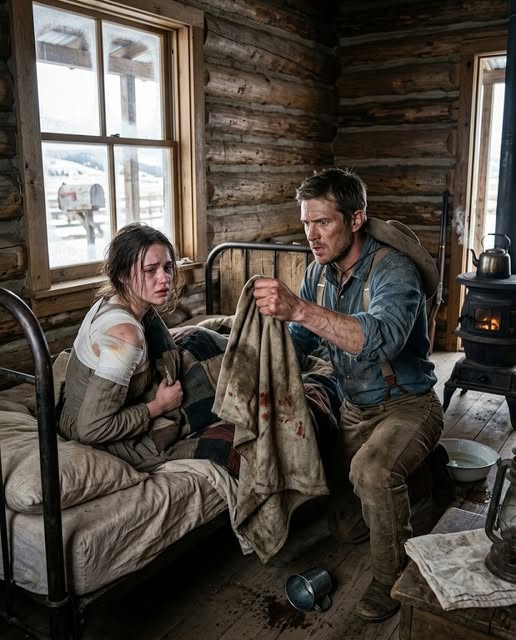
Elias Turner found her at dawn, in the hour when the world had not yet decided whether it wanted to be blue or gray.
The Wyoming sky hung low over the plains, pale and hard, and the cold had a way of turning every breath into proof a person was still alive.
He had been riding for hours.
A calf had gone missing sometime before first light, slipping through a crooked stretch of fence and disappearing into the brush and dry gullies beyond the Turner place.
Elias hated losing stock.
He hated wasted daylight.
Most of all, he hated trouble that came with no hoofprints to explain it.
His horse, Buck, was old enough to know when a man was too tired to speak, so the animal moved quietly beneath him, head low, ears flicking at the wind.
Elias had one hand on the reins and the other loose near his coat, where the weight of his revolver sat the way old habits sit.
Not dramatic.
Not eager.
Just there.
In that country, a man learned to keep one eye on the horizon and the other on anything that looked too still.
The bridge was no more than weathered planks over a creek bed that had been dry for months.
Once, water had run under it.
Now the creek looked like a scar, cracked and empty, carrying only weeds and wind.
That was where he saw the shape.
At first, Elias thought it was a feed sack.
Someone might have dropped it from a wagon or left it after a bad crossing.
Then the sack moved.
Not much.
Just a tremble.
Buck stopped before Elias pulled the reins, as if the horse had felt the wrongness too.
Elias sat still for one breath.
Then another.
No smoke in the distance.
No wagon.
No horse tied in the brush.
No tracks he could make sense of from the saddle.
A person did not end up alone beside a dead creek in the Wyoming cold unless something had gone badly wrong.
“Who’s there?” he called.
His voice sounded rough in the thin morning air.
The bundle folded tighter.
For a moment, Elias heard only wind scraping over the dry creek and the small clink of Buck’s bit.
Then a voice answered.
“Please… don’t hurt me.”
The words were so weak he almost wondered if he had imagined them.
Elias swung down from the saddle slowly, keeping his hands where they could be seen.
He had found desperate men before.
He had found thieves.
He had found drifters with fever and boys pretending not to be scared.
This was different.
The closer he came, the more the shape became a person.
A young woman.
She was tucked beneath a thick cloth, the fabric dirty with dust and stiff in places with dried blood.
Her face showed only in pieces.
Cracked lips.
Hollow cheeks.
Eyes too large for the rest of her.
Her hands gripped the cloth so tightly that the knuckles looked bloodless.
“I’m not going to hurt you,” Elias said.
The softness in his own voice surprised him.
He had not used that tone in a long time.
Maybe not since his mother was alive.
The woman shook her head hard, and pain crossed her face so quickly he saw her bite it back.
“Don’t lift it,” she whispered.
“The cloth?”
“Please. Don’t look.”
Elias stopped where he was.
The request was not modesty.
It was terror.
He had seen fear before.
He had seen men stare down fever, storms, bullets, and hunger.
This woman was afraid of being seen.
That was a different kind of wound.
“What’s your name?” he asked.
She did not answer at once.
Her eyes moved past him to the empty bridge, then the brush, then the horizon.
Every direction looked like danger to her.
“Lydia,” she finally said.
“Lydia,” Elias repeated, so she could hear that he had caught it correctly. “I’m Elias Turner.”
She said nothing.
“My ranch is a few miles from here. There’s a stove, water, and food. I can get you warm.”
Her face changed at the word ranch.
Not hope.
Calculation.