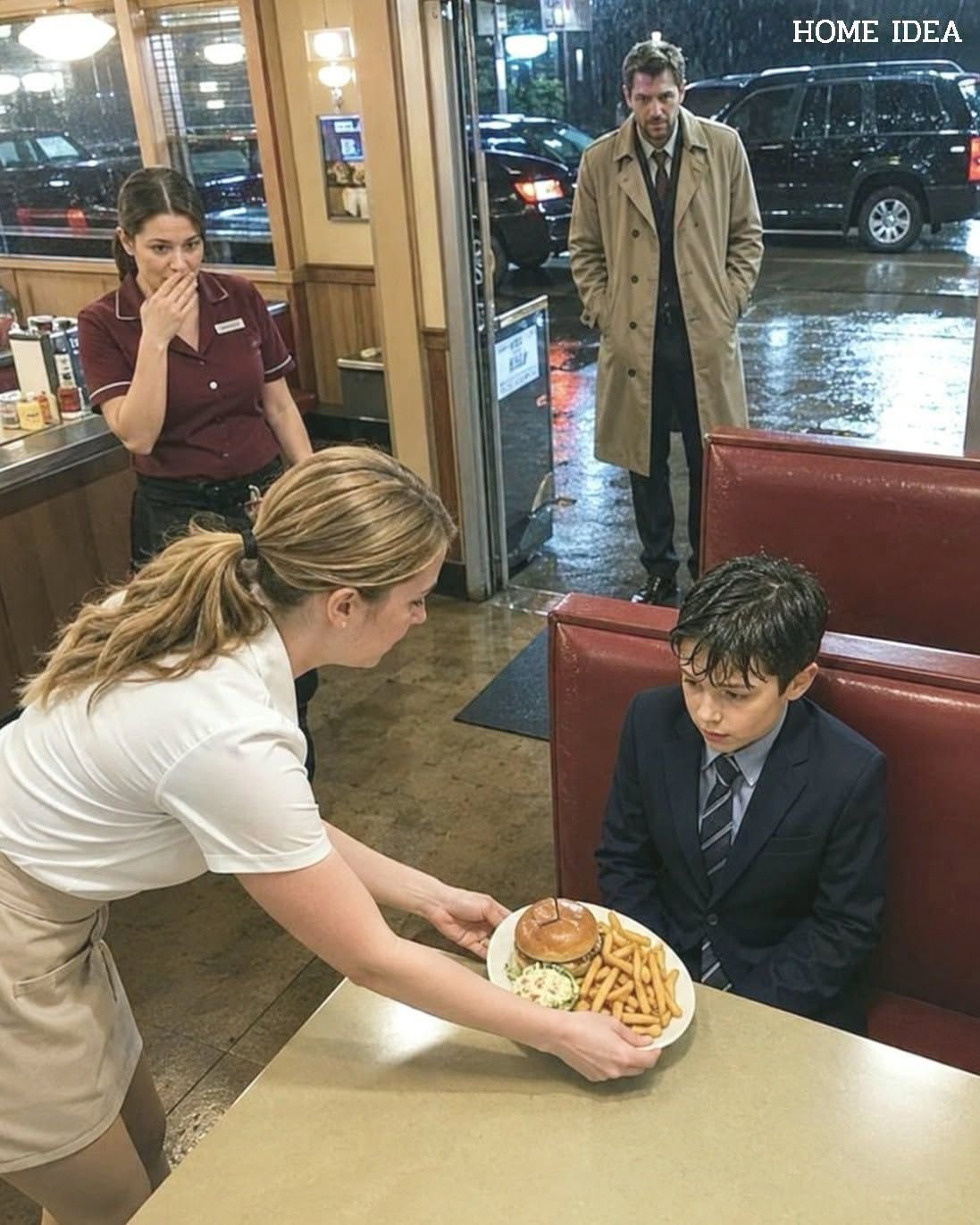
“Two blocks from the mall. Empty.”
Misha reached for his father’s sleeve. “Is Nina hurt?”
The man glanced at Mikhail, not answering.
Mikhail placed the kitten back into Misha’s hands and lowered his voice.
“We do not know yet.”
“But you’ll find her.”
“Yes.”
“You promise?”
Mikhail hesitated for less than a heartbeat.
“I promise I will do everything I can.”
Misha stared at him.
He was old enough to know that was not the same as a promise that everything would be all right.
I came around the counter without thinking.
“Misha,” I said gently, “does Nina have a phone? Maybe she lost it. Maybe someone helped her like I helped you.”
He clung to that possibility. “Maybe.”
Mikhail looked at me, and I could tell he appreciated the kindness even if he could not afford to believe it.
The man at the door spoke again. “There’s something else.”
Mikhail’s eyes narrowed.
The man looked uneasy. “The car was locked. No sign of forced entry. Her purse was inside.”
Mikhail said nothing.
“And her phone.”
Misha’s mouth opened.
I felt the air go cold.
Ray whispered, “That’s not good.”
Mikhail’s gaze sharpened toward him.
Ray raised both hands. “Sorry. Thinking quietly from now on.”
Mikhail turned back to his son. “We are leaving.”
Misha looked at me. “Can Anna come?”
The question startled all of us.
“No, sweetheart,” I said quickly. “I have to close the diner.”
“Then we can help her close.”
Ray made another strangled noise.
Mikhail studied his son. “Why do you want Anna to come?”
Misha looked down at the kitten.
“Because Nina said if I was ever lost, I should find the blue bell.”
The room became very still.
Mikhail’s face changed.
“What did you say?”
Misha seemed confused by the reaction. “The blue bell. She told me once. If something bad happens and I can’t find her or you, find the blue bell.”
My eyes moved toward the front window.
The old neon sign outside flickered weakly in the storm.
BELL’S DINER.
Beside the words was a faded blue bell, painted by my father when I was little. I remembered him standing on a ladder in the summer heat, his shirt stuck to his back, blue paint on his cheek, whistling some old song my mother loved.
I had always thought the bell was just a sign.
Just a name.
Mikhail slowly turned toward it.
His voice was quiet. “Nina knew this place?”
Misha nodded. “She said the blue bell was safe.”
A strange pressure built behind my ribs.
“That doesn’t make sense,” I said. “I don’t know anyone named Nina.”
Mikhail looked at me.
“Did your father?”
“My father?”
“Yes.”
I almost laughed. It came out wrong. “My father served pancakes and coffee. He knew postal workers, nurses, mechanics, half the neighborhood, and one retired magician who never paid on time. He did not know people who travel in black SUVs.”
Mikhail did not smile.
“What was his name?”
“Thomas Bell.”
The change in his face was unmistakable this time.
Not just recognition.
Impact.
Like a door inside him had opened and he had seen something he had tried very hard to keep closed.
Ray saw it too. “Anna…”
I looked from him to Mikhail. “What?”
Mikhail’s voice lowered. “Your father was Thomas Bell?”
“Yes.”
“From this diner?”
I folded my arms, though suddenly I felt cold. “Obviously.”
Mikhail looked toward the wall behind the register.
There were photos there, dozens of them in mismatched frames. My parents cutting the opening-day ribbon. Local kids in Little League uniforms. My father holding a giant pancake shaped like Illinois. My mother laughing with whipped cream on her nose. Customers who had become family, some long gone now.
Mikhail walked toward the photographs.
I followed him, unease crawling up my spine.
His eyes moved over the wall until they stopped on one frame near the end.
It was old, the colors faded warm and yellow at the edges. My father stood outside the diner at night, one arm around a younger man I had never recognized. The younger man wore a dark jacket and had sharp cheekbones, tired eyes, and a faint smile, as if smiling had once been easy but no longer was.
I had asked my father about that picture when I was a teenager.
“Just someone who needed a friend,” he had said.
At the time, I had accepted it. My father had been that kind of man. He collected people who needed a friend.
Mikhail lifted one hand but did not touch the glass.
“Viktor,” he said.
The word was barely audible.
Misha looked up. “Uncle Viktor?”
My heart thudded.
“You know him?” I asked.
Mikhail did not answer right away.
His eyes stayed on the photograph, and for the first time since entering my diner, he looked younger than his power, older than his age, and unbearably tired.
“He was my brother.”
Rain beat against the windows.
The little diner seemed to shrink around us.
“Your brother knew my father?” I asked.
“Yes.”
“How?”
Mikhail’s mouth tightened. “That is not a simple story.”
“I’m not asking for simple.”
His gaze moved to mine. “Tonight may not be the safest time to tell it.”
A laugh escaped me, small and humorless. “A missing nanny told your son to find my father’s diner if he was ever in trouble. Your brother is in a photograph on my wall. You recognized my father’s name. I think safe left a while ago.”
Ray came out from behind the counter and stood beside me.
“Anna’s right,” he said. His voice shook a little, but he didn’t back down. “You owe her some kind of explanation.”
Mikhail looked at him for a long moment.
Then at me.
Then at Misha, who had gone very quiet.
He seemed to make a decision.
“My brother Viktor came to Chicago many years ago,” Mikhail said. “He was younger than me. Too trusting in some ways, too proud in others. He got involved with people who did not forgive mistakes easily.”
I felt Ray stiffen beside me.
Mikhail continued, carefully choosing each word. “One night, he disappeared. For three days, no one knew where he was. When he came back, he told me only one thing clearly.”
“What?” I whispered.
“That a man named Thomas Bell had saved him from dying alone in an alley behind a diner.”
My hand went to the counter to steady myself.
“My father never told me.”
“He may have thought silence protected you.”
“From whom?”
Mikhail’s face closed.
There it was.
The wall.
I had felt it before in people who knew more than they could say.
“Mikhail,” I said, surprising myself with the firmness in my voice, “I helped your son tonight without asking who he belonged to. I didn’t calculate what it might cost or benefit me. I just helped him. So don’t stand in my diner, looking at my father’s picture, and tell me half the truth like I’m a child.”
Misha looked at me with something like admiration.
Ray looked terrified but proud.
Mikhail looked at the floor.
When he spoke, his voice was quieter.
“Viktor believed your father hid something for him.”
I frowned. “Hid what?”
“I don’t know.”
“You don’t know?”
“If I knew, I would not have spent years wondering.”
“Years?”
Mikhail nodded once. “After Viktor died, some of his belongings disappeared. Letters. A journal. A small metal case. He had said only one thing to me in the hospital, when he was barely conscious.”
Misha’s eyes lowered at the mention of the hospital.
Mikhail’s voice softened. “He said, ‘Thomas kept the promise.’”
A shiver moved through me.
Thomas kept the promise.
My father had been a man of promises. Small ones, mostly. He promised pie to lonely widowers. He promised extra fries to kids who brought good report cards. He promised my mother he would fix the sink and then pretended not to hear her laughing when it broke again the next week.
But this was different.
This sounded like a promise with shadows around it.
“I don’t know anything about a metal case,” I said.
“Did your father leave storage? A safe deposit box? A locked cabinet?”
“No.”
But even as I said it, a memory stirred.
My father’s old toolbox.
Not the one in the kitchen. The other one. The metal blue one he kept in the basement at home, under the stairs. I had opened it once after he died, looking for a wrench, and found it locked.
I had assumed it held old tools.
Or maybe I had wanted to assume that.
Mikhail watched my face.
“What did you remember?”
“Nothing.”
“Anna.”
“I said nothing.”
His expression softened slightly. “You are a poor liar.”
“I’m not lying. I’m deciding.”
That, at least, made Ray smile.
Mikhail nodded slowly, as if he respected the distinction.
“Fair.”
Misha stepped forward. “Miss Anna, if your father helped Uncle Viktor, maybe you can help Nina.”
The simplicity of it hurt.
I knelt so I could look him in the eyes.
“I want Nina to be found,” I said. “But I don’t know how to help.”
“You found me,” he said.
“You found me.”
He shook his head. “No. Nina told me the blue bell was safe. But you made it true.”
For a second, I couldn’t speak.
Then the lights flickered.
Once.
Twice.
The old neon sign outside buzzed loudly, then the diner lights dimmed to a sickly yellow.
Ray looked up. “Storm’s messing with the power.”
The lights steadied.
But the moment had changed.
One of Mikhail’s men moved to the window, peering through the rain. Another spoke quietly into his phone. The older man who had arrived with them stepped toward Mikhail.
“Sir, we need to go. Now.”
Mikhail’s face hardened. “What is it?”
The man hesitated, glancing at Misha.
Mikhail placed one hand gently over his son’s ear, though Misha immediately tried to duck away.
“Papa, I’m not a baby.”
“No,” Mikhail said softly. “But you are my son.”
The man leaned closer and murmured something.
I caught only fragments.
Mall camera.
Wrong exit.
Followed.
Not random.
Mikhail’s expression did not change, but the room seemed to tighten around him.
Misha saw enough. “What happened?”
Mikhail lowered his hand. “We are going home.”
“What about Nina?”
“We continue looking.”
“Can Miss Anna call us if she remembers something?”
Mikhail looked at me.
The question sat there between us.
I didn’t want his phone number. I didn’t want black SUVs in my parking lot. I didn’t want old secrets crawling out of my father’s photographs.
But I looked at Misha’s face.
At the kitten shivering against his towel.
At the fear he was trying so hard to swallow.
“Fine,” I said. “Give me a number.”
Mikhail took a card from his wallet and placed it on the counter.
It was simple. Heavy. No company name. Just his name and one phone number printed in black.
Ray looked at the card as if it might explode.
Mikhail turned to leave, then paused.
“You said this diner is struggling.”
My eyes snapped up. “Misha talks too much.”
“I observe,” Misha said.
Ray muttered, “The kid conducted a full financial audit over meatloaf.”
Mikhail almost smiled.
Almost.
“I meant what I said,” I told him. “I’m not taking payment.”
“Then do not call it payment.”
“What should I call it?”
“Repair.”
I frowned.
He looked toward the ceiling, where a brown water stain spread above booth four. “Your roof leaks.”
“It has character.”
“It has mold.”
“It has history.”
“It can have both.”
Ray whispered, “He’s not wrong.”
I shot him a look.
Mikhail continued, “Let me send someone to repair the roof.”
“No.”
“The sign.”
“No.”
“The electrical panel, which sounds like it is moments away from becoming a fire hazard.”
“That panel has been dramatic for twenty years.”
“Anna.”
The way he said my name stopped me. Not commanding. Not impatient. Almost tired.
“I am not trying to buy your kindness,” he said. “I am trying to honor it.”
The words unsettled me because they sounded sincere.
I looked at the old photographs on the wall. My father smiling in every one, as if optimism were not a feeling but a discipline.
What would he have done?
He would have fed the child.
He would have given the kitten a saucer of milk, even if the vet said not to.
He would have accepted help only if pride stood in the way of keeping the diner alive for the people who needed it.
I hated that I knew the answer.
“Not tonight,” I said. “Not while everything is strange.”
Mikhail accepted that with a nod. “Then another time.”
“I didn’t agree to another time.”
“You did not refuse it.”
Ray whispered, “Technically true.”
I elbowed him lightly.
Misha stepped toward me, still damp, still pale, still holding the ridiculous little kitten.
“Can I come back?” he asked.
The question nearly broke me.
I bent down. “For pie?”
He nodded.
“When your father says it’s okay.”
Mikhail looked down at him. “With proper supervision.”
“And the kitten?”
“We will discuss the kitten.”
“That means yes,” Misha said to me.
“It does not,” Mikhail replied.
“It does a little.”
Ray laughed before he could stop himself.
Mikhail looked at him, and this time Ray didn’t flinch as much.
Maybe because the room had changed again. Maybe because Mikhail Volkov, feared by men far tougher than Ray, was losing a quiet argument to a wet child and a gray kitten.
Mikhail guided Misha toward the door.
Before they reached it, Misha turned back.
“Miss Anna?”
“Yes?”
“My papa looks scary, but he reads stories in funny voices.”
Mikhail stopped walking.
The men by the door suddenly became fascinated by the rain.
Ray covered his mouth.
Mikhail said, “Misha.”
“What? It’s true.”
I smiled. “I’ll remember that.”
“Please don’t,” Mikhail said.
But there was warmth under it.
They stepped into the storm surrounded by men with umbrellas. Mikhail kept his coat angled over Misha, though it did little against the wind. The kitten’s little face peeked from the towel, unimpressed by Chicago weather.
Misha waved once from beneath the umbrella.
I waved back.
Then the black SUVs pulled away, one after another, their red taillights bleeding into the rain until the street swallowed them.
The diner became quiet.
Too quiet.
Ray locked the front door and turned the sign to CLOSED.
Neither of us spoke for a full minute.
Then he said, “So.”
I leaned against the counter. “Don’t.”
“I haven’t said anything.”
“You said ‘so.’ That’s worse.”
He picked up Mikhail’s card and looked at it, careful not to bend the edges. “Anna, this is not nothing.”
“I know.”
“Your father knew his brother.”
“I know.”
“His nanny sent that boy here.”
“I heard.”
“And you apparently have something to remember.”
I rubbed my forehead. “I might.”
Ray lowered the card. “What?”
“My father’s old blue toolbox.”
Ray’s eyebrows lifted. “The one from the basement?”
I stared at him. “How do you know about that?”
“Your dad brought it here once, years ago. Wouldn’t let me touch it.”
“When?”
Ray thought. “Maybe a few months before he passed.”
A strange feeling opened in my chest.
“What did he do with it?”
“He took it into the back office. Stayed there a long time. When he came out, he looked…” Ray paused.
“Looked what?”
“Like he had seen a ghost.”
My mouth went dry.
“Why didn’t you tell me?”
“Because after he died, you were barely holding yourself together. And honestly, Anna, I thought maybe it was just grief making me remember it wrong.”
I looked toward the hallway that led to the back office.
The diner was old enough to have noises of its own. Pipes ticking. Fridge humming. Wind pressing against weak seals around the back door. Usually those sounds comforted me.
Tonight they sounded like whispers.
Ray followed my gaze.
“You think the toolbox is here?”
“No. It’s at home.”
“Are you sure?”
I started to say yes.
Then I remembered something else.
The winter after Dad died, I had cleared out some things from the apartment because I couldn’t bear to look at them. Old uniforms, broken appliances, boxes of receipts. I had brought several bins to the diner basement because I told myself I would sort them later.
Later had become six years.
“Actually,” I said, “I’m not sure.”
Ray sighed. “Of course not.”
We checked the basement first.
The diner basement was a place I avoided whenever possible. It smelled of dust, onions, old wood, and faint dampness. The lightbulb at the bottom of the stairs swung slightly when the storm shook the building. Metal shelves lined the walls, packed with paper towels, canned tomatoes, holiday decorations, and things my father had refused to throw away because “you never know.”
Ray came down behind me with a flashlight.
“You realize this is how people in movies find cursed dolls,” he said.
“Stop talking.”
“I’m just saying, if something whispers my name, I’m leaving you.”
“Good to know.”
We searched for twenty minutes.
Old tax boxes.
Christmas garland.
A broken milkshake machine.
Three chairs my father had insisted he would fix someday.
No blue toolbox.
I was about to give up when Ray, crouched near the old freezer, said, “Anna.”
Something in his voice made me turn.
He was holding a small cardboard box labeled in my father’s handwriting.
NAPKINS / EXTRA MENUS.
Except it was far too heavy for napkins.
I knelt beside him and opened it.
Inside were menus, just as labeled.
Underneath them was a folded dish towel.
Under that, a metal cash box.
Not the blue toolbox.
Smaller.
Black.
Locked.
My heart began to pound.
Ray whispered, “That yours?”
“No.”
The lock was old, the kind you could probably break with enough force, but I didn’t move.
Because taped to the top was an envelope.
And written on it in my father’s handwriting was one word.
Anna.
My knees weakened.
Ray saw it and gently took the box from my hands, setting it on the floor.
“You okay?”
“No.”
He sat back on his heels.
“We don’t have to open it tonight.”
I stared at my name.
My father’s handwriting had always been slightly slanted, confident, messy in a way that made every grocery list look like it had somewhere important to be.
Six years.
For six years, this had been beneath my feet.
Beneath the diner.
Waiting.
“Yes,” I said. “We do.”
My hands shook as I peeled the envelope from the box. The paper had yellowed slightly at the edges. It had been sealed, then sealed again with tape.
Inside was a single folded page.
I opened it carefully.
My father’s words filled the page.
Anna,
If you found this, then either I became braver than I have been, or the past finally came looking for us.
I stopped reading.
Ray’s face had gone pale.
“Keep going,” he whispered.
I swallowed and forced my eyes back to the page.
There are things I did not tell you, not because I did not trust you, but because I wanted you to have a life that belonged to you. A life of pancakes, college applications, bad first dates, your mother’s music, and ordinary worries.
But some promises do not end just because we want them to.
Years ago, a young man came to my back door bleeding, frightened, and carrying something people were willing to destroy lives over. His name was Viktor Volkov. I helped him because he was someone’s son, someone’s brother, and because your mother would have boxed my ears if I let a scared boy die in the alley.
I almost laughed and almost cried at the same time.
That sounded like Mom.
Ray leaned closer.
I continued reading.
Viktor gave me something to keep hidden. He said if anything happened to him, one day a child might come looking for the blue bell. I thought he meant his own child. I was wrong about many things.
Anna, if that child comes, help him if you can. But do not trust the first version of any story, even mine.
My breath caught.
Ray whispered, “What does that mean?”
I shook my head and kept reading.
The key is not with this letter. I hid it where only you would think to look, in the place your mother said held all our best days.
I am sorry, sweetheart. I wanted to tell you. Every year I waited, it became harder. Every year I convinced myself silence was protection.
Maybe it was only fear.
Remember this: family is not always blood, and danger is not always a man with a frightening name.
Sometimes it is the person everyone trusts to hold the child’s hand.
Dad
The basement seemed to spin.
I lowered the letter.
Ray was utterly still.
“Read that last part again,” he said.
I couldn’t. The words were already burning in my mind.
Sometimes it is the person everyone trusts to hold the child’s hand.
“Nina,” I whispered.
Ray stood abruptly. “We need to call that number.”
He pulled Mikhail’s card from his pocket.
My phone buzzed before he could hand it to me.
The sound made both of us jump.
The screen showed an unknown number.
For a moment, neither of us moved.
Then I answered.
“Hello?”
Static crackled softly.
Rain pounded somewhere on the other end of the line.
A woman’s voice whispered, breathless and shaking.
“Anna Bell?”
My blood went cold.
“Yes?”
There was a pause, and then the woman said the name that made every secret in the room shift into a new shape.
“This is Nina.”
Ray’s eyes widened.
I gripped the phone tighter. “Where are you? Mikhail is looking for you.”
“No,” she said quickly. “Listen to me. You cannot give him the box.”
I looked down at the locked metal box on the basement floor.
“How do you know about the box?”
Her breath hitched.
“Because Thomas Bell hid it for my father.”
My heart stopped.
“Your father?”
Another burst of static.
Then Nina whispered,
“Viktor Volkov was not only Mikhail’s brother.”
The line crackled.
“He was mine, too.”