Three weeks after giving birth, I took my children to the beach for the first time since my son was born.
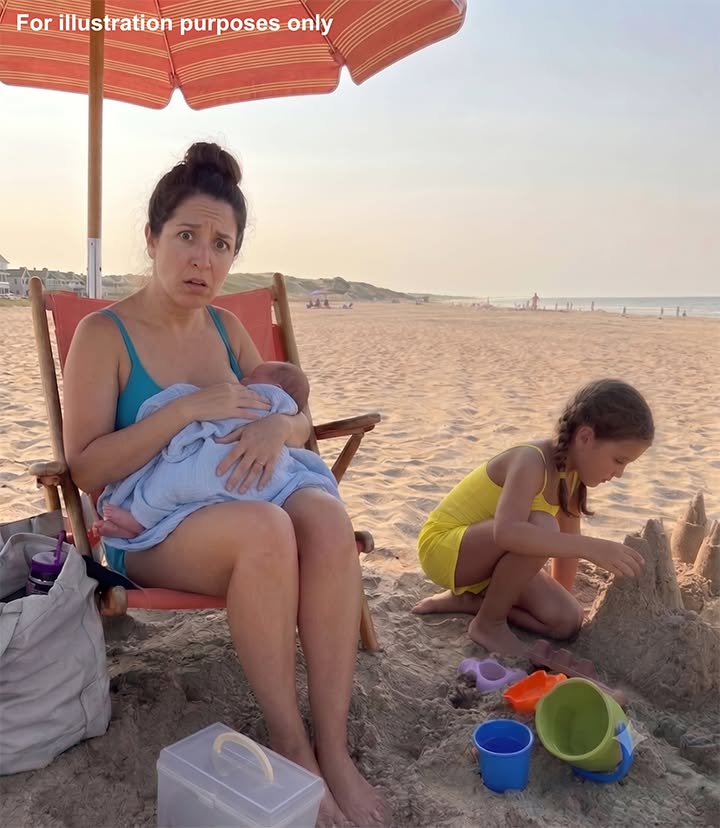
I was sitting beneath an umbrella, feeding my newborn under a thin blanket, when a woman stopped in front of us and raised her phone.
At first, I thought she was taking a picture of the water.
Then she stepped closer, aimed the camera directly at my face, and said, “People like you are exactly why families can’t enjoy public places anymore.”
Several people turned to look.
I asked her to stop filming, but she only moved the phone lower, toward the baby in my arms.
I was already fighting back tears and preparing to leave when my eight-year-old daughter stood up from her sandcastle.
Sophie walked straight between the woman and my newborn son.
Then she looked up and asked a question that made the entire beach fall silent.
The hardest part about bringing Oliver home was not the exhaustion.
It was Sophie.
Not because she misbehaved or complained.
Because she did neither.
Before her brother was born, Sophie had been asking almost every day when we could go to the beach.
She had already chosen the purple bucket she wanted to bring. She had drawn a picture of the castle she planned to build, complete with two towers, a bridge, and what she described as “a very serious moat.”
Then Oliver arrived, and the beach was never mentioned again.
Our days became a blur of feeding, laundry, diaper changes, and trying to sleep whenever the baby allowed it.
Sophie adjusted without being asked.
She poured her own cereal in the morning because my hands were usually full. She stopped requesting bedtime stories when Oliver cried in the evenings. She learned to close doors carefully and walked through the house as though every floorboard might wake him.
One afternoon, I found her sitting on the laundry-room floor, matching her socks into small piles.
“Why didn’t you call me?” I asked.
She looked up.
“Oliver was sleeping.”
“I could still help you.”
“You looked tired.”
She returned to the socks as though the matter had been settled.
That frightened me.
Sophie had always been independent, but this was different. She was not simply learning to do more for herself.
She was trying to become less noticeable.
A few days later, while I was feeding Oliver on the couch, she stood by the window and said quietly, “The weather looks good for the beach.”
She did not ask to go.
She simply made the observation and began walking away.
“Sophie.”
She turned.
“Get your sandals.”
Her eyes widened.
“Really?”
“Really.”
She stared at me for another second, almost as though she expected me to change my mind.
Then she ran down the hallway.
While I packed towels, sunscreen, wipes, water, snacks, and enough baby supplies for a three-day journey, Sophie added Oliver’s sun hat and two burp cloths to the bag.
“You don’t have to help with everything,” I told her.
“I know.”
But she added an extra onesie anyway.
The beach was busy when we arrived, but we found a place beneath a large striped umbrella near the water.
Sophie immediately dropped to her knees and began digging.
“You’re too close to the waves,” I warned.
“The moat needs real water.”
“The moat will become the ocean if you build it there.”
She considered that.
“Then it will be a coastal kingdom.”
For the first time in weeks, she sounded like herself.
Oliver slept in his carrier beside me while Sophie worked. She narrated each decision, explaining why one tower had to be taller and why a shell beside the entrance represented a guard.
I listened, answered at the appropriate moments, and tried not to check the baby every ten seconds.
For nearly an hour, the day felt normal.
Then Oliver woke and began turning his head against my chest.
I knew the signs.
“He’s hungry,” Sophie said.
“You are becoming an expert.”
“He makes the same face every time.”
I settled beneath the umbrella and lifted him into my arms. Then I placed a light muslin blanket over us.
It covered my chest and most of Oliver’s body. Only the top of his tiny head was visible.
Sophie sat beside me, decorating the castle wall with shells.
The sound of the waves was soft, and people around us were busy with their own families.
Nobody looked in our direction.
Then I heard a woman say, “That is disgusting.”
I looked up.
She stood several yards away in a wide sun hat and a white cover-up. Her phone was raised in front of her.
For a moment, I thought she was speaking to someone else.
Then she moved the phone slightly, and I saw my own reflection on the screen.
She was filming me.
I pulled the blanket closer around Oliver.
“Are you recording us?”
The woman began walking toward our umbrella.
“So this is acceptable now?” she asked loudly. “Women can just expose themselves anywhere they want?”
Nearby conversations began to fade.
“I’m not exposed,” I said. “I’m feeding my baby.”
She stopped a few feet away.
“There are men here. There are children here.”
I looked around.
Two families nearby had turned toward us, but only because she was shouting.
Before that moment, none of them had noticed what I was doing.
“I’m covered,” I repeated. “Please stop filming.”
She gave a short laugh.
“If you were doing nothing wrong, you wouldn’t care about the camera.”
My stomach tightened.
Oliver shifted beneath the blanket, disturbed by her voice.
I lowered my eyes and tried to settle him.
The woman stepped closer.
“If you need to do that, there are restrooms.”
“I’m not feeding my newborn in a public restroom.”
“Then go to your car.”
“It’s hot, and he’s hungry.”
“That is not everyone else’s problem.”
Sophie stopped placing shells on the castle.
I could see her watching the woman from the corner of my eye.
“Please leave us alone,” I said.
The woman adjusted the angle of her phone.
“My name is Karen, and I believe people should know what families are being forced to see in public.”
My face began to burn.
I could feel strangers watching now.
Some looked uncomfortable. Others seemed curious. A few whispered to each other.
I knew I had done nothing wrong, but shame still crept over me.
That was what Karen wanted.
She wanted me to feel as though every person on the beach had been silently judging me before she was brave enough to say it aloud.
“Delete the video,” I said.
Karen ignored me.
“This will probably end up online,” she continued. “Maybe then people will understand that not everyone wants to watch this.”
The phone moved again.
This time, it was pointed toward Sophie.
Then toward the small shape of Oliver beneath the blanket.
My embarrassment vanished.
“Do not record my children.”
Karen kept filming.
“Your daughter is old enough to understand that some things should be private.”
Sophie’s face changed.
She was no longer looking at Karen.
She was staring at the phone aimed toward her baby brother.
I felt a cold rush of fear.
Karen could upload a few seconds of footage and tell any story she wanted.
She could show my face, Sophie’s face, and Oliver’s head beneath the blanket. She could invite strangers to debate us, mock us, and share the video with people we had never met.
I shifted Oliver against me and reached for the diaper bag.
“We’re leaving,” I told Sophie.
Karen smiled as though she had won.
“That would be more appropriate.”
Sophie did not move.
“Sweetheart, get your bucket,” I said.
She looked at me.
“You said I could finish the castle.”
“We’ll come back another day.”
Her eyes moved from my face to Karen’s phone.
“You look like you’re going to cry.”
“I’m fine. Please get your things.”
Sophie stood slowly.
She brushed the sand from her knees but left the bucket beside the castle.
Then she walked toward Karen.
“Sophie, come back.”
She continued until she was standing directly between the phone and Oliver.
Karen lowered the device slightly.
“Go back to your mother, sweetheart. This is an adult conversation.”
Sophie looked up at her.
“You keep talking about children.”
Karen frowned.
“What?”
“You said there are children here.”
“Yes. Exactly.”
Sophie glanced around the beach.
“Which one is yours?”
Karen blinked.
“Excuse me?”
“Where is your child?”
For the first time since she approached us, Karen appeared uncertain.
“I don’t have one with me.”
Sophie did not move.
“Then why are you telling my mom how to feed hers?”
Nobody spoke.
The waves continued breaking against the shore, but the people nearest us had fallen completely silent.
Karen stared down at Sophie as though she had not expected a child to answer her.