
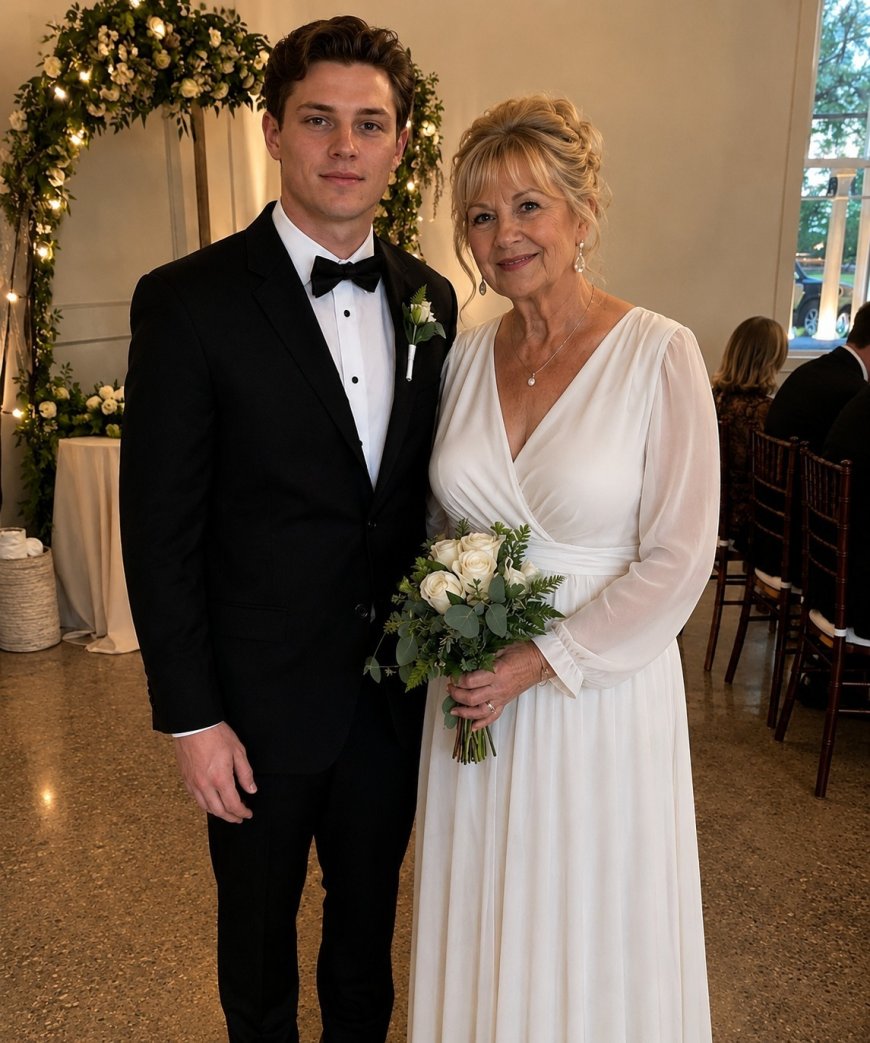
A man, driven by desperation, marries an older woman, believing for a long time that he is only thinking of his own future. But after their separation, he discovers that she had long since recognized his true motives—and yet treated him with unexpected warmth. What she ultimately leaves behind changes his life in a way he never could have imagined.
I married Evie because I needed protection, peace, and a future that her house seemed to promise. For a long time, I called it survival because that sounded easier than the truth.
Evelyn was seventy-one, widowed, and possessed that gentle way about her that made people instantly feel safe around her. I was twenty-five, deeply in debt, and spent many nights in my truck behind a supermarket while the night manager politely pretended not to notice me.
So when Evie proposed, I said yes.
Not because I loved her.
But because her house was warm, the fridge was always full, and I was tired of freshening up in gas station restrooms before job interviews.
The first person I told was Jesse, a former colleague who, after a couple of beers, could make even the most uncomfortable thoughts sound like harmless jokes.
We were sitting in a small bar when I said,
“Jess, I’m getting married.”
He almost choked on his drink.
“Who?”
“Evie.”
“The older lady with the blue house?”
I told him to speak more quietly, but he just grinned.
“Damon, this isn’t marriage. It’s an apartment with perks.”
I muttered that at least it was a roof over my head.
Jesse leaned closer to me.
“And if you stay long enough, maybe you’ll own it all eventually.”
I should have gotten up and left.
Instead, I stared silently into my beer and simply said that I was tired of freezing, getting debt collection calls, and constantly smelling like cheap soap.
Two weeks before our civil ceremony, Evie slid a thick binder across the kitchen table to me.
“What’s this?”
“A prenuptial agreement, Damon.”
I laughed at first, thinking she was joking.
But she clasped her hands calmly.
“Loneliness doesn’t make a person reckless. The house is still mine. So are my savings. And if something ever happens to me, my will will take care of everything else.”
I asked her if she thought I’d be interested in her money.
Evie looked straight at me over her reading glasses.
“I think that difficult times sometimes make people do things they later regret.”
My face flushed.
Even so, I signed.
I told myself paper was just paper.
Time changed a lot of things, after all.
People changed their minds.
Everyone called her Evelyn, but she let me call her Evie because she said it sounded younger.
That was her.
She brought warmth to every room she entered.
But I often noticed other things.
The full pantry.
The soft towels.
At the medicine boxes in the bathroom cabinet.
At the doctor’s appointments, carefully marked in the calendar.
Each new appointment made me think.
Each additional pack of medicine reminded me how fragile time could be.
Even so, Evie treated me better than I deserved.
One afternoon, she left new boots on the doorstep.
A week later, a warm winter coat was hanging there.
“I don’t need any presents,” I said.
She just smiled.
“Then call it help around the house. I don’t like wet footprints.”
When I said I could buy myself a coat, she asked quietly,
“Can you really?”
At our little local restaurant, every waitress knew Evie by name.
I didn’t particularly like the place because everyone valued her so much, and I could feel their questioning glances when they looked at me.
One afternoon, Evie stirred sugar into her tea.
“Why do you always go so quiet when people are kind to me?”
I forced a laugh.
But she continued.
“You drum your fingers on the table, like you’re counting who trusts me.”
Then she gently touched the sleeve of my coat.
“You’re ashamed when I see what you need.”
I immediately objected.
But when she quietly said my name, I was the first to look away.
Evie never tried to pressure me into confessing.
She simply left the door open and waited patiently to see if I would one day find the courage to go through it.
I never did.
One evening, I found her sitting at the bottom of the stairs, one hand leaning against the wall.
She immediately said that everything was fine.
Nevertheless, I slowly helped her up.
For a brief moment, her weight rested on my shoulder before she straightened up.
In the kitchen, I wanted to make tea and even forgot to heat the water first.
Evie chuckled softly.
For a few minutes, the house almost felt like a real home.
Almost as if I were actually her husband and not just a man seeking shelter under her roof.
Then my phone vibrated.
A message from Jesse.
“How’s your future plan going?”
Evie smiled down at her teacup.
When she asked if everything was okay, I simply said,
“Jesse’s making silly jokes again.”
Then I texted back,
“Everything’s fine. If things ever change, I’m covered.”
For two seconds, I felt shame.
Then I locked my phone and pretended that was enough of a conscience.
Three days later, Evie dropped a spoon.
I turned from the stove and saw her clutching the kitchen counter.
Her lips moved, but no words came out.
“Hey. Look at me.”
Her legs went weak, and I caught her just in time.
Later, at the hospital, a doctor with tired eyes spoke to me.
He calmly explained that her heart had been under considerable strain.
All I could manage to whisper was,
“But she was just eating jam.”
A few days later, the memorial service took place.
I wore the coat she had bought me.
Claire, Evie’s niece, noticed it immediately.
“Of course you’re wearing that.”
I said I’d been cold.
She slowly shook her head.
“You still haven’t understood how much she cared for you.”
I said I was, after all, her husband.
Claire replied,
“You were her passion project.”
Those words stung more than any outright accusation.
Because a part of me had known all along that she was right.
Despite all the shame, one thought kept returning:
the will.
The next morning, I sat across from Mr. Carson, Evie’s lawyer.
He calmly explained that the house would go to Claire.
The savings would go to the church’s community fund.
My throat went dry.
“She didn’t leave me anything at all?”
Mr. Carson adjusted his glasses.
“Yes. A personal item.”
“A check?”
“A shoebox.”
He placed an old cardboard box on the table.
My name was written on the lid in Evie’s neat handwriting.
“What’s this?”
Mr. Carson replied calmly,
“She said this was what you really needed.”
With stiff fingers, I opened the box.
On top was a folded piece of paper.
It contained the words of my message to Jesse:
“Everything’s fine. If things ever change, I’m covered.”
The office fell silent.
Mr. Carson explained that my cell phone had lit up on the kitchen table while Evie was nearby.
She had seen the message, copied it down, and asked him to keep it.
She never brought it up with me.
She wanted to see who I would be if no one forced me to be honest.
Underneath the paper were receipts.
Boots.
The coat.
Repair bills.
A dentist appointment.
Credit card payments.
Evie had written something on each one.
“You lied here.”
“You thanked me here.”
“You almost wanted to be honest here.”
The last receipt was for the coat I’d worn to her farewell party.
Next to it, she’d written:
“You were ashamed when I noticed you were cold, Damon. That was the first honest look on your face.”
I clapped my hand over my mouth.
“Was this her way of punishing me?”
Mr. Carson shook his head and handed me an envelope.
Inside was Evie’s letter.
She wrote that I probably thought she hadn’t left me anything.
But she had left me the truth.
And that was the only thing you couldn’t sell.
She wrote that even before the wedding, she’d understood why I’d stayed.
She had seen me smiling too hard at her neighbors.
How carefully I watched her medicine bottles.
She also knew about the message to Jesse.
But she had also seen me repair Mrs. Alvarez’s railing for free.
How I patiently accompanied her to doctor’s appointments, even though hospitals made me nervous.
How I made terrible tea when her hands were too shaky to even hold the kettle.
“You weren’t honest with me,” she wrote.
“Not completely. But you weren’t heartless either.”
Tap the photo to view the full article.


