PART 2
For a moment, I thought I must have heard him wrong.
Leave the house by noon.
Not because I had committed a crime. Not because I had harmed anyone. Not because I had dragged the family name into some scandal my mother would whisper about for years.
Because I had protected what my grandfather had left me.
I looked from my father to my mother. Cynthia Kingsley sat perfectly straight in her cream silk robe, one hand curled around the stem of an untouched mimosa. She looked annoyed, not devastated. As if I had spilled something valuable.
“You’re serious?” I asked.
My father’s jaw tightened. “You made an adult decision. Adults live with adult consequences.”
I almost laughed. It rose like a cough, then died in my throat.
“Grandpa left that money to me.”
“He left it to the family,” my mother snapped.
“No,” I said. “He left it to me. His will was very clear.”
My father slammed his palm onto the table. The silverware jumped. “Do not lecture me about clarity. Do you know what you’ve done? Do you understand what kind of position you’ve put us in?”
There it was. Not pain. Not betrayal. Position.
I remembered the phone call in the corridor. I remembered Grant’s stare. I remembered Paige wearing my grandmother’s bracelet, the one my mother always said was locked in a safe.
“What position?” I asked quietly.
My mother looked at my father, warning him with her eyes.
But he was too angry to stop.
“We had obligations,” he said. “Temporary obligations. Your brother needed help with the restaurant investment, and your mother’s charity gala deposits were due, and I had a bridge loan structured around incoming family liquidity.”
Incoming family liquidity.
That was what I was. Not a daughter. Liquidity.
“You planned to use my inheritance,” I said.
My mother stood abruptly. “We planned to manage it until you were mature enough not to be manipulated by some old lawyer.”
“Nora was Grandpa’s lawyer for twenty years.”
“Nora is a meddling woman who never liked your father.”
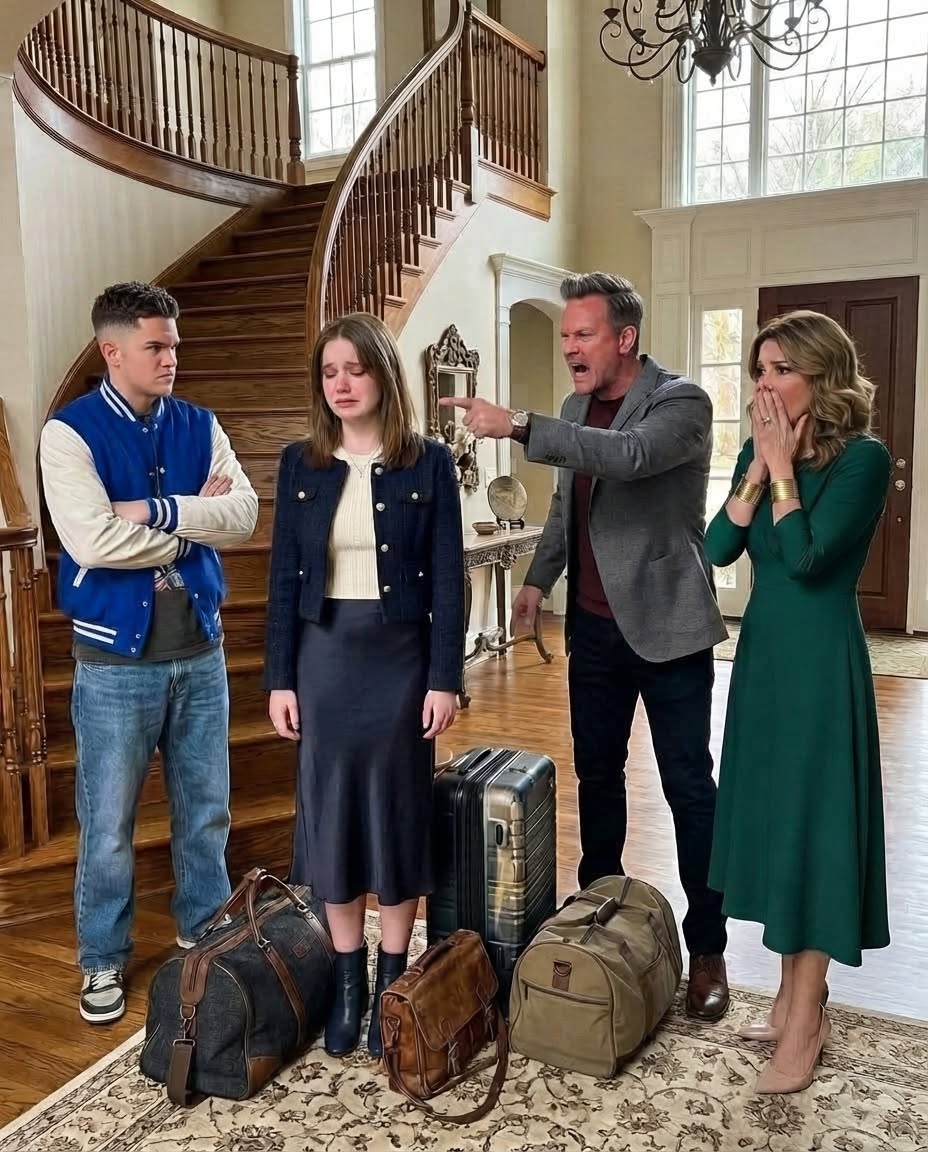
My father pointed toward the stairs. “Pack. I’m not debating this. You wanted independence, Evelyn. Enjoy it.”
I went upstairs without crying. That surprised me. Maybe some part of me had started grieving them the night before.
My room looked untouched, soft, expensive, and suddenly foreign. Framed riding ribbons. Private school photographs. A silver music box from my grandfather. I packed clothes, my documents, my laptop, the music box, and three framed photos: one of me with Grandpa at Lake Geneva, one of me alone on graduation day, and one of my grandmother before she became ill.
At 11:42 a.m., I rolled two suitcases down the staircase.
Grant leaned near the front door with his arms crossed.
“You really screwed us,” he said.
I stopped on the landing. “Us?”
He gave me a flat smile. “Don’t act innocent. Dad was going to fix everything.”
“With my money.”
“You weren’t even using it.”
“I was going to college.”
He stepped closer. “You think a trust makes you untouchable?”
Before I could respond, the front door opened.
Nora Whitman stood outside in a navy coat, carrying a leather folder.
Behind her waited a black car.
“Evelyn,” she said, glancing past me at my family. “Your grandfather anticipated this possibility. I’m here to take you to your new apartment.”
My mother went pale.
My father opened his mouth, but nothing came out.
Nora looked at him calmly. “Also, Richard, I would advise you not to interfere. The trust owns the lease, the vehicle, and the legal retainer. Any attempt to coerce Evelyn financially or physically will be documented.”
For the first time in my life, my father had no space to perform.
I picked up my suitcases and walked past them.
No one hugged me goodbye.
No one apologized.
But as Nora opened the car door, I heard my mother whisper behind me, “Robert knew.”
And Nora said, just loudly enough for them to hear, “Robert knew everything.”