
Part 1
The courtroom was colder than it should have been.
Not just the air, though that had its own bite, sliding under my thrift-store blazer and settling between my shoulder blades. It was the wood, polished so hard it looked wet. It was the gray walls, the silver clock, the way every cough sounded guilty. Even the flags in the corner seemed stiff with judgment.
My son, Crew, sat beside me on the bench with his little legs hanging above the floor. He was seven, thin as a pencil, with careful hands and eyes too observant for a child. I had combed his hair that morning in the bathroom light while the heater clicked and groaned. I had tucked his gray T-shirt into his jeans. I had wiped a scuff off his left sneaker with a wet paper towel until the white rubber looked decent again.
He looked like a boy whose mother tried.
That was all I had brought with me.
I did not have a lawyer. I did not have a folder full of expensive arguments. I had pay stubs, school notes, pediatric appointment cards, and the truth. The truth had kept me standing through double shifts, skipped lunches, and nights when I fell asleep sitting upright with laundry still warm in my lap.
Across the aisle, Logan sat with his attorney.
My ex-husband looked clean in the way money looks clean. Navy suit, polished shoes, fresh haircut, silver watch. He did not look at me. That was one of his talents. He could sit ten feet from the woman who had once packed his lunches and held his hand through his father’s funeral, and look through her like she was fog.
His lawyer, Mr. Brackley, stood with a stack of folders and a face that looked carved for disappointment.
“Your Honor,” he said, “this case is not about sentiment. It is about stability.”
I felt Crew’s knee bump mine. I placed my hand over it, lightly, so he would know I was still there.
Judge Elwood watched from the bench. He was an older man with silver-rimmed glasses and a mouth that did not give away much. He had listened all morning while Logan’s side painted me as exhausted, scattered, barely fit. Not cruel. They were careful about that. Cruel would have been too obvious. Instead they used words like overwhelmed, financially fragile, inconsistent.
Advertisements
Words that sounded reasonable until you knew the life behind them.
Mr. Brackley lifted a photograph. “This is the child last Tuesday.”
I knew the picture before he turned it toward the judge.
Crew in his gray T-shirt. The one with the tiny space rocket on the sleeve. The one I had bought after working an extra overnight shift stocking shelves at Millard’s Market.
“The shirt is visibly worn,” Brackley said. “Small stain near the hem. Collar stretched. Your Honor, this is not an isolated issue. It reflects a larger pattern.”
My face heated.
Crew looked down at his shirt.
I wanted to stand. I wanted to tell the court that stain was from blueberry jam because Crew liked to make his own toast on Sundays. I wanted to tell them the collar was stretched because he pulled it over his nose when he was nervous. I wanted to say I had bought that shirt new, with money I had counted in quarters at my kitchen table.
But my voice stayed trapped.
Then Judge Elwood gave one small nod.
Not a ruling. Not even agreement, maybe. But it landed inside me like a door locking.
Mr. Brackley turned slightly, his confidence growing. “If a parent cannot consistently provide clean, properly fitted clothing, how can she provide the emotional and developmental structure this child requires?”
That was when Crew stopped swinging his feet.
At first, I thought he was scared.
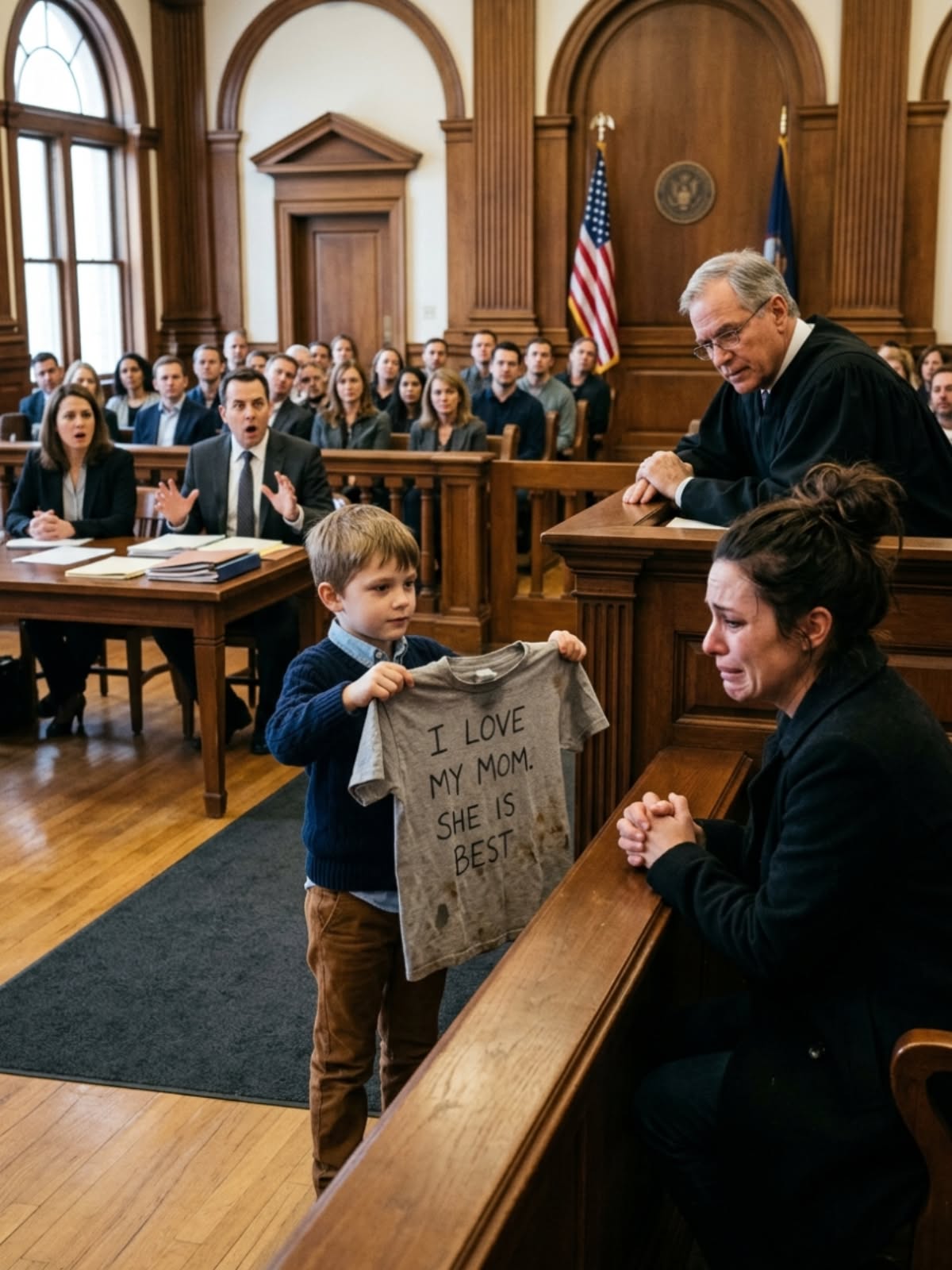
Then he stood up.
No one asked him to. No one expected him to. His small shoes touched the courtroom floor with two soft taps, and every adult in the room turned toward him.
Crew held the front of his gray shirt in both hands.
His voice was quiet, but it carried.
“This is the shirt he’s talking about.”
And suddenly, I realized my son knew something I didn’t.
Part 2
Before that morning, I had believed humiliation had a limit.
I thought there was only so much a person could take before the body stopped receiving it. But sitting there while a stranger used my child’s clothes as evidence against me, I learned humiliation had layers. It could peel you open slowly. It could make you remember every cashier who looked impatient while you counted change, every school form you signed late, every bill you paid after the red notice came.
Two years earlier, when Logan left, he took the good mattress and the coffee machine.
That sounds ridiculous now, but at the time, those were the things that made his leaving real. Not the divorce papers. Not his empty side of the closet. The mattress gone from our bedroom floor and the missing coffee machine from the kitchen counter. He left me with Crew’s race car bed, a cracked lamp, three towels, and a rent payment due in eleven days.
He said we would “work out support like adults.”
Then he stopped answering texts.
My mother, Nola, moved in the second week after he left. She showed up with two suitcases, a slow cooker, and the look she wore when she had already decided something. She didn’t ask whether I wanted help. She just put coffee on and started sorting laundry into piles on the living room floor.
“Cry after dinner,” she told me. “The boy needs to eat first.”
That was my mother. Tenderness wrapped in instructions.
Our apartment was on the second floor above a nail salon and a tax office. The hallway smelled like acrylic powder, fried onions, and old carpet. The kitchen window faced a brick wall. In winter, the bathroom tiles got so cold Crew would hop from towel to towel like the floor was lava.
It was not beautiful.
But it was ours.
I worked mornings at a diner, afternoons at a gas station, and grocery deliveries whenever my car decided to cooperate. My hands smelled like sanitizer and fryer oil no matter how many times I washed them. Some nights, I came home so tired I could hear my own pulse in my ears.
Crew never complained.
He noticed things, though.
He noticed when I ate toast for dinner and told him I wasn’t hungry. He noticed when I smiled too quickly after opening mail. He noticed when I limped from the parking lot because my shoes had no support left.
Once, at the grocery store, I dropped a can of green beans. It rolled under a display of cereal boxes, and a teenage boy laughed behind me. My face burned. Before I could bend down, Crew crawled halfway under the shelf, retrieved the can, and placed it in my hand.
“It’s okay, Mom,” he said. “Sometimes hands need help.”
That was the kind of child Logan wanted the court to believe was suffering under my care.
Not long after Logan filed for full custody, little things began happening.
A school pickup volunteer I didn’t know asked Crew if he was “excited about his new room at Dad’s.” A woman from a private counseling office called my phone and said Logan had listed himself as Crew’s primary guardian. My landlord mentioned a man in a suit had asked whether I was behind on rent.
Then came the photographs.
Someone had taken pictures of our apartment from the doorway during one of Logan’s short visits. The couch with my folded blanket on it. Crew’s lunchbox drying by the sink. A basket of clean laundry waiting to be folded. Nothing shameful, not really. But frozen in the wrong angle, under the wrong eyes, even a home could be made to look like failure.
The night before court, Crew watched me iron my only blazer with a towel over the kitchen table because we did not own an ironing board.
He was quiet for a long time.
Then he said, “Are they going to ask me questions?”
“I don’t think so, baby.”
“What if they say something wrong?”
I smiled, but my hands shook on the iron. “Then grown-ups will handle it.”
He looked down at his gray rocket shirt laid over the back of a chair. His fingers touched the sleeve.
“What if grown-ups don’t understand?”
I had no answer ready for that.
So I kissed his forehead and told him to get some sleep.
I thought he did.
But later, when I woke at 2:13 a.m. to the sound of the bathroom door closing softly, I saw a thin line of light under his bedroom door.
I almost went in.
Then I heard a drawer shut, and silence followed.
By morning, he had that shirt on.
And now, standing in front of the judge, he looked like a child who had been waiting for his turn all along.