
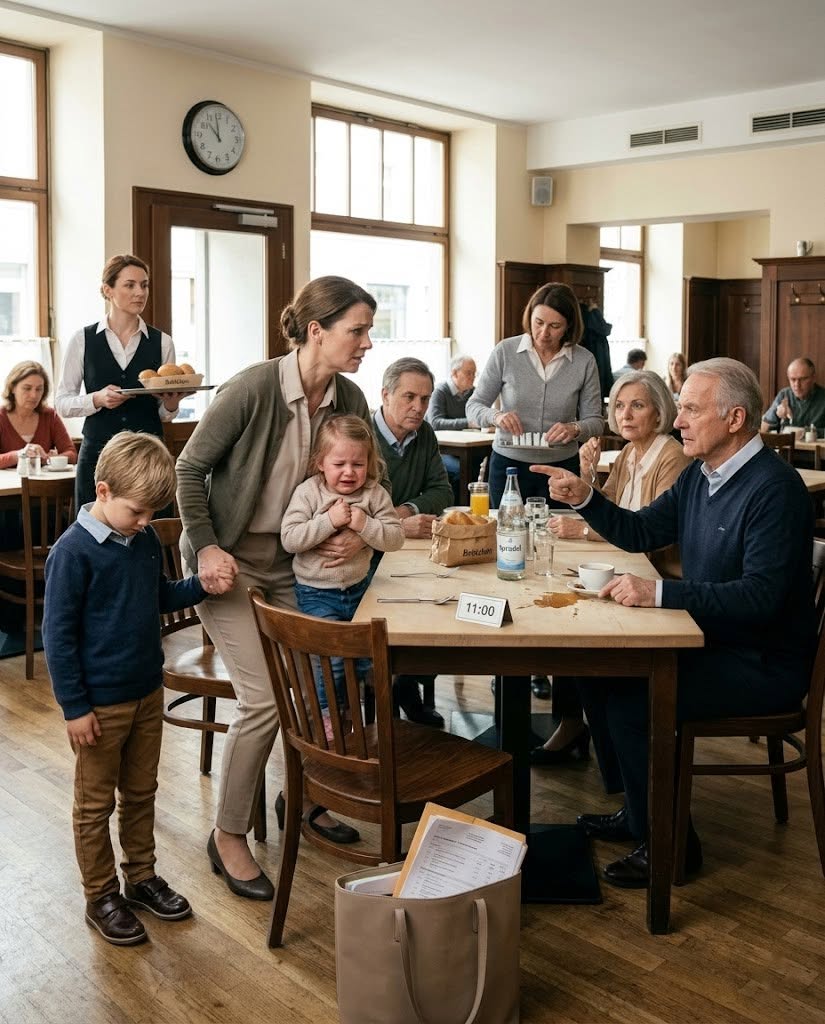
At 11:00 a.m., my father turned a 312-euro family brunch into a public rejection of my children, saying, “The Sunday was perfect—until now.”
By sunset, I closed a door so quietly that no one understood what had just come to an end.
I did not arrive late.
I did not arrive uninvited.
I did not arrive with a quarrel behind me or an accusation on my lips.
I arrived with two children—neatly combed, tidily dressed, and excited about a family brunch scheduled to start at 11:00 a.m.
My mother Elvira had written three days earlier: “Sunday, 11 a.m. Everyone is coming.”
Everyone.
I had read those words, taken them to heart, and accepted them as true.
I had laid out the clothes the night before, ironed Mateo’s blue shirt, found Lucia’s bow, and made sure in the morning that we didn’t leave at the last minute.
In my family, punctuality had never been just about being on time.
It was respect.
It was proof.
It was a small test—one you were better off passing if you didn’t want to be labeled as difficult.
So there we stood in front of the restaurant at 10:52 a.m.
Mateo held my hand and asked if his hair was still in place.
Lucia pressed her little finger against the windowpane and said she could see Grandma.
Beyond the windows, the water along the harbor promenade glistened, and sunlight bounced from polished glasses onto white plates.
Inside, the air smelled of butter, orange peel, lemon cleaner, and hot coffee.
There were bread rolls in a basket, sparkling water on the table, small packets of sugar beside every cup, and a reservation card with the time—neatly displayed like a silent witness.
I saw my mother first.
Elvira sat with her back straight, hands in her lap, her face already wearing that quiet tension that meant Rogelio was in a bad mood.
My father sat at the head of the table.
Rogelio didn’t look up as I approached.
He only raised his eyes when Mateo stopped beside me.
Then he set down his coffee cup.
Not loudly.
Not in a way that anyone could later accuse him of making a scene.
Just firmly enough for the saucer to make a sharp, dry sound.
He looked past me at my children.
“Sunday was perfect—until now,” he said.
Mateo’s grip on my hand tightened.
Lucia stood so close to my leg that I could feel her warm cheek through the fabric of my sweater.
For a moment, I hoped for that one miracle I had expected from my family for years.
That someone would laugh and say this wasn’t right.
That my mother would clearly say: Rogelio, not in front of the children.
That Ivan would stand up.
That Karen would frown.
That one of my aunts would at least find the courage to look up.
But none of that happened.
My brother Ivan poured orange juice, even though his glass was already nearly full.
Karen tugged at her handbag, as if the strap had suddenly become the most important problem in the room.
My aunts stared into their menus.
Elvira began sliding sugar packets into a straight line.
Order must be maintained—even when two children are learning what exclusion sounds like.