
Not the romance first, but the alliance — two parents who had remembered, under pressure, that they were on the same team and always had been.
I have since thought that this was Gregory’s final, unintended gift, the one thing he did for us by accident while trying to destroy us: he frightened Christopher and me back into being partners.
He had spent eight months prying us apart because two parents united are hard to rob.
And in the end, it was exactly that — two parents united — that he ran into, and broke against, and could not get past.
Chapter 16 — Say It Louder
Abigail changed, after.
For weeks she checked her closet every night before she could sleep.
She asked, more than once, whether Gregory had a secret key.
She asked whether a stranger could really take her just by saying her mother was in the hospital.
Christopher and I gave her the same answer every time, until it was worn smooth as a stone.
“No one is ever allowed to take you without our word.
And if anything ever scares you, you say so right away — even if a grown-up gets upset, even if you think you might be making a big deal out of nothing.” One night she looked up at me and asked the question that went through me like a wire.
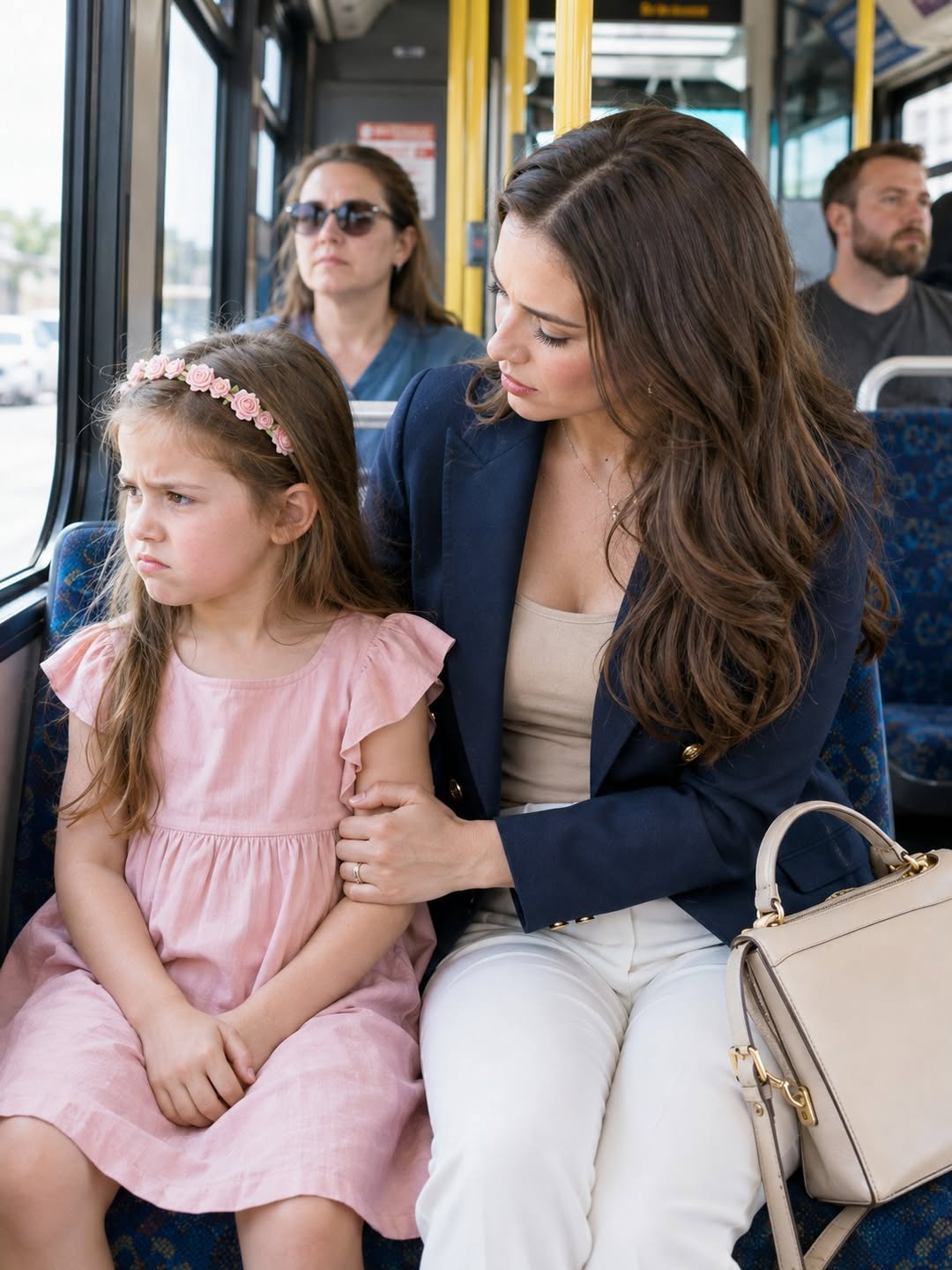
“What if I say it and nobody believes me?” And I thought of a crowded bus, and angry strangers, and how close I had come to pulling her down those steps.
“Then you say it again, louder,” I told her.
“And you keep saying it, louder and louder, until you find someone who listens.
And I promise you that I will always be someone who listens.” Months later the case went to trial, and the mountain of it spoke for itself: the recorded threats, the one-dollar transfer with its written extortion, the forged note, the rental receipt, Stephanie’s texts, Colette’s testimony, Raymond’s confession, Renata’s phone.
And Abigail’s deposition, taken with a child psychologist so she never had to sit in that room — her small clear voice coming through the speaker: First he needs the mother’s signature, and then the kid can be taken later. I closed my eyes and wept, because those words no longer sounded like a frightened child.
They sounded like the sentence that had stopped a monster.
Gregory got a long sentence as the mastermind; Stephanie and Renata went away for the extortion and the attempt on my daughter; Raymond cooperated and was held to account for the fraud.
As they led Gregory out, he turned to me.
“Alison — you know I’d never have let anyone hurt her.” “You turned an eight-year-old into a bargaining chip to force my signature,” I said, and my voice did not shake.
“You didn’t need your own hands for it to be unforgivable.” “I loved you!” he called, at the door.
“No,” I said.
“You needed me to trust you.
They are not the same thing.” And I turned my back and walked out.
A year later — after a great deal of therapy, and a great many honest, difficult conversations — Christopher moved back in, not by pretending the past had not happened but by building something new on top of it.
Abigail set the only rule for the wedding that mattered: a giant chocolate cake, and both of us arriving on time for once.
That is exactly what we did, in my mother’s backyard, our daughter guarding the rings in a wooden box like state secrets.
And that night, home again, she ran to her room and threw open the closet and looked inside and walked back out and announced, to the whole apartment, “All clear!” I have thought since about what I used to believe being a good mother meant — having every answer, keeping control, never being fooled.
I know better now.
Sometimes it means only this: that in the noise of a crowded bus, with strangers glaring and your own face burning, you make the brave and simple choice to believe your child.
She found the courage, at eight years old, to say she was afraid to go home.
And for once, I did not talk her out of it.
That single decision saved our home, and our safety, and taught my daughter the truest thing I know — that her fear has a voice worth listening to, and that in a real family, no one ever has to suffer in silence just to keep the peace.
I think, in the end, that is the whole of what I learned, and I would give it to every parent if I could.
We spend so much of our energy trying to protect our children from the world — the locks, the rules, the warnings, all of it necessary, none of it enough.
But the deepest protection I can give my daughter is not a lock.
It is the certainty, built into her before she can even reason about it, that when she says something is wrong, she will be believed — that her mother will not smile at the strangers and pull her down the steps, will not tell her she is exaggerating, will not rank the comfort of the adults in the room above the fear in her child’s chest.
Because the predators of this world do not, in the end, rely on locked doors failing.
They rely on children not being believed.
They count on the little girl being told she is making a big deal out of nothing, on her learning to swallow the frightening true thing to keep the peace, on the long training that turns a brave eight-year-old into a quiet, doubting, silent victim.
Gregory’s whole scheme, in the end, ran aground on the one thing he could not corrupt or forge or buy: a child who spoke, and a mother who, for once, listened.
That is the lock that actually holds.
Not the one on the door.
The one that opens — the open channel between a frightened child and a parent who will always, always believe her first and ask questions second.
I keep that channel open now like my life depends on it, because once, it turned out, all our lives did.
THE END.