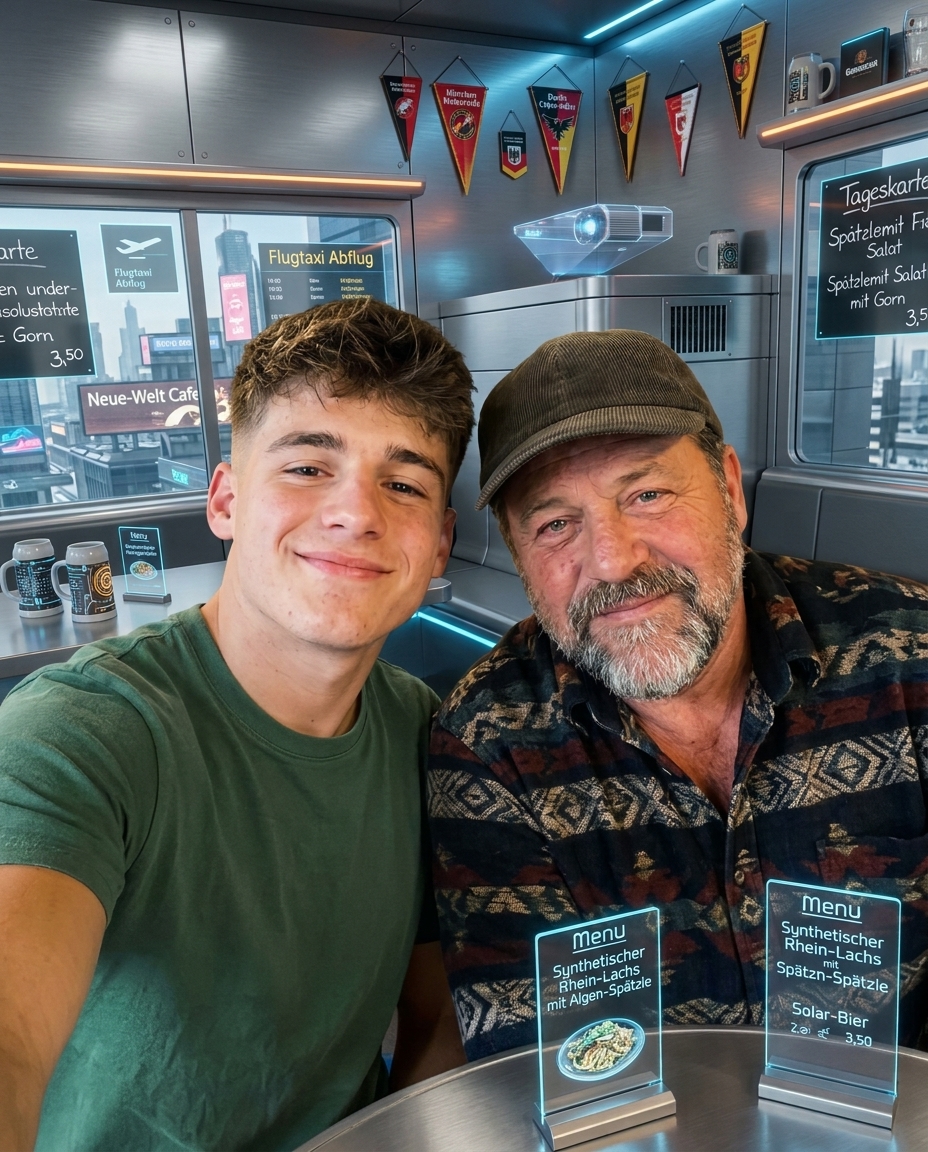
For the first time in years, I saw my father laughing.
Not the brief, tired smile I remembered from childhood, but a real, carefree laugh that seemed to come from somewhere deep inside him.
I kept watching.
The video showed the band playing in small clubs, loading equipment into battered vans, and celebrating after their first sold-out show.
Then the footage changed.
Papa sat alone in what looked like a hospital waiting room. He was older now, his hair shorter, his face drawn and exhausted.
Franz sat beside him.
“I don’t know how to tell him,” Papa said quietly.
“Tell your son the truth,” Franz replied.
Papa shook his head.
“He’ll think I’m trying to buy his forgiveness.”
“You’re not buying anything. You’re giving him something you should have given him years ago.”
Papa stared at the floor for a long time.
“I promised his mother I’d make sure he had a future. I thought if I taught him to work hard, to save money, to stand on his own two feet, I’d be doing the right thing.”
Franz leaned forward.
“And what about his dream?”
Papa’s eyes filled with tears.
“I saw what happened to me. The touring, the debts, the nights when we couldn’t afford to eat. When his mother died, I couldn’t bear the thought of losing him to that same life.”
He wiped his face with his sleeve.
“So I pushed him away from the one thing that might have made him happy.”
I covered my mouth.
My father had spent years telling me that music was a waste of time.
But he hadn’t stopped believing in music.
He had been afraid.
Afraid that I would suffer as he had suffered. Afraid that I would make the same mistakes. Afraid that I would lose everything.
And instead of telling me the truth, he had made me feel as though my dream was worthless.
The video continued.
Papa looked directly into the camera.
“If you’re watching this, son, then I’m not there to explain myself. I know I haven’t been the father you needed. I know the rent was cruel, and I know I made you feel like you had to earn your place in your own home.”
He paused, struggling to speak.
“Every month, when you put that money on the kitchen table, I wanted to tell you to keep it. I wanted to tell you that you didn’t owe me anything.”
He looked down at his hands.
“But I didn’t know how to be your father after your mother died. I thought being strict would protect you. I thought if I made you strong enough, the world couldn’t hurt you.”
He took a shaky breath.
“I was wrong.”
Tears blurred the screen.
“I kept every payment you made, son. Every single one. I put the money into an account for you. I added to it whenever I could, and Franz helped me buy this building and turn it into a studio.”
He smiled faintly.
“The equipment is yours. The studio is yours. And the money is yours, too. You can use it to study music, make an album, or do whatever you want with your life.”
He leaned closer to the camera.
“You don’t have to become the musician I was. You don’t have to prove anything to me. I just want you to have the chance to become whoever you were meant to be.”
His voice broke.
“And there’s one more thing. Your mother always said you had music in your soul. She believed in you before you even knew how to play a note.”
He looked away for a moment, fighting back tears.
“I should have told you that every day.”
The screen went black.
I sat in the studio for a long time, holding my father’s old guitar against my chest.
For five years, I had hated him for charging me rent when I could barely afford to live.
I had hated him for dismissing my dreams, for making our house feel like a place where I was merely tolerated.
And now I was discovering that behind his silence had been a man who loved me deeply but had never learned how to show it.
That didn’t erase the hurt.
It didn’t make the lonely birthdays, the arguments, or the years of feeling unwanted suddenly disappear.
But it finally helped me understand him.
The next morning, I called Franz.
“Why didn’t he just tell me?” I asked.
Franz sighed.
“Because your father was very good at fixing things with his hands, but terrible at fixing things with words.”
I laughed through my tears.
“That sounds like him.”
“He loved you more than anything,” Franz said. “He just got so frightened of losing you that he forgot to let you live.”
I looked around the studio.
“Did he really save every euro?”
“Every one,” Franz replied. “He kept a record of every payment. He said that one day you’d understand.”
I wasn’t sure I ever would.
But I knew what I wanted to do next.
Over the following months, I enrolled in a music production course and began restoring the studio. I repaired cables, learned the mixing desk, and spent long nights recording songs I had been too afraid to finish.
I put Mama’s photograph on the wall above the mixing console.
Beside it, I placed a picture of Papa with his guitar, laughing under the stage lights.
The first song I recorded there was one I had written when I was sixteen.
I called it “The Room I Paid For.”
It was about a boy who believed he had to earn his father’s love, and a father who had so much love to give but no idea how to express it.
When I finished the recording, I sat in the quiet studio and listened to it one more time.
For the first time since Mama died, the silence didn’t feel empty.
It felt peaceful.
A year later, I released my first independent album. It didn’t make me famous, and it didn’t make me rich.
But people listened.
Some wrote to tell me that the songs reminded them of their own fathers. Others said the music helped them find the courage to speak to someone they had been avoiding for years.
I thought about Papa every time I read those messages.
I wished he could have been there to hear the songs.
I wished he could have sat beside me in the studio and told me what he thought.
Most of all, I wished I had known sooner that his silence wasn’t the whole story.
One evening, I found a final envelope tucked inside the guitar case.
My name was written across the front in Papa’s handwriting.
Inside was a short letter.
My son,
If you’ve made it this far, then you’ve already done something I struggled to do my entire life: you’ve faced the truth.
I can’t give you back the years I spent pushing you away. I can’t undo the things I said or the times I should have listened.
But I hope you understand that you were never a burden to me. Not when you were nine, not when you turned eighteen, and not when you placed that rent money on the table.
You were my son. You always were.
I charged you rent because I thought I was teaching you responsibility. The truth is, I was too afraid to tell you how much I needed you, too.
Your mother used to say that love isn’t measured by what you give someone, but by whether you make them feel safe enough to be themselves.
I wish I’d understood that sooner.
Play your music, son. Make mistakes. Take chances. Live a life that belongs to you.
And when you play, remember that your mother is somewhere in every melody.
I’m proud of you.
Love,
Dad
I folded the letter carefully and placed it beside Mama’s photograph.
Then I picked up my guitar.
I played the song she used to sing while Papa sat on the sofa, and for a moment, I could almost hear her voice again.
I used to believe my father had spent five years taking money from me because he didn’t care about my future.
Now I understood that he had been trying, in his own broken way, to give me one.
He had made mistakes. He had hurt me. And there were things between us that we never got the chance to repair.
But the box he left behind gave me something I had spent years believing I would never have.
Not just a studio, or money, or the chance to make music.
It gave me the truth.
And sometimes, the truth is the most precious inheritance a parent can leave their child.