
“Keep reading.”
For a moment, I couldn’t move.
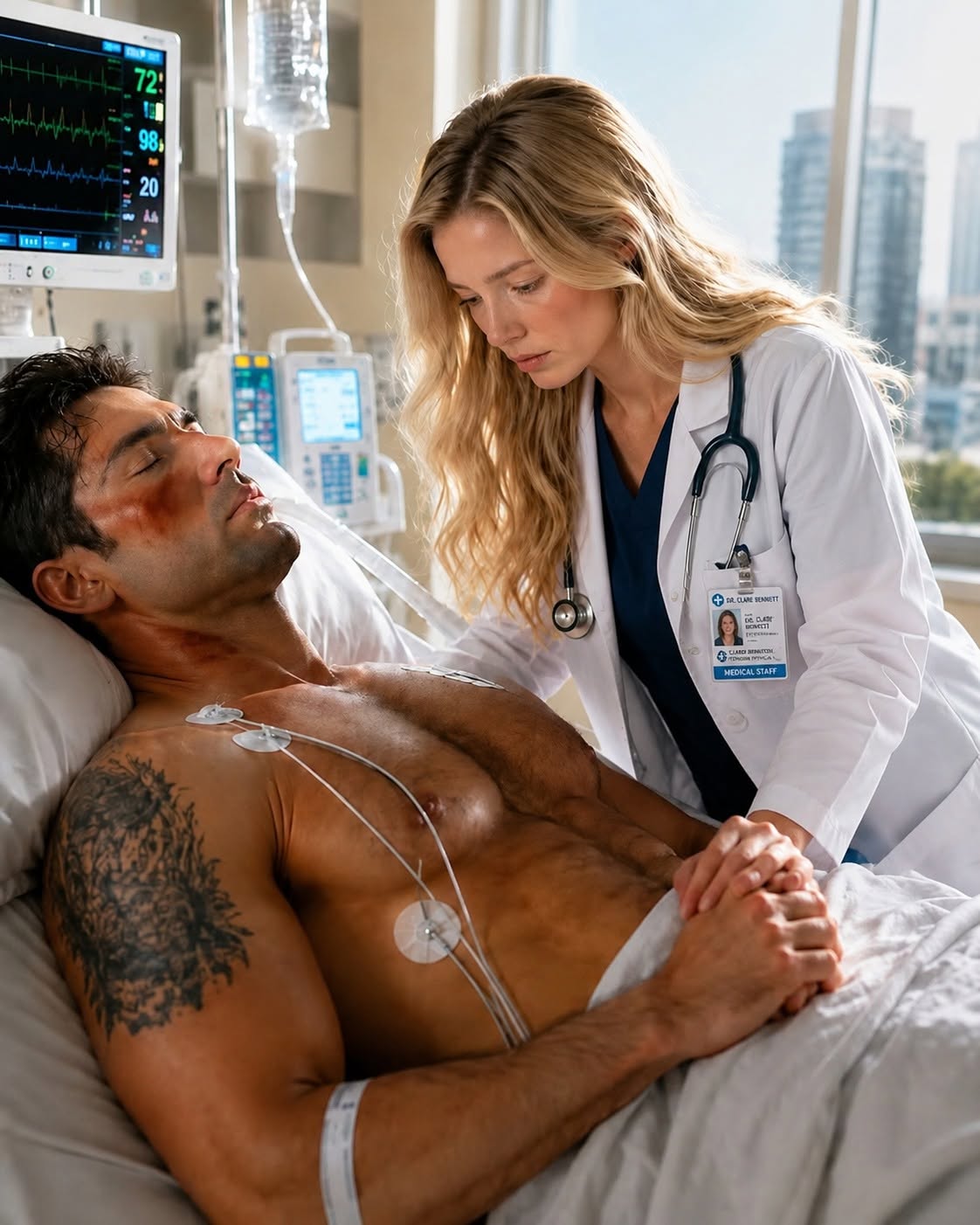
Vincent Romano’s hand was wrapped around my wrist, his fingers cold and impossibly strong for a man who had spent half a year lying motionless beneath hospital sheets. His eyes were open, but not truly seeing. They moved through the dim red emergency light as if he were looking for something in a room that no longer existed.
My pulse thundered so loudly I almost missed the second wordless movement of his mouth.
I leaned closer despite every instinct warning me to step back.
“Mr. Romano?” I whispered. “Vincent, can you hear me?”
His grip tightened.
Not enough to hurt.
Enough to answer.
The heart monitor was still racing, sharp alarms cutting into the storm-heavy silence. In the hallway outside, footsteps shifted. One of the guards must have heard the monitor, because a shadow crossed the narrow strip of glass beside the door.
I pulled gently at my wrist.
“Vincent, I need to check you.”
His eyes moved toward my face.
Really moved.
This time, his gaze focused.
I had seen men wake after surgery confused and frightened. I had seen patients cry because they didn’t recognize their own families. But there was something different in Vincent’s stare. Confusion was there, yes, but underneath it was discipline. He was gathering himself piece by piece, forcing his mind through the fog by sheer will.
His lips parted again.
“Door,” he rasped.
The word was barely sound.
“What?”
His eyes flicked toward the hallway.
“Don’t.”
The door handle turned.
I had no idea why I listened.
Maybe it was the urgency in his face. Maybe it was the strange intimacy of being the first person he had spoken to after six silent months. Or maybe, after all that time alone with him, some part of me had begun to believe I knew the rhythm of that room better than anyone else.
I reached over and silenced the monitor alarm, then quickly adjusted the sensor on his finger as if it had slipped. The numbers were still high, but no longer screaming.
A guard opened the door halfway.
His name was Matteo, though he had never told me that himself. I had learned it from overheard conversations and the embroidered tag inside his suit jacket when he once bent to pick up a dropped phone. He was broad-shouldered, dark-haired, and had the kind of stillness that made him seem more like a locked door than a person.
“Everything all right?” he asked.
My wrist was still trapped beneath the blanket.
Vincent’s hand remained around it.
I stepped slightly to the side, hiding the angle of his arm with my body.
“The storm caused interference,” I said, surprised by how steady my voice sounded. “His pulse spiked for a moment, but it’s settling.”
Matteo’s eyes moved past me.
Vincent’s face had gone slack again. His eyelids were lowered, his mouth still, his expression unreadable.
If I hadn’t felt his fingers pressing into my skin, I would have believed the impossible had already ended.
Matteo watched him for a few seconds too long.
Then he looked back at me.
“You’re sure?”
“I’m sure.”
Another flicker of lightning washed the hallway white behind him. For one second, I saw two other men waiting beyond the door.
Not hospital security.
Vincent’s men.
Matteo nodded once and closed the door.
I stood there, frozen, listening until the footsteps outside faded.
Only then did Vincent open his eyes again.
His grip loosened.
I pulled my wrist free and stared at the red marks his fingers had left behind.
“You’re awake,” I breathed.
He blinked slowly.
It seemed to take him great effort.
“Water.”
I grabbed the small sponge swabs from the bedside tray, dipped one into a cup of water, and touched it carefully to his cracked lips.
“Not too much,” I said, the nurse in me taking over because panic was useless. “You’ve been unconscious a long time. Your throat may not work the way you expect.”
A faint crease appeared between his brows.
It might have been irritation.
It might have been pain.
Either way, it was the most human expression I had ever seen on his face.
“Claire,” he whispered.
The sponge froze against his mouth.
My name sounded different coming from him. Rough, broken, and yet certain.
“You know my name?”
His eyelids lowered again, not fully closing. “You talk.”
A strange heat rose in my chest.
For six months I had spoken into silence. I had complained about my student loans, read him murder mysteries, told him which nurses stole the good coffee, admitted once during a thunderstorm that I was afraid I had chosen the wrong life because caring too much hurt more than I expected.
He had heard all of it.
Every foolish, private thing.
I set the sponge down with shaking fingers.
“You heard me?”
His gaze stayed on mine.
“Some.”
The word was small, but it opened a door inside me I wasn’t ready to look through.
Behind it were all the nights I had thought I was alone. All the little pieces of myself I had left in that room because I believed no one could collect them.
I should have called a doctor immediately.
I should have pressed the emergency button, notified the care team, documented his responsiveness, and let the hospital’s protocol take over.
Instead, I glanced toward the door.
“Why didn’t you want them to know?”
Vincent closed his eyes.
For several seconds, I thought he had slipped away again.
Then he whispered, “Not safe.”
The storm rolled over the building, low and heavy.
I stared at him, my hand hovering near the call button.
“Vincent, you’ve been in a coma for six months. If you’re awake, you need scans, bloodwork, neurological assessment, respiratory evaluation—”
“Claire.”
The sound of my name stopped me again.
He didn’t say it loudly.
He didn’t have the strength.
But there was a command buried inside the weakness, not cruel, not arrogant, just absolute.
I hated that it worked.
“What?”
His eyes opened by a fraction.
“Please.”
That was the word that changed everything.
Not keep reading.
Not door.
Not water.
Please.
I had been warned about Vincent Romano in fragments. A nurse in the break room said he was not a man you denied. A surgeon said powerful people had cried in that hallway during the first week, not from grief, but fear. The hospital administrator said we were being paid for discretion, not curiosity.
No one had ever mentioned that he could sound like a man asking not to be abandoned.
I took a slow breath.
“I can’t hide this forever.”
“No.”
“You understand that?”
A faint nod.
It was barely movement, but it was there.
“I can give you a little time,” I said carefully. “Not much. And only if your vitals stay stable. But if anything changes, I call the doctor.”
His eyes remained on me.
“Promise?”
I almost laughed. The absurdity of Vincent Romano asking a nurse to promise she would call a doctor nearly broke through my fear.
Instead, I nodded.
“I promise.”
His fingers shifted on the blanket.
“Book.”
I looked down.
The novel had fallen open on the floor beside the bed, its pages bent from the impact. It was an old paperback I had found in the hospital donation cart two weeks earlier, a story about a soldier returning home to discover that home had changed without him.
“You want me to keep reading?”
His mouth barely curved.
It wasn’t a smile.
Not yet.
But it was close enough to make the room feel suddenly less cold.
So I picked up the book, smoothed the damaged page, and sat beside him again.
My voice trembled on the first sentence.
By the third paragraph, it steadied.
Vincent watched the ceiling while I read. He didn’t speak again, but his breathing changed. It grew less shallow, less hurried. Every few minutes, his gaze drifted toward me, as if he needed to confirm I was still there.
Outside the windows, rain struck the glass in silver lines.
Outside the door, men waited for a king they didn’t know had opened his eyes.
And inside Room 412, for one fragile hour, I read to him as if the world beyond those walls had no claim on either of us.
By morning, his fever returned.
It wasn’t high enough to send the room into chaos, but it was enough to force my hand. His pulse became uneven just after six, and his blood pressure dipped lower than I liked. I told myself I had already given him more time than I should have.
When Dr. Elaine Mercer arrived for rounds, I met her outside the room before she went in.
“There’s been a change,” I said.
She was in her fifties, silver-haired, sharp-eyed, and too experienced to react dramatically to anything. Still, when I told her Vincent had opened his eyes and spoken, her face lost color.
“He spoke?”
“Yes.”
“What did he say?”
I hesitated.
There were several answers I could have given.
Keep reading.
Water.
Door.
Not safe.
Please.
“He asked for water,” I said.
Dr. Mercer studied me with the careful patience of someone who knew there was more.
Then she looked toward the two guards at the end of the hall.
“Who else knows?”
“No one.”
The answer seemed to matter.
She opened the door herself, and I followed.
Vincent lay exactly as I had arranged him, eyes closed, face still. If he was awake beneath that quiet mask, he gave no sign.
Dr. Mercer leaned over him.
“Mr. Romano,” she said clearly. “Vincent. Can you open your eyes for me?”
Nothing.
She tried again.
No movement.
She checked his pupils, reflexes, response to pain, then ordered scans and labs with a speed that set the wing into motion. Within twenty minutes, the hallway outside Room 412 was filled with quiet urgency. Nurses appeared. A neurologist was called. Matteo made several phone calls in a low voice, his back turned but his shoulders tense.
Through all of it, Vincent did not wake again.
Not for Dr. Mercer.
Not for the neurologist.
Not for the nurse who replaced me at shift change.
By noon, the official language in his chart was cautious.
Possible emergence from prolonged disorder of consciousness.
Intermittent responsiveness reported by night nurse.
Further observation required.
Reported.
The word followed me all the way home.
I slept badly that day.
Every time I closed my eyes, I felt his hand on my wrist. I heard his voice scraping through the red-lit dark.
Not safe.
When I returned that evening, the entire private wing felt different.
It was still spotless. Still quiet. Still expensive.
But the silence had tightened.
There were new men near the elevators. One stood beside the nurses’ station pretending to read messages on his phone. Another leaned against the wall near the exit stairwell with his hands folded in front of him.
Matteo was outside Vincent’s room.
He looked at me as I approached.
“Nurse Bennett.”
It was the first time he had used my name.
“Matteo.”
A flicker of surprise crossed his face, quickly hidden.
“You were here when he responded.”
“Yes.”
“What did he say?”
I held his gaze.
“That’s a medical matter.”
He stepped slightly into my path. Not threatening. Just present.
“Everything about him is a family matter.”
“I’m not family.”
“No,” he said quietly. “You’re not.”
Something in his tone made the words feel less like dismissal and more like warning.
Before I could answer, Dr. Mercer stepped out of the room.
“Claire,” she said. “Come in.”
Matteo moved aside.
Inside, Vincent’s room looked the same, but it no longer felt like a sickroom. It felt like a place where every object might be listening.
Dr. Mercer closed the door behind us.
“He’s shown no further response,” she said softly. “But the scans show increased cortical activity. It’s possible he’s experiencing periods of awareness that he can’t reliably demonstrate.”
“You think locked-in?”
“Not exactly. His injury pattern doesn’t match classic locked-in syndrome. But after this length of unconsciousness, recovery can come in fragments. Sound, emotion, familiar voices—sometimes those reach patients before anything else does.”
Familiar voices.
I looked at Vincent.
His face was still.
Dr. Mercer followed my gaze.
“You’ve been reading to him?”
“Yes.”
“How often?”
“Most nights.”
Her expression softened in a way I didn’t expect.
“Keep doing it.”
I turned back to her.
“That’s your medical instruction?”
“It’s my human one.” She lowered her voice further. “And Claire? Be careful.”
The words moved through me like cold water.
“Because of him?”
Dr. Mercer looked toward the closed door.
“Because of everyone waiting for him to wake up.”
That night, I read poetry.
I don’t know why. Maybe because the novels suddenly felt too full of plots and betrayals, and there were already enough of those pressing against the room. Poetry seemed safer. Smaller. Something that belonged to breath and silence.
At one in the morning, Vincent opened his eyes.
I stopped mid-line.
His gaze found me faster this time.
“Don’t stop,” he whispered.
My throat tightened.
“You enjoy being dramatic, don’t you?”
His eyelids lowered halfway.
“Apparently.”
It was the longest word he had managed yet.
Relief hit me so suddenly I laughed under my breath. It was a terrible laugh, half panic and half exhaustion.
“You scared me.”
His eyes stayed on my face.
“Sorry.”
I looked away before he could see too much.
“You should be. I’m fairly sure I lost five years off my life.”
“Bill me.”
A real smile touched his mouth this time.
Small.
Faint.
Gone almost immediately.
But real.
I sat back down, suddenly aware of the distance between us. Or rather, the lack of it. For months, I had leaned close to adjust his pillow, bathe his skin, change his dressings, speak into the silence around him. Now every familiar motion carried new meaning.
“You didn’t respond to Dr. Mercer today,” I said.
His jaw tightened.
“Couldn’t.”
“Or wouldn’t?”
He was quiet long enough that I thought he might refuse to answer.
Then he whispered, “Both.”
I set the book down on my lap.
“You need to tell me what’s going on.”
His eyes shifted to the door.
I followed his glance.
“They’re outside,” I said. “Same as always.”
“No.”
The word was faint but firm.
“No?”
“Not same.”
I waited.
Speaking cost him. I could see it in the fine tremor at his throat, the way his breathing changed after each word. Whatever else Vincent Romano had been, whatever he had done before he ended up in that bed, he was helpless now in a way that stripped power down to its bones.
And still, he was trying to protect himself.
“Who are you afraid of?” I asked.
He closed his eyes.
For a moment, I thought I had pushed too hard.
Then he said, “Brother.”
I went still.
“Your brother?”
His eyelids opened again.
“Marco.”
I knew the name. Everyone in the wing did. Marco Romano had visited every Sunday at exactly four in the afternoon, always dressed like he had walked out of a magazine spread. He brought fresh flowers once a week, spoke kindly to the staff, asked thoughtful questions, and placed a hand on Vincent’s shoulder before leaving.
I had thought grief made him polished and careful.
Now I wondered if grief had nothing to do with it.
“Marco visits you,” I said. “He seems concerned.”
Vincent’s gaze sharpened.
Even weak, half-starved by months of stillness, his expression turned almost amused.
“Marco seems many things.”
The room felt suddenly smaller.
“Are you saying he was involved in the ambush?”
Vincent didn’t answer.
He didn’t have to.
A soft knock came at the door.
I jumped.
Vincent’s eyes closed instantly.
Dr. Mercer entered a second later, carrying a tablet. She looked from me to Vincent and back again.
“He was awake,” she said.
It was not a question.
I nodded.
She approached the bed slowly.
“Vincent,” she said. “It’s Dr. Mercer. Can you hear me?”
For several seconds, nothing happened.
Then his eyes opened.
Dr. Mercer exhaled quietly.
“Well,” she whispered. “Hello.”
Vincent looked at her with weary suspicion.
“You’re safe with me,” she said.
His gaze moved to me.
I nodded once.
Only then did he look back at the doctor.
Over the next fifteen minutes, Dr. Mercer performed the gentlest neurological exam I had ever witnessed. She asked him to blink once for yes, twice for no when speech became too tiring. She checked his grip strength, eye tracking, memory, pain level.
He knew his name.
He knew he was in Chicago.
He knew the year after thinking for a long moment.
But when she asked him who the president was, he looked so deeply annoyed that I had to hide a smile behind my hand.
Dr. Mercer noticed and pretended not to.
“Do you remember what happened to you?” she asked.
Vincent’s eyes went dark.
One blink.
Yes.
“Do you feel safe with the men outside this room?”
He stared at her.
No blink.
No movement.
The silence stretched.
Dr. Mercer lowered the tablet.
“That’s answer enough.”
Vincent looked exhausted by then. His skin had gone gray around the mouth, and sweat shone at his temples.
“You need rest,” I said.
His gaze returned to me.
“Story.”
“Vincent—”
“Please.”
Dr. Mercer’s face changed at that.
Not shock, exactly.
Recognition.
As if she understood something I was only beginning to feel.
“I’ll update the chart carefully,” she said. “Only essential language. No details about specific conversations.” She looked at me. “And no visitors without my approval until we assess his condition further.”
“You can do that?”
“For twenty-four hours, yes. After that, the hospital board may develop a sudden interest in policy.”
Meaning Marco Romano might develop a sudden interest in the hospital board.
After she left, I dimmed the lights again.
Vincent’s breathing had already begun to slow. Still, his eyes stayed open, fixed on me with stubborn intent.
“You need sleep,” I told him.
“Read.”
“You’re impossible.”
“So I’ve heard.”
I picked up the book.
This time, I read until he fell asleep.
Not unconscious.
Asleep.
There was a difference, and somehow that difference filled my chest with something dangerous and warm.
Over the next week, Vincent woke in pieces.
A few minutes at first. Then an hour. Then nearly an entire evening with short rests between conversations. His voice strengthened from a rasp to a low, rough murmur. Physical therapy began in secret under the excuse of passive mobility sessions. Dr. Mercer brought in only two specialists she trusted, both older, both discreet, both unimpressed by the men outside the door.
Vincent hated being weak.
He never said it directly, but I saw it in every controlled breath when his hand failed to close around a foam therapy ball. I saw it in the muscle that ticked in his jaw when he couldn’t lift his arm more than two inches. I saw it most clearly when he looked away from me before accepting help.
“You know,” I said one night while adjusting the pillows behind his shoulders, “most patients get frustrated during recovery.”
He stared at the wall.
“I’m not frustrated.”
“No?”
“I’m considering a strategic disagreement with my body.”
I laughed before I could stop myself.
His eyes cut to mine.
“What?”
“That might be the most Vincent Romano way to describe physical therapy.”
His expression changed slightly.
“You say my name differently now.”
I busied myself with his blanket.
“How did I say it before?”
“Like I couldn’t hear you.”
My hands stilled.
He regretted the words immediately. I saw it in his face, in the way his gaze dropped.
“I didn’t mean—”
“No,” I said softly. “It’s true.”
For a moment, only the monitor spoke.
Then I sat in the chair beside his bed.
“What else did you hear?”
His eyes remained lowered.
“Enough.”
“That’s not an answer.”
“It’s the safest one.”
I studied him.
The scar near his temple had faded from angry red to a pale line, but it still changed his face somehow. It made him look less untouchable. Less like the whispered legend that had followed me into Room 412 on my first night.
“What do you remember?” I asked.
His fingers moved against the sheet.
“Dark,” he said. “Pain sometimes. Voices. Yours more than others.”
I swallowed.
He continued, slowly.
“At first, I thought I was dreaming you. You read a poem about winter. Then a story about a lighthouse. You told me your grandmother smelled like lavender and burned toast.”
My eyes stung unexpectedly.
“I can’t believe you remember that.”
“I held onto what I could.”
The words were quiet.
They landed heavily.
I looked down at my hands.
“My grandmother raised me,” I said, though he already knew pieces of it. “After my mom left. She used to read to me when I couldn’t sleep. I think that’s why I started reading to you.”
Vincent watched me.
“You said she died in April.”
I nodded.
It had happened two months into my assignment. I had come to work because I needed the money and because grief felt worse in an empty apartment. That night, I had read him the same poem my grandmother loved. I thought no one heard me cry afterward.
“You heard that too?”
“Yes.”
Embarrassment rose fast, followed by something more vulnerable.
“I’m sorry.”
His brow furrowed.
“For what?”
“For crying on a patient.”
“You weren’t crying on me.”
“I was sitting beside you.”
“Then I was honored.”
I looked up.
He seemed almost as surprised by the words as I was.
Neither of us spoke for a while.
Outside, the hallway remained guarded. Inside, the machines hummed and breathed. The city beyond the windows glowed in distant gold and white, indifferent to the quiet shift happening between a nurse and a man who should have been unreachable.
The next afternoon, Marco Romano arrived early.
I was at the nurses’ station reviewing medication records when the elevator doors opened. He stepped out wearing a navy suit and a camel-colored coat, carrying a small white box tied with string. He looked handsome, composed, and concerned in the effortless way certain men learned to wear expressions like cufflinks.
Matteo straightened when he saw him.
Something passed between them.
Not a greeting.
Not warmth.
Recognition edged with tension.
“Matteo,” Marco said.
“Mr. Romano.”
“I’m here to see my brother.”
“Dr. Mercer restricted visitors.”
Marco’s smile didn’t move.
“I’m his next of kin.”
“Still restricted.”
The air changed.
I stood behind the desk, suddenly aware of how alone the private wing felt despite all the people in it.
Marco’s gaze drifted to me.
“Nurse Bennett,” he said warmly. “Perhaps you can help clear up this confusion.”
I had spoken to him only a handful of times before. He had always been polite. He remembered my name, thanked me for my care, once sent pastries for the entire staff.
Now, his politeness felt like a hand resting lightly on the back of my neck.
“Dr. Mercer is handling visitation,” I said.
“I see.” He looked toward Vincent’s door. “And how is my brother today?”
“Stable.”
“A beautifully useless word.”
“It’s the accurate one.”
Marco’s eyes sharpened with interest.
Then Dr. Mercer appeared from the stairwell, as if summoned by the strain in the air.
“Mr. Romano,” she said. “I wasn’t expecting you until Sunday.”
“I’m told I need permission now to sit beside my own brother.”
“For today, yes.”
“I assume there’s a medical reason.”
“There is.”
“And I assume you’ll tell me what it is.”
“I’ll tell you that his condition requires limited stimulation.”
Marco’s gaze moved slowly from her face to mine.
“Limited stimulation,” he repeated.
He held up the white box.
“I brought sfogliatelle from the bakery he likes. Obviously not for him in his current state.” His smile returned, softer now. “For the staff. You’ve all been very dedicated.”
No one reached for the box.
After a long second, Marco placed it on the counter.
“Please let me know when the doctor’s restrictions change.”
He turned to leave, then paused beside me.
“I imagine this assignment has been difficult,” he said quietly. “My brother inspires unusual loyalty. Even unconscious.”
I said nothing.
His smile deepened by a fraction.
“Take care of yourself, Nurse Bennett.”
Then he walked back to the elevator.
Only when the doors closed did I realize my hands were cold.
Dr. Mercer took the pastry box and dropped it unopened into the trash.
I stared at her.
“That seems wasteful.”
“I don’t eat gifts from worried relatives who make my staff go pale.”
Matteo, still standing near Vincent’s door, gave the smallest nod of approval.
That night, Vincent was waiting when I entered.
His eyes were open.
“You saw him,” he said.
I set down my bag.
“News travels fast in this wing.”
“Your face.”
I touched my cheek self-consciously.
“What about it?”
“You look like someone handed you a puzzle piece you didn’t want.”
I sat beside him.
“Marco came early. Dr. Mercer wouldn’t let him in.”
Vincent closed his eyes.
A tired breath left him.
“He knows.”
“Knows what?”
“That something changed.”
The room seemed to tilt around that sentence.
“How could he know?”
Vincent opened his eyes again.
“Because Marco doesn’t visit. He inspects.”
I thought of the flowers he brought every week. The careful questions. The hand on Vincent’s shoulder.
“He seemed devoted.”
“He is,” Vincent said. “To outcomes.”
I hated how plausible that sounded.
“What happened the night you were shot?”
His gaze moved to the window.
For a long moment, he was silent.
When he spoke, his voice had lost all trace of humor.
“There was supposed to be a meeting. Private. A man wanted out of a bad agreement. I went because my father made promises before he died, and some debts aren’t written down.”
He paused, gathering strength.
“Marco knew the route. Only Marco.”
The storm from the night he woke felt suddenly present again, though the sky outside was clear.
“You think he gave it to someone?”
“I know he did.”
“Why?”
Vincent’s mouth tightened.
“Because I was leaving.”
The answer surprised me.
“Leaving what?”
He looked at me then.
“All of it.”
I didn’t speak.
The infamous Vincent Romano, feared boss of Chicago, lying in a hospital bed too weak to sit without help, telling me he had been trying to walk away.
“I don’t understand,” I said.
“No one did.”
“From the business?”
“From the part of it that made men whisper in hallways.” His eyes held mine. “My father built something ugly and called it protection. I inherited it before I was old enough to know inheritance can be a cage.”
There was no self-pity in his voice.
Only exhaustion.
“I spent years making it quieter,” he continued. “Moving money into legal companies. Cutting ties. Buying people out instead of burying them in debt. Some men liked the old ways. Marco most of all.”
“But he’s your brother.”
Vincent looked away.
“That never stopped anyone from wanting a crown.”
The words settled between us.
I wanted to know how much was true. I wanted to ask what he had done, what he regretted, what kind of man tries to leave darkness only after learning how to survive inside it.
But his face had gone pale.
“That’s enough for tonight,” I said.
“No.”
“Yes.”
He gave me a look that probably once made grown men reconsider their life choices.
From a hospital bed, it only made him look stubborn and tired.
“You need rest.”
“I need a phone.”
“Absolutely not.”
“Claire.”
“No.”
“You don’t know what’s happening.”
“I know you can barely hold a cup for ten seconds. You are not orchestrating anything from this bed.”
His eyebrows rose slightly.
“Orchestrating?”
“You seem like an orchestrating kind of man.”
For one second, amusement warmed his eyes.
Then it faded.
“If Marco gains control before I can speak to the right people, others get hurt.”
“Then tell the police.”
He stared at me.
Right.
I rubbed my forehead.
“Fine. Not the police.”
“There are documents,” he said. “Proof. Insurance.”
“Where?”
His gaze shifted toward the small wooden cabinet near the window.
My heart skipped.
“In here?”
“Not exactly.”
I stood and walked to it. The cabinet contained extra linens, sealed medical supplies, and a stack of books I had brought over the months. Nothing else.
Vincent watched me.
“The copy of The Odyssey.”
I turned.
It was on the lower shelf. A thick hardcover with a cracked blue spine. I had read from it during my third month with him because I remembered my grandmother saying everyone should hear a journey home at least once.
I pulled it out.
It felt heavier than it should have.
My fingers found a seam inside the back cover.
“What is this?”
“Open it.”
I slipped my nail beneath the loosened paper and peeled back a hidden flap. Inside was a flat black memory card sealed in plastic.
For a few seconds, neither of us spoke.
Then I turned to him.
“How long has this been here?”
“Before.”
“Before the shooting?”
He nodded faintly.
“You put evidence in a hospital room before you were ambushed?”
“I put it somewhere no one would look unless they cared enough to read to a corpse.”
My breath caught.
“You planned this?”
“No.” His eyes softened just slightly. “I hoped.”
Something inside me twisted.
For six months, I had believed I chose the books.
Maybe I had.
Maybe he had.
Maybe both things could be true in a way that made the room feel suddenly full of invisible threads.
“What’s on it?”
“Names. Transfers. Messages. Enough to stop Marco from taking everything.”
“Why not give it to Dr. Mercer?”
“Because I don’t know who she trusts.”
“But you trust me?”
His gaze held mine with uncomfortable steadiness.
“I heard who you are when you thought no one was listening.”
That should not have been enough.
It was too intimate. Too fragile. Too unfair.
“You don’t know everything about me,” I said.
“No.”
“I could be scared.”
“You are.”
“I could walk away.”
His eyes moved over my face, and for the first time, the man beneath the reputation looked painfully uncertain.
“You could.”
The memory card felt tiny in my palm.
Tiny and heavy enough to change lives.
“What do you want me to do with it?”
“There’s a man named Adrian Vale,” Vincent said. “Attorney. Not family. Not hospital. He has a gray office on Wabash and a secretary who hates everyone equally. Give it to him. Only him.”
“This sounds like the part of the movie where the nurse makes a terrible decision.”
“It is.”
“At least you admit it.”
His mouth curved faintly.
Then the effort drained from his face.
I closed my hand around the card.
“I’ll think about it.”
“Claire—”
“I said I’ll think.”
He studied me, then nodded once.
That was the first time Vincent Romano accepted my no.
It mattered more than I wanted it to.
I did not sleep after my shift.
I went home, showered, made coffee, and sat at my kitchen table while morning light turned the walls pale yellow. The memory card lay in front of me beside my unpaid electric bill and a chipped mug that said BEST NURSE EVER, a graduation gift from my grandmother.
Adrian Vale.
I searched his name from an old laptop with a cracked hinge. He existed. Defense attorney. Former federal prosecutor. Small firm. Excellent reputation. No flashy website, no social media presence beyond a business listing and a few terse legal articles.
The address was on Wabash.
I closed the laptop.
Then I opened it again.
I thought about calling Dr. Mercer. I thought about putting the memory card back and pretending I had never found it. I thought about quitting, leaving the city, and applying to every hospital within a hundred miles under the argument that self-preservation was also a form of intelligence.
Instead, at two in the afternoon, I took the train downtown.
Adrian Vale’s office was on the seventh floor of an old building that smelled of dust, paper, and radiator heat. His secretary was a woman in her sixties with steel-gray hair and red glasses. She looked at me over the frames as if I had interrupted a private war.
“Appointment?”
“No.”
“Then no.”
“I’m here for Mr. Vale.”
“Many people are.”
“It’s about Vincent Romano.”
Her expression did not change.
But her hand stopped moving over the keyboard.
“Your name?”
“Claire Bennett.”
She picked up the phone, pressed one button, and said, “A Claire Bennett is here about him.”
Silence.
Then she hung up.
“Down the hall. First door.”
Adrian Vale stood when I entered.
He was tall, lean, and older than I expected, with tired eyes and a careful face. He did not ask me to sit until he closed the door behind me.
“How is he?” he asked.
The question was too immediate to be casual.
“You knew he might wake up?”
“I knew he was stubborn.” He gestured to the chair. “Please.”
I sat, clutching my bag.
“I have something.”
He waited.
I placed the memory card on his desk.
For the first time, Adrian Vale’s composure cracked.
He didn’t touch it right away.
“Where did you find this?”
“In a book.”
His eyes lifted to mine.
“He told you?”
“Yes.”
Adrian sat slowly.
“Then he’s speaking.”
“Sometimes.”
“And does Marco know?”
“I don’t know.”
“That means yes, soon.”
He opened a desk drawer, took out a small metal case, and placed the card inside without inserting it into any device.
“Aren’t you going to look at it?”
“Not here.”
“Why?”
“Because Vincent wouldn’t have sent you to me with something harmless.”
That was not comforting.
I stood.
“I’ve delivered it. I need to go.”
“Miss Bennett.”
I stopped at the door.
Adrian’s voice was quiet.
“You should understand something. Vincent prepared for many possibilities. You were not supposed to be involved.”
I turned back.
“Then why was the card in a book in his hospital room?”
“Because he trusted patterns more than people. He knew the staff would rotate. He knew most would avoid speaking to him. He knew anyone loyal to Marco would search obvious places and ignore anything sentimental.” Adrian paused. “But you changed the pattern.”
I thought of months of reading aloud beside a man who could not answer.
“You make that sound like a mistake.”
“No,” Adrian said. “I make it sound like a risk.”
When I returned to St. Jude’s that evening, the pastry box was gone from the trash.
I noticed because the trash liner had been changed, but the small white string from the bakery box lay on the floor near the nurses’ station, half-hidden beneath the desk.
A tiny detail.
Meaningless, perhaps.
Except that Dr. Mercer had thrown it away unopened.
And someone had taken it out.
I walked to Vincent’s room with my pulse climbing.
Matteo was not outside the door.
In his place stood a younger man I didn’t recognize.
“Where’s Matteo?” I asked.
The man shrugged.
“Reassigned.”
“By whom?”
“Family.”
My mouth went dry.
I pushed open the door.
Vincent was asleep, or pretending to be. The room looked normal. Machines steady. Curtains half-drawn. Books stacked beside the cabinet.
Dr. Mercer was not there.
I checked his chart.
No new orders.
No note about Matteo.
No sign that anything had changed.
Except the air.
The air felt wrong.
I moved to Vincent’s bedside and touched his shoulder lightly.
His eyes opened at once.
“Claire.”
“Matteo’s gone.”
His face hardened.
“How long?”
“I don’t know. Someone new is outside.”
He tried to sit up.
I put a hand against his chest.
“No.”
“Claire—”
“No. You fall, I lose my license and my mind.”
He stopped, breathing hard from the small effort.
I leaned closer and lowered my voice.
“I delivered it.”
His eyes locked onto mine.
“To Adrian?”
“Yes.”
For the first time since he woke, Vincent looked almost relieved.
Almost.
Then he glanced toward the door.
“You need to leave.”
“I just got here.”
“Leave the hospital. Tonight.”
A chill moved through me.
“Why?”
Before he could answer, the door opened.
Marco Romano stepped inside.
He wore no coat this time. His sleeves were rolled neatly to his forearms, and his expression was calm in a way that made every nerve in my body wake up.
The unfamiliar guard stood behind him.
“Good evening,” Marco said.
I straightened.
“Visitation is still restricted.”
“I know.” He looked past me at the bed. “But restrictions have a way of changing when the right people discuss them.”
Vincent’s eyes were closed.
His face slack.
His body still.
Marco approached slowly, stopping at the foot of the bed.
“My brother always did love an audience,” he said softly. “Even when sleeping.”
I said nothing.
Marco looked at me.
“How has he been?”
“Stable.”
“That word again.”
“It remains accurate.”
His gaze lingered on my face.
“You’re very loyal for someone paid by the hour.”
“I’m professional.”
“Of course.”
He walked to the window and looked out at the city.
For a moment, he seemed almost sad.
“You know, when we were boys, Vincent used to read to me. Our mother was ill often. Father was absent often. Vincent filled silence before he learned what silence was worth.”
My eyes flicked toward the bed despite myself.
Vincent did not move.
Marco noticed.
A faint smile touched his mouth.
“He had a good voice then. Gentle. People forget that about him.”
I didn’t know what to say.
Marco turned from the window.
“Did he ever tell you about the night our mother died?”
“No.”
“No, I imagine not.” He smoothed one cuff. “Vincent is selective with tenderness. It makes people feel chosen.”
Something in his tone pricked at me.
Not anger.
Not jealousy.
Old hurt, carefully polished until it shone like something else.
“Mr. Romano, your brother needs rest.”
“My brother needs many things.”
Marco walked to the bedside.
I stepped in front of him before thinking.
His eyes dropped to my shoes, then rose slowly.
The silence that followed was delicate and dangerous.
Finally, he smiled.
“You’ve grown attached.”
“That’s inappropriate.”
“Not untrue.”
The monitor beeped steadily.
I forced myself not to look at Vincent.
Marco leaned slightly closer, his voice lowering.
“Claire, may I call you Claire?”
“No.”
He smiled wider.
“Nurse Bennett, then. My brother has always been very good at turning strangers into soldiers. He makes them believe they are protecting the wounded man, not serving the dangerous one.”
I hated that the words found a place inside me.
“He’s my patient,” I said.
“And patients recover. Men like Vincent return.”
His gaze shifted to the bed.
“Isn’t that right, Vince?”
The nickname fell softly.
Vincent did not react.
Marco watched him for one breath, two, three.
Then he placed a hand on the bedrail.
“I know you’re in there,” he whispered.
My heart stopped.
The monitor betrayed nothing.
Vincent remained still.
Marco waited.
When no answer came, he sighed.
“You always were better at patience than me.”
He moved away from the bed and headed for the door.
At the threshold, he paused.
“Oh,” he said, glancing back. “One more thing. Dr. Mercer has been called into an emergency review with the board. Administrative concerns. Very dull. She may be away from this wing for a while.”
The door closed behind him.
For several seconds, I couldn’t breathe.
Then Vincent’s eyes opened.
“Claire,” he said.
His voice was calm, which frightened me more than panic would have.
“What?”
“Under the mattress.”
I stared at him.
“What now?”
“Left side. Near the rail.”
I slipped my hand carefully beneath the mattress, feeling along the seam until my fingers brushed paper. Not a memory card this time. An envelope.
It was thin, sealed, and old.
My name was written across the front.
CLAIRE BENNETT.
Not Nurse Bennett.
Claire.
The handwriting was strong, dark, and unmistakably Vincent’s.
My fingers went numb.
“You wrote this before the ambush,” I said.
Vincent looked at the envelope as if it pained him.
“Yes.”
I could barely hear myself.
“How did you know my name before I ever walked into this room?”
He closed his eyes.
Not from exhaustion.
From guilt.
The hallway outside filled with voices.
Marco’s voice among them.
Closer now.
Vincent opened his eyes again, and in them I saw the answer before he said a word.
The answer was going to change everything I thought I knew about why I had been hired, why I had stayed, and why a man everyone feared had been listening for my voice long before I ever began to read.