
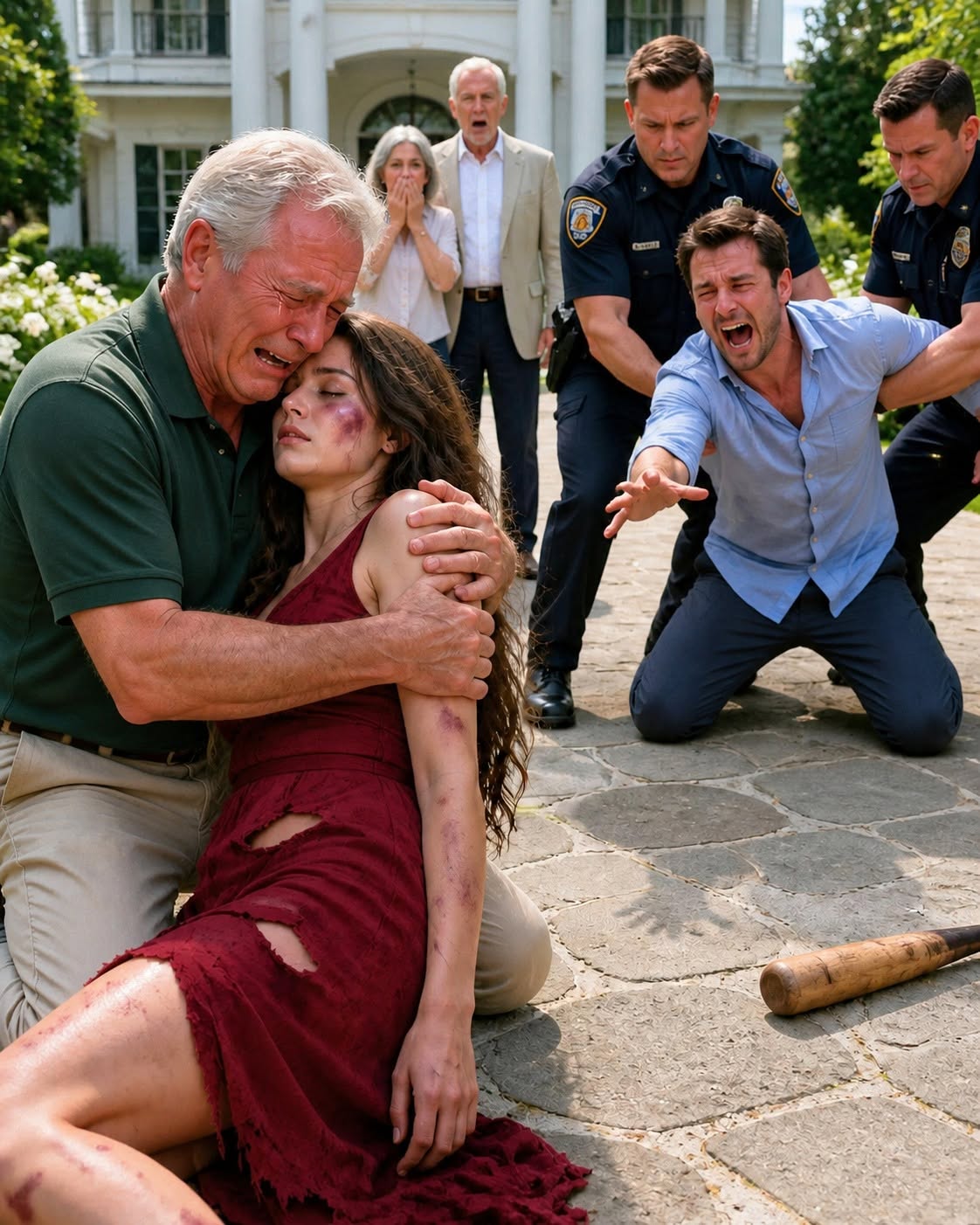
PART 2: The House That Held Its Breath
A muffled scream came from upstairs.
Julian’s smile vanished for half a second.
That was enough.
I looked him directly in the eyes. “You just made the worst mistake of your life.”
Rain drummed against the roofline of the Thorne mansion, sliding in sheets down the white columns and over the wide marble steps. The house behind Julian seemed to hold its breath. Every window was dark except the one upstairs where I had seen Audrey’s hand against the glass.
My daughter was alive.
She was inside.
And every second I stood on that porch felt like an accusation.
Julian shifted the baseball bat from one shoulder to the other. “You don’t get to talk to me like that on my property.”
I kept my phone low by my leg, the recording still running. My thumb moved once across the screen. One tap. The signal.
Silver Street is flooding.
That was all I sent.
Sofia Reyes would understand.
Julian did not.
Arthur Thorne gave a quiet laugh behind his son, the kind of laugh men used when they believed money had already settled the outcome. “You’re emotional, Mr. Vale. Understandable, perhaps. But unhelpful.”
My name sounded wrong in his mouth.
“Let me see Audrey,” I said.
Miriam Thorne stepped closer to the doorway, her silk robe belted with perfect precision. Her face was calm in the way marble was calm. Cold, polished, unmoved by weather.
“Audrey is resting,” she said. “She had a difficult evening.”
“Then she can tell me that herself.”
“She is not in a condition to speak sensibly.”
“Funny,” I said. “She sounded very sensible when she called me.”
Julian’s jaw tightened.
There it was.
The tiniest crack.
He knew about the call. He knew what she had said. He knew how it sounded.
I had spent enough years interviewing people in rooms with bad coffee and humming fluorescent lights to recognize the moment a liar realized the truth had left the building before he could lock the door.
Julian raised the bat an inch. Not swinging. Not yet. Just reminding me he had something in his hands and I did not.
But I had something he could not see.
A recording. A signal. Twenty years of patience forced into my bones by men much worse than him.
And a daughter upstairs who had once held my finger while learning to walk.
“Julian,” I said softly, “put the bat down.”
He smiled again, but it had become thinner. “Or what?”
“Or when the officers arrive, they’ll see you holding it.”
Arthur’s expression changed.
Miriam’s eyes moved to the driveway.
Julian laughed too loudly. “Officers? You called the cops on your own daughter’s family?”
“My daughter called me for help. You blocked the door while holding a weapon and told me she had to be disciplined. I’d say that’s a reasonable situation for law enforcement.”
“You’re trespassing,” Julian snapped.
“Not yet,” I said. “I’m standing outside asking to confirm my daughter’s safety.”
Arthur stepped forward. “This is absurd. I know the commissioner.”
“I know where my daughter is,” I replied. “And that matters more to me.”
For the first time, the older man’s confidence flickered. It was brief, but I saw it. He had expected anger. He had expected shouting, maybe even a shove on the steps—something he could twist into a story by morning.
He had not expected calm.
He had not expected documentation.
He had not expected me.
The rain thickened, turning the driveway into a dark mirror. Beyond the iron gates, faint blue and red lights appeared against the wet road.
Julian saw them too.
His shoulders stiffened.
Arthur swore under his breath.
Miriam’s hand moved to her throat, not in fear, but irritation, as if the weather had ruined a dinner party.
“You did this,” Julian said, stepping toward me.
I did not move.
“Son,” Arthur warned.
Julian ignored him. “You think you can walk in here and embarrass me?”
“I’m not here for you.”
That made him angrier than any insult would have.
The gates opened slowly.
Two patrol cars entered first, followed by an unmarked sedan and an ambulance with its lights muted in the rain. They rolled up the long driveway without sirens, tires hissing over wet stone. Sofia stepped out of the unmarked sedan wearing a dark raincoat over her suit, silver hair pulled back, expression alert and steady.
I had not seen her in almost a year.
She had once told a governor to stop talking until his attorney arrived. She had stared down judges, union bosses, corporate boards, and grieving mothers with the same careful respect. She never rushed unless the rushing mattered.
Tonight, she moved fast.
“Thomas,” she called.
“I’m here.”
Her eyes went to Julian, then the bat, then the closed curtains.
“Mr. Thorne,” she said, showing her badge. “Captain Reyes. Please set that down.”
Julian’s grip tightened. “This is private property.”
“And that’s a bat in your hand after a distress call.”
“I haven’t done anything.”
Sofia tilted her head slightly. “Then setting it down should be easy.”
For a moment, the porch became a stage where everyone understood the audience had changed. Julian looked from his father to his mother, waiting for one of them to make the world bend back into shape.
Arthur spoke first. “Captain Reyes, this is a domestic misunderstanding. My daughter-in-law has been under emotional strain. We were handling the matter privately.”
Sofia looked at him. “Where is Audrey Thorne?”
“She is resting.”
“Is she free to leave?”
Miriam answered smoothly. “Of course.”
“Then bring her to the door.”
No one moved.
Rain tapped on Julian’s bat.
Sofia’s voice hardened, but only slightly. “Mr. Thorne, put it down.”
Julian looked at me, and in his face I saw all the things Audrey must have been living beside in silence. Not constant rage. Not wildness. Something more controlled and, in some ways, more dangerous: a man raised to believe other people’s fear was proof of his importance.
Finally, he tossed the bat onto a wicker bench. It landed with a dull thud.
One of the officers stepped forward and moved it aside.
Sofia turned to me. “You saw her?”
“Upstairs window. Left side. Second floor. I heard a scream seconds later.”
Arthur sighed theatrically. “A scream? In a house this size? Perhaps a television, Captain.”
“Then you won’t mind if we check.”
“Our attorney—”
“Can meet us inside.”
Sofia stepped past Julian.
He blocked her for half a second.
Only half.
But every officer on that porch noticed.
“Move,” Sofia said.
Julian moved.
Inside, the mansion smelled of polished wood, expensive candles, and something beneath it—a stale, trapped quiet that did not belong in a home. The foyer rose two stories, all glass and stone and portraits of Thornes who had mastered the art of looking important while saying nothing.
I had been in houses like this before. Houses where every surface gleamed, every chair cost more than a month’s rent, and every person inside believed beauty could keep secrets from sounding ugly.
Sofia glanced back at me. “Stay behind Officer Malik.”
“I’m her father.”
“I know,” she said quietly. “That’s why I’m telling you before I make him tell you.”
I stopped.
It took everything in me.
The old part of my brain—the father part, the soldier part, the part that had heard Audrey whisper help—wanted to push past everyone and run upstairs.
But I had taught people for years that one ruined procedure could destroy a good case. I had told frightened families to breathe while officers did their work. I had asked victims to trust systems that felt too slow when the person they loved was on the other side of a door.
Now it was my turn to obey the lesson.
Sofia moved toward the staircase. “Audrey Thorne,” she called. “This is Captain Reyes with the police. If you can hear me, make any sound.”
For a moment, there was nothing.
Then, faintly from above, three knocks.
Not loud.
Not random.
Three slow knocks.
My heart nearly stopped.
When Audrey was little, she had been afraid of thunderstorms. Her mother taught her a game: three knocks meant I’m here. Three knocks back meant I’m coming.
I gripped the banister.
Sofia heard my breath change. “Thomas?”
“That’s her.”
We climbed.
Miriam followed two steps behind, voice tight. “This is unnecessary. She needs quiet.”
Sofia did not turn around. “Then everyone should stop talking.”
The upstairs hallway was carpeted in cream, lined with paintings and locked doors. At the far end, one door had a chair propped beneath the handle.
A chair.
Such a simple thing.
Not chains. Not an elaborate trap. Just a chair placed by someone who believed nobody would challenge him for putting it there.
Officer Malik moved it aside.
“Audrey?” Sofia said.
A weak voice answered from inside. “Dad?”
I broke then.
Not completely. Not loudly. But something inside my chest split open.
“I’m here, honey,” I said. “I’m right here.”
Sofia opened the door.
Audrey sat on the floor beside a guest bed, wrapped in a pale blue cardigan I remembered buying her two Christmases ago. Her hair had slipped from its clip, and her face was wet with tears. One cheek was reddened, though not badly. Her wrist had a narrow mark where she had clearly struggled against something pulled too tight. Her eyes found mine and filled with a kind of relief I hope no parent ever has to earn this way.
“Dad,” she whispered.
I moved past Sofia before anyone could stop me.
Audrey tried to stand and nearly lost her balance. I caught her, carefully, as if she were both my grown daughter and the six-year-old who used to fall asleep on my shoulder during Sunday football games.
“I’m sorry,” she said into my coat.
I held her tighter. “No. None of that. You called. You did exactly right.”
Her fingers clutched the back of my jacket. “I didn’t know if you’d hear me.”
“I will always hear you.”
Behind us, Sofia began asking calm questions. The paramedics came in quietly. Julian’s voice rose somewhere down the hall, but another officer shut it down before it reached the room.
Audrey trembled against me.
I wanted to ask everything at once. What happened? Why did you stay? How long had this been going on? Why didn’t you tell me?
But grief and fear are not improved by interrogation.
So I said the only thing that mattered.
“You’re coming home.”
Her breath hitched.
Then she nodded.
The paramedics checked her in the room while Sofia stood near the door, giving us as much privacy as the situation allowed. Audrey answered softly, her voice steadying with each question. She had not fallen down the stairs, as Miriam claimed. She had not become hysterical. She had not agreed to be locked in the room. She had tried to leave after an argument. Julian had taken her keys. Miriam had taken her phone after the call cut off. Arthur had told everyone to wait until morning because “nothing good happens when outsiders get involved.”
Outsiders.
That was what I was to them.
Audrey’s father.
An outsider.
When the paramedic asked if she wanted to go to the hospital, Audrey looked at me first.
I shook my head gently. “Your choice.”
That mattered. I saw it matter.
She swallowed. “Yes. I want to go.”
Miriam made a wounded sound from the hallway. “Audrey, must you make this dramatic?”
Audrey flinched.
I stood so quickly my knees cracked.
Sofia’s hand touched my arm. Not holding me back. Reminding me.
I turned toward Miriam.
For one second, all the words I wanted to say burned behind my teeth. Words about mothers who protected appearances instead of people. Words about families that built rooms into cages and called it tradition. Words that might feel good and do nothing.
So I gave her something colder.
“Not another word to my daughter.”
Miriam blinked.
No one in that hallway spoke.
Audrey looked at me as if I had closed a door she had been trying to close for months.
The paramedics helped her downstairs. She leaned on my arm, not because she could not walk at all, but because she needed to know I was still there.
At the bottom of the staircase, Julian stood between two officers, no longer smirking. His hair was wet from the rain and his face pale with disbelief. Men like him did not imagine consequences as real things until they entered the room wearing uniforms.
Audrey stopped when she saw him.
Her hand tightened around my sleeve.
Julian’s expression changed instantly. Softer. Pleading. Practiced.
“Audrey,” he said. “This got out of hand.”
She did not answer.
“You know I love you.”
Her shoulders drew in.
I leaned close enough that only she could hear me. “You don’t owe him a conversation.”
She inhaled slowly.
Then Audrey lifted her head.
“No,” she said.
Julian stared at her.
It was a small word. One syllable. Barely louder than the rain.
But it changed the whole room.
“No what?” Julian asked.
“No, I’m not explaining this away for you.” Her voice shook, but it held. “No, I’m not calling it a misunderstanding. No, I’m not going upstairs to rest while your family decides what story to tell.”
Arthur’s face darkened. “Audrey, be careful.”
She looked at him then. Really looked. The last of her fear did not vanish, but it stepped aside long enough for something stronger to stand in its place.
“I am being careful,” she said. “For the first time in months.”
Sofia watched quietly.
I could have lived the rest of my life on the strength in my daughter’s voice.
Julian tried to step forward, but Officer Malik stopped him with one hand.
“Audrey, please,” Julian said. “Don’t let your father poison this. He never liked me.”
Audrey’s mouth trembled.
Then she almost smiled.
“My father tried very hard to like you,” she said. “I was the one who kept making excuses for why he couldn’t.”
That hit Julian harder than anger would have.
The paramedics guided her toward the door.
As she passed Miriam, her mother-in-law reached for her hand. “Think about the family.”
Audrey stopped.
Rain and flashing lights colored the foyer blue, then red, then blue again.
“I am,” Audrey said. “I’m thinking about mine.”
Then we walked out.
The ambulance was warm inside. Audrey sat on the bench with a blanket around her shoulders while one paramedic checked her blood pressure. I sat across from her, soaked through, hands folded because I did not trust them to be still otherwise.
Outside, Sofia spoke with the officers near the porch. Julian had been escorted to one patrol car. Arthur stood under the portico on the phone, one hand pressed to his forehead. Miriam remained in the open doorway like a portrait no one had wanted to hang.
Audrey watched the mansion through the ambulance window.
“I thought it was love at first,” she said quietly.
I looked at her.
“He was attentive. Not in a frightening way. Just… present. He remembered everything I liked. He said I deserved to be protected. After Mom died, I think I wanted that to mean something good.”
My throat tightened at the mention of her mother.
Claire had been gone four years, but some nights I still expected to hear her humming in the kitchen, still reached for her side of the bed before remembering emptiness had moved in permanently.
Audrey continued, “Then protection became permission. Then permission became rules. Then every rule became proof I loved him if I followed it.”
I kept my voice gentle. “Why didn’t you tell me?”
She looked down at her hands.
There was the question I hated myself for asking even softly.
“Because you had already lost Mom,” she whispered. “And after she died, you looked so tired. You tried to hide it, but I saw. I didn’t want to be another emergency you had to survive.”
The words broke me in a place no investigation had ever reached.
I moved beside her carefully.
“You are not an emergency,” I said. “You are my daughter.”
A tear slipped down her cheek.
“I was embarrassed,” she admitted. “You taught me to spot manipulation. You taught me to document things, to trust patterns, not promises. And I still missed it.”
“No,” I said.
She looked at me.
“You survived it. There’s a difference.”
Her face folded then, and I pulled her gently into my arms. She cried quietly, the way she had cried as a child when she was trying to be brave enough for both of us.
I rested my cheek against her hair.
“I should have asked better questions,” I said.
“You did ask.”
“I accepted your answers too easily.”
“I lied well.”
“I taught you that too,” I said, and she gave a small, broken laugh.
It was the first sound of light in the entire night.
The ambulance doors opened, and Sofia climbed halfway in, rain shining on her coat.
“Audrey,” she said, “I know you’ve already answered a lot, and you’ll have time before any formal statement. But I need to ask one immediate question. Is there anything inside that house that could be destroyed if we wait?”
Audrey’s body went still.
I felt it before I saw it.
She looked at Sofia, then at me.
“Yes,” she said.
Sofia’s expression sharpened. “Where?”
Audrey closed her eyes for a second, gathering herself. “The library. Behind the second row of legal books, there’s a wall safe. Julian doesn’t know I found it. Arthur does.”
Arthur.
Sofia glanced toward the mansion.
“What’s in it?” she asked.
Audrey swallowed. “Documents. Ledgers. Maybe recordings. I didn’t get through everything.”
I stared at her.
“Sweetheart,” I said carefully, “why were you looking in Arthur Thorne’s safe?”
Audrey opened her eyes.
“Because Mom’s name was in one of his files.”
The rain seemed to quiet.
For one impossible second, I thought I had misheard her.
“Your mother?”
Audrey nodded. “Claire Vale. There was a file marked with her maiden name.”
The world narrowed to the sound of my own breathing.
Claire had been a school librarian. Kind, stubborn, funny when she was tired, incapable of leaving a grocery store without buying flowers from the clearance bucket because “they still deserved a good week.” She had hated politics. Hated corruption cases. Hated the way my old job followed me home in sealed boxes and late-night calls.
“What kind of file?” I asked.
“I only saw it for a few seconds,” Audrey said. “Julian came in and I had to close the drawer. But there were dates. Photographs. Notes about Silver Street.”
Silver Street.
The phrase punched through twelve years.
Silver Street had been my last major case before I left the attorney general’s office. A redevelopment scandal wrapped in charity language, backroom contracts, and missing public funds. We proved enough to take down a deputy mayor, two contractors, and a nonprofit director. But there had always been someone above them. Someone insulated by lawyers and shell companies. Someone I never reached.
After Claire died, I let retirement swallow the rest.
Or maybe I let grief do what threats never could.
Sofia heard the name too. Her face changed.
“Thomas,” she said quietly.
“I know.”
Audrey looked between us. “What is Silver Street?”
I had not spoken those words to my daughter in years. Not because they were secret, but because they belonged to the life I thought I had buried.
“It was a corruption case,” I said. “A development project that hurt a lot of families and made a few people very wealthy.”
Audrey’s voice dropped. “Was Arthur involved?”
“I suspected someone like him was,” I said. “But I never had proof.”
Sofia stepped back from the ambulance. “I’m getting a warrant request started now, but exigent destruction risk may be enough to secure the room. Audrey, can you describe the safe?”
Audrey did.
Calmly.
Clearly.
With the precision of a woman who had been frightened, yes, but not defeated.
Sofia listened, then turned to Officer Malik and gave instructions. Within minutes, two officers entered the house again. Arthur’s voice rose from the porch, demanding names, badge numbers, supervisors. Miriam stood rigidly beside him. Julian watched from the patrol car window, his face unreadable.