
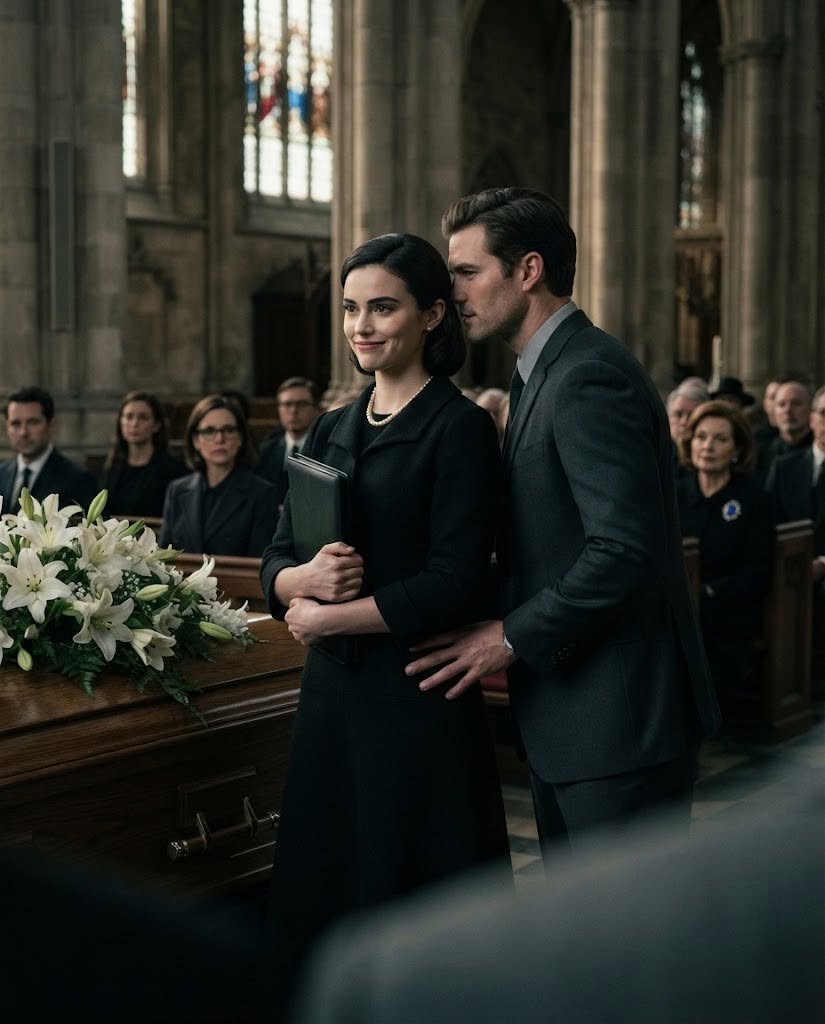
Before she could answer, the reception room doors opened.
Victor Salazar, the penthouse building manager, entered carrying a tablet beneath one arm and a blue metal document box in both hands.
Two uniformed officers followed him.
Mason’s confidence finally cracked.
“Why are the police here?”
Victor set the box on the table beside the unsigned authorization form.
“Building security recovered this from your vehicle after Mrs.
Callahan instructed us to preserve all property connected to the penthouse.”
Mason stepped forward.
“You searched my car?”
One officer answered.
“The box was visible through the rear window.
The vehicle was parked in a secured loading zone, and Mr.
Salazar identified it as property removed from the residence.
We asked you to return to the garage.
You declined our calls.”
“Because I was at a funeral.”
“So was your wife,” Elena said.
Mason ignored her and reached for the box.
Victor pulled it away.
“It has already been photographed and logged.”
Mason looked at me again, searching for the version of me who had once apologized when he raised his voice.
That woman had spent years believing patience could heal contempt.
She had mistaken silence for peace
and accommodation for love.
She had disappeared beside my father’s coffin.
“Open it,” I told Elena.
The hinges creaked.
Inside were property records, bank statements, copies of my passport, and several documents bearing my name.
Elena removed the first page and laid it flat.
It was a loan application for eight million dollars.
The penthouse was listed as collateral.
Mason’s consulting company was identified as the borrower, and I was named as guarantor.
At the bottom of the final page was my signature.
I had never seen the document before.
Mason spoke quickly.
“That was only a draft.
Nothing was submitted.”
Elena turned to the next page.
A bank receipt showed that the application had been uploaded three weeks earlier.
One of the foundation directors exhaled sharply.
I read the figure again.
Eight million dollars.
Mason’s company had always appeared successful.
He wore tailored suits, spoke on leadership panels, and told interviewers that disciplined risk created wealth.
At home, he dismissed my questions about his finances as evidence that I did not understand business.
Now Elena placed three overdue notices beside the application.
His company owed nearly six million dollars to private lenders.
Two projects had collapsed.
A third was under investigation for misstating investor funds.
The condo was not a trophy to him.
It was a life raft.
“You forged my name,” I said.
“I signed on your behalf.
There’s a difference.”
One of the officers glanced at the other.
Mason realized too late how the sentence sounded.
“Ava gave me authority over household finances,” he added.
“Ask her.”
“I gave you access to one joint checking account.”
“We are married.”
“That is not a power of attorney.”
His voice hardened.
“You’re confused because you’re grieving.”
It was the same tactic he had used for years.
When I questioned a missing transfer, I was anxious.
When I objected to his mother entering our home unannounced, I was territorial.
When I asked why he read my messages, I was secretive.
Every boundary became a symptom.
Every objection became proof that he should control more.
But now there were witnesses.
And documents.
Victor unlocked his tablet.
“There is also security footage from yesterday.”
Mason moved toward him.
“You cannot show private residential footage in public.”
“The trust owns the security system,” Elena said.
“Ava is the acting trustee.
She authorized the review.”
Victor turned the screen toward us.
The video showed Mason entering the penthouse at 2:14 the previous afternoon.
A locksmith followed him, carrying a tool case.
Diane entered ten minutes later with two suitcases and a garment bag.
The footage had no audio in the hallway, but the next camera captured sound from my father’s study.
He had installed it after several valuable items disappeared during his illness.
Onscreen, the locksmith asked for proof of ownership.
Mason handed him a printed letter.
“My wife authorized the change,” he said.
“Her father died, and she’s in no condition to deal with this.”
My father had still been alive at that moment.
He had died at 4:37 that morning.
A murmur moved through the room.
The locksmith changed the main lock.
Mason then opened my father’s desk, searched the drawers, and found the blue box.
He tried several combinations before unlocking it with a code saved on his phone.
Diane entered