
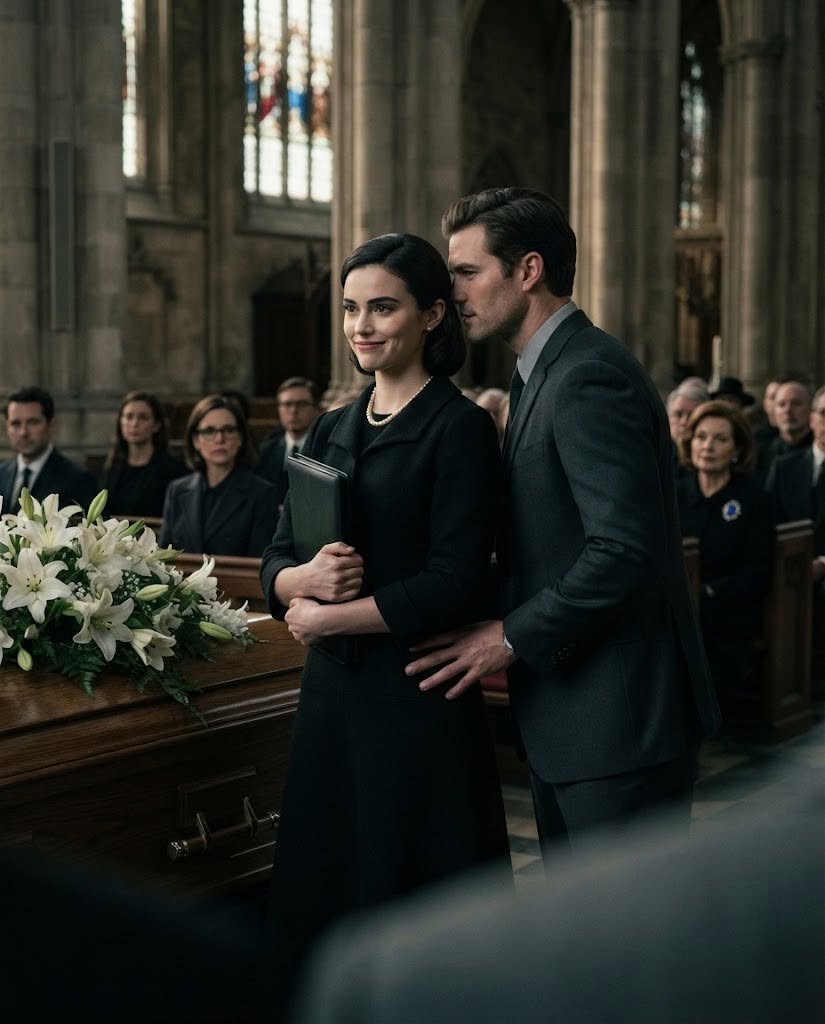
the room wearing the sapphire brooch.
“Did you find the deed?” she asked on the recording.
“Not yet,” Mason replied.
“But once Ava signs the authorization, it won’t matter.
The bank only needs a clean title package.”
Diane touched the brooch and smiled at her reflection in the glass cabinet.
“And if she refuses?”
Mason laughed.
“Today she loses her father.
Tomorrow she can lose her husband.
She won’t risk both.”
No one in the reception room looked at me.
Their restraint felt kinder than pity.
Mason reached for the tablet, but the officer stepped between them.
“That video is incomplete,” Mason said.
“It’s taken out of context.”
“Which part needs context?” I asked.
“The burglary, the forgery, or the threat?”
“Burglary? I am your husband.”
Elena removed another document from the box.
“The building’s access policy lists only Thomas Callahan and Ava Callahan as authorized residents.
You were repeatedly denied independent access after Thomas discovered you photographing files in his office last month.”
Mason’s head snapped toward her.
That was new to me.
Elena continued.
“Thomas asked building security to review prior footage.
He also instructed me to investigate your interest in the property.”
She placed a sealed statement on the table.
My father had dictated it six days before his death.
The statement described Mason visiting him while I was collecting medication from the hospital pharmacy.
Mason had asked my father to sign a temporary management agreement.
When my father refused, Mason told him that I lacked the temperament to manage wealth and that, after the funeral, he would make sure the family assets were handled by someone stronger.
My father had looked straight into the camera recording his statement.
“My daughter’s kindness is not incompetence,” he had said.
“Anyone who confuses the two should be kept far away from her property.”
Hearing his voice nearly broke me.
I gripped the edge of the table until the wood pressed into my palms.
Mason saw the movement and mistook pain for weakness.
He softened his tone.
“Ava, come outside with me.
We can fix this privately.
Your father distrusted everyone near the end.
He was sick.
Elena is turning his fear against us.”
Elena did not defend herself.
She did not need to.
“Did you forge my signature?” I asked.
“I was trying to save my company.
Our company.”
“I have never owned part of your company.”
“Everything I built was for us.”
“Then why did you hide the debt?”
His face tightened again.
“Because you panic when you see numbers you don’t understand.”
There it was—the contempt he usually saved for empty rooms.
One of my father’s board members, Ruth Bennett, stepped forward.
“Ava chaired our audit committee for four years,” she said.
“She understands numbers perfectly well.”
Another director nodded.
Then another.
Mason looked around, realizing that the audience he had used to humiliate me was no longer neutral.
Diane unclasped the sapphire brooch.
“This has become unnecessarily ugly,” she said, placing it beside the folder.
“I only borrowed this because Mason said Ava wanted me to have something meaningful.”
The video had shown otherwise.
Still, I did not argue.
I picked up the brooch and handed it to Elena for safekeeping.
Mason lowered his voice.
“Think carefully about what you do next.
A public scandal will
damage your father’s foundation.
It will damage you.
The press will call you the widow who had her husband arrested at a funeral.”
“I’m not a widow.”
For the first time, a few people in the room almost smiled.
Mason’s expression sharpened.
“You know what I mean.”
“Yes,” I said.
“I finally do.”
I turned to the officers.
They explained that the building would submit a formal complaint regarding unauthorized entry, false documentation, and removal of property.
The forged loan application would be referred to the appropriate financial-crimes unit.
They could not promise charges that afternoon, but the evidence would be preserved and examined.
Mason was instructed not to enter the penthouse or remove anything else.
His access credentials were deactivated.
The blue box, tablet footage, and original papers were logged for collection.
He was not taken away in handcuffs.
Real consequences rarely arrive with perfect theatrical timing.
Instead, an officer escorted him from the reception while dozens of people watched him walk past my father’s flowers alone.
At the door, he turned back.
“If you do this, our marriage is over.”
The threat sounded smaller the second time.
I picked up the unsigned authorization form, tore it once down the middle, and placed the pieces on the table.
“You decided that yesterday.”
Diane hurried after him without her luggage, her brooch, or the keys she had displayed so proudly that morning.
The funeral reception slowly resumed, but nothing returned to normal.
Ruth sat beside me and quietly took my hand.
Victor arranged for a locksmith approved by the trust to restore the original security system.
Elena gathered the legal documents and asked whether I wanted to postpone the estate meeting.
“No,” I said.
“My father planned for today.
We should honor that.”
The meeting revealed that the penthouse was only one part of his preparation.
He had appointed me chair of the family foundation, not because I was his daughter, but because the board had unanimously approved my succession months earlier.
He had left detailed instructions separating charitable assets from family property.
He had also established a fund for the longtime nurses and aides who had cared for him.
There was no sudden empire waiting to be handed to Mason.
There was structure, oversight, and accountability—the three things he hated most.
Within forty-eight hours, Elena obtained an emergency court order preventing Mason from using my name, trust assets, or personal information in any financial transaction.
The bank froze the fraudulent application and began its own investigation.
His lenders, alerted to the false collateral, demanded updated disclosures.
His company did not collapse because I exposed him.
It collapsed because it had already been hollow.
My forged signature had merely been the board he tried to lay across the final crack.
Mason filed for divorce first, apparently hoping to control the narrative.
His petition described me as emotionally unstable and accused me of withholding marital property.
Elena answered with the recorded deed, the trust agreement, our prenuptial contract, the bank application, and security footage from the penthouse.
His attorney withdrew several claims before the first hearing.
The divorce took eight months.
During that time, Mason sent apologies that never contained responsibility.
He said pressure had changed him.
He said his mother had influenced him.
He said my father had provoked him.
He said he had only threatened divorce because he was afraid of losing me.
Not once did he write, “I chose to hurt you.”
The court confirmed that the penthouse and trust assets were separate property.
Mason received his personal belongings and his lawful share of the joint accounts.
He received no interest in the condo, the foundation, or my father’s estate.
The financial investigation produced consequences of its own.
Mason eventually admitted submitting documents containing a signature he was not authorized to use.
The resolution included restitution, probation, and a prohibition against managing client funds for several years.
His professional reputation, carefully built from polished speeches and borrowed confidence, did not survive the public filings.
Diane returned the remaining items she had removed from the penthouse through her attorney.
She included no note.
On the first evening after the divorce became final, I went to the penthouse alone.
The approved locksmith had restored the brass lock my father chose when he bought the place.
My own key turned easily.
Inside, the rooms were quiet.
His reading glasses still rested beside his chair.
A half-finished crossword lay on the table.
The city glowed beyond the windows exactly as it had when I was a child and believed my father would live forever.
For months, I had avoided sitting in his chair.
That night, I finally did.
Elena had given me one last envelope from him, marked for after the divorce.
Inside was a single handwritten page.
He did not mention Mason by name.
He wrote that protecting me had never meant making my choices for me.
It meant leaving me enough truth to make my own.
He apologized for seeing Mason’s ambition before he understood its cruelty.
Then he reminded me of something he had told me when I was young: a locked door can keep danger out, but it can also reveal who believes they have the right to enter.
I read the final line twice.
“This home was never your inheritance, Ava.
It was always evidence that you already belonged to yourself.”
I opened the curtains.
Morning light moved across the floor, touching the desk, the empty chair, and the sapphire brooch I had placed beside my daughter’s photograph.
Mason had changed the locks because he thought possession would make the condo his.
In the end, the lock exposed him.
The deed restored the truth.
And when I closed the door behind me that evening, the key in my hand felt nothing like wealth.
It felt like my name.