I told Daniel everything.
He listened the way he always listened — still, his coffee forgotten, his eyes on my face.
When I finished, he didn’t speak immediately.
He looked at the wall for a moment, then back at me.
“He thinks James might be your son,” he said.
“Yes.”
“And James knows.”
“According to Robert’s letter, yes.”
Daniel set his cup down on the small table beside his chair.
“How do you feel?”
“I don’t know yet,” I said.
“Ask me again in an hour.”
Mr.
Hartley came back in then, and we spent the next forty minutes going through the formal details of the estate.
Robert had left a modest but meaningful sum — enough to matter — and had directed that if Eleanor Marsh was located and if she chose to pursue a DNA test, the cost would be covered by the estate regardless of the result.
He had thought of everything.
Even in dying, he had tried to make it easier.
“James Calloway is aware of this meeting,” Mr.
Hartley said.
“He asked me to give you his contact details and to tell you there is no pressure and no timeline.
He will wait as long as you need.”
He slid a card across the desk.
A name, a phone number, an email address.
I picked it up.
On the drive home, Daniel said, “Do you want to call him?”
“I want to think first,” I said.
“That’s fair.”
“Daniel.” I looked at the road ahead.
“If it’s true — if the test comes back and he is — then you have a brother you didn’t know about.”
He was quiet for a moment.
“I know.”
“How do you feel about that?”
Another pause.
Longer.
“I feel like Grandma had a lot to answer for,” he said finally.
“And I feel like you deserved better than what you got.
And I feel like — ” He stopped.
“I feel like if there’s a person out there who’s ours, I’d rather know than not know.”
I reached over and put my hand briefly on his arm.
That afternoon, I called Sarah and told her.
Then Judith.
Then Tom, Cara, and Bess, one by one, each conversation its own version of the same long silence followed by the same careful questions.
Bess cried.
Tom said very little but stayed on the phone for twenty minutes.
Cara said, “Mom, you have to meet him.”
“I know,” I said.
“When?”
“Soon,” I said.
I waited two days.
Not from reluctance — from the need to be steady when it happened.
To not walk into that meeting still raw from the letters and the solicitor’s office and the arithmetic I kept doing in my head.
On the third morning, I picked up the card and dialed the number.
It rang twice.
“Hello?” A man’s voice.
Younger than I expected, though I don’t know why I expected anything.
“James,” I said.
“My name is Eleanor.
I think you’ve been expecting my call.”
A breath.
Then: “Yes.
I have.” A pause.
“Thank you for calling.”
“Would you like to meet?” I said.
“Very much,” he said.
“Whenever you’re ready.”
We arranged it for the following Saturday.
A café in the town between us.
Neutral ground, he said, and I appreciated that he understood why that mattered.
I told Sarah the plan.
She asked if I wanted company.
“No,” I said.
“This one I need to do alone.”
Saturday came gray and cold, the kind of November morning that makes everything feel significant whether it is or not.
I arrived ten minutes early and chose a table near the window where I could see the door.
He came in at exactly the time we’d agreed.
I knew him before he reached the table.
Not because I was looking for resemblance.
Not because I had prepared myself.
But because there are things the body recognizes before the mind has finished thinking, and when James Calloway walked through that door in his dark coat with his hands slightly uncertain at his sides, something in me went very quiet and very sure.
He had Robert’s height and Robert’s careful posture.
But his eyes — the particular shade, the slight downward tilt at the outer corners — were mine.
I had seen them in the mirror my entire life.
He stopped at the table.
He looked at me.
And I watched his face do the same thing mine was doing — the recognition arriving before the words.
“Eleanor,” he said.
“James,” I said.
“Sit down.
Please.”
He sat.
We looked at each other across the small table.
“I don’t know how to start,” he said.
“Neither do I,” I said.
“So let’s just start.”
He smiled.
It was a careful smile, uncertain at the edges, and it was the smile of someone who had been waiting a long time for a door to open and was not yet sure what was on the other side.
“My father talked about you,” he said.
“Not often.
But when he did, he was — different.
Quieter.
Like he was handling something fragile.”
“I didn’t know he thought about me,” I said.
“I thought he had moved on.”
“He had,” James said.
“He loved my mother.
I want you to know that.
But there are two things that can both be true.”
“Yes,” I said.
“There are.”
We ordered tea.
We talked for two hours.
He told me about his work, his flat, the dog he’d had since university.
I told him about the children, the grandchildren, the grocery store mornings and the office cleaning nights and the apple tree in the garden.
At some point he said, “Can I ask you something?”
“Yes.”
“Are you afraid of what the test might show?”
I thought about it honestly.
“No,” I said.
“I think I’m more afraid of what it might not show.
Of sitting across from you and feeling what I feel and then being told it’s nothing.”
He looked at his hands.
Then back at me.
“I feel it too,” he said.
“Whatever it is.”
“Then we’ll find out,” I said.
“Together.”
He nodded.
Outside the café window, the gray morning had shifted without either of us noticing.
A thin winter sun was coming through the clouds, falling across the table between us, and James Calloway was sitting in it with his eyes that were my eyes, and I thought: *whatever the test says, this man lost his father five months ago and he came here anyway.*
That meant something.
That meant everything.
The DNA results came back on a Tuesday, three weeks after the café.
I was at home when the email arrived.
I had asked Sarah to be with me when I opened it, and she was sitting across the kitchen table with her hands wrapped around a mug of tea she hadn’t touched.
“Ready?” she said.
“Yes,” I said.
I opened the email.
I read the result.
Then I set the phone face-down on the table and looked at my daughter.
“Mom,” Sarah said.
“He’s mine,” I said.
Sarah put her mug down.
Her eyes filled immediately.
“Oh, Mom.”
“Ninety-nine point nine,” I said.
“That’s what it says.”
She came around the table and put her arms around me and I let her, and for a moment I simply sat there in my daughter’s arms in my kitchen with the apple tree visible through the window and thirty years of a story I hadn’t known I was living rearranging itself into something I could finally see the shape of.
I cried.
Not the quiet crying I’d done alone at the birthday table — this was something older and deeper, the kind that comes when something you lost so long ago you stopped naming it is suddenly, unexpectedly, returned.
When I could speak again, I said, “I need to call James.”
Sarah let go of me and nodded.
She picked up her tea and moved to the window to give me space.
I dialed his number.
He answered on the first ring.
“I got the email,” he said.
Before I could speak.
“So did I,” I said.
A silence.
Not an empty one.
“I have five brothers and sisters,” he said.
“I’ve never had any.”
“They’re going to want to meet you,” I said.
“All of them.
I should warn you — they’re a lot.”
He laughed.
It was the first time I’d heard him laugh, and it was a good sound, uncomplicated and genuine.
“I think I can manage,” he said.
“James.” I paused.
“I’m sorry I wasn’t there.
I didn’t know.
I want you to know that — I didn’t know.”
“I know you didn’t,” he said.
“My father knew you didn’t.
That’s why he kept writing.”
“He was a good man.”
“He was,” James said.
“He would have been glad about this.
He would have been very glad.”
I called the others that afternoon, one by one, the same way I had when I first learned about the letters.
Each call was different.
Tom went silent for a long moment and then said, “Right.
When do we meet him?” Bess cried again, happy tears this time.
Daniel said, “Good.
That’s good, Mom,” in the voice he used when something had resolved the way it should have from the beginning.
We arranged a dinner for the following Sunday.
My house.
All six of them, their partners, the grandchildren, and James.
I cooked for two days.
I made too much of everything, the way I always did when the people I loved were coming.
I baked Sarah’s apple pie with extra cinnamon.
I set eight places at the table.
James arrived last, slightly early by accident, and stood in my doorway in his dark coat with a bottle of wine and an expression that was trying very hard to be calm.
“Come in,” I said.
He stepped inside.
He looked at the hallway, the photographs on the wall, the coats hung by the door.
“This is a good house,” he said.
“It’s a loud one,” I said.
“Fair warning.”
He smiled.
“I was hoping it would be.”
The evening was exactly what it should have been.
Loud and warm and slightly chaotic, the grandchildren immediately fascinated by this new tall person who turned out to be patient and funny and willing to be climbed on.
Daniel shook James’s hand and then, after a moment, pulled him into a brief, firm embrace that said more than Daniel would ever put into words.
Bess sat beside him at dinner and talked to him for an hour straight, which was how Bess showed someone they were welcome.
At the end of the night, when the children had gone and the grandchildren were asleep in the back bedroom and James was helping me carry dishes to the kitchen, he stopped in the doorway and looked at me.
“Can I ask you something?”
“Of course,” I said.
“Are you all right?
With all of this?
It’s a lot to take in.”
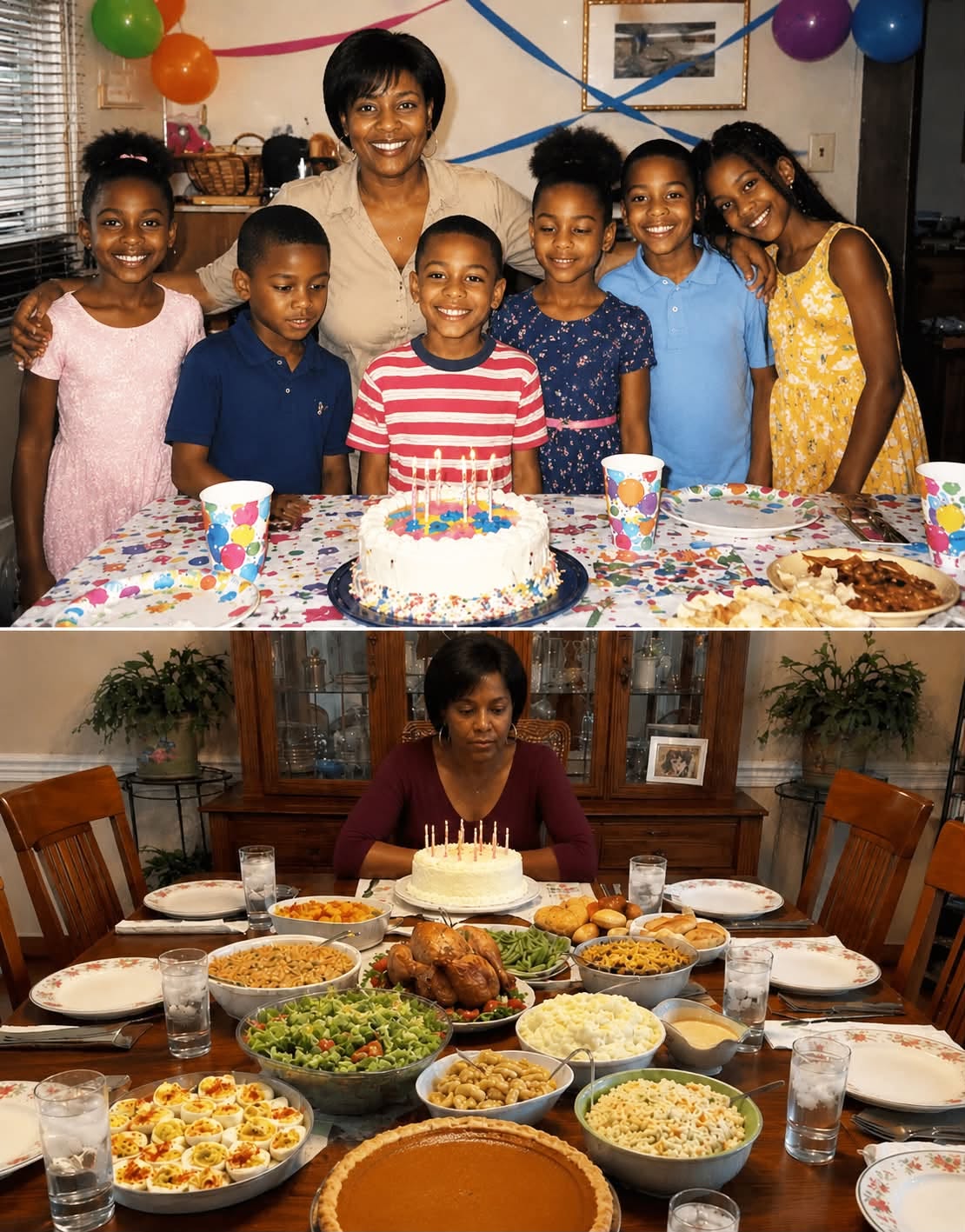
I thought about the birthday table set for seven with no one coming.
I thought about the ironed napkin and the four hours of waiting and the police officer on the porch.
I thought about eleven letters in a wardrobe and a photograph with four words on the back and a solicitor’s office and a café table in November light.
“I’m better than all right,” I said.
“I’ve been waiting for a full table for a long time.”
He looked at the kitchen — the dishes, the leftover pie, the eight chairs pushed back at angles the way they get when people have been comfortable.
“Your father used to say that,” I said.
“A table that’s never empty.”
James was quiet for a moment.
“He said that to me too,” he said softly.
“My whole life.
I never knew where it came from.”
I handed him a dish towel.
“Now you do,” I said.
We stood side by side at the sink, washing up, while the house settled into its nighttime quiet around us — the particular peace of a home that has held a lot of people and is resting now, full.
The last dish was dried and put away.
I folded the towel over the oven handle the way I always did.
“Same time next Sunday?” James said.
“Same time next Sunday,” I said.
He put on his coat.
I walked him to the door.
He paused on the porch — the same porch where a police officer had stood with a folded note six weeks ago — and turned back once.
“Goodnight, Eleanor,” he said.
“Goodnight, James,” I said.
I watched his car until the taillights disappeared around the corner.
Then I went back inside, turned off the kitchen light, and walked through my quiet house to bed.
The table had eight chairs pushed back at angles.
I left them exactly where they were.
—
Some things that were lost to us don’t disappear — they wait, in wardrobes and old envelopes, until someone is brave enough to bring them into the light.
Have you ever discovered a family secret that changed how you understood your own story?
Share it in the comments — you’re not alone.