
Suddenly, heavy, rapid footsteps echoed in the hallway outside.
Before I could shove the papers back into the briefcase, a woman’s voice shrieked, shattering the quiet of the maternity ward.
“Where is he?! Where is my baby?!”
I scrambled to my feet, dropping the briefcase onto the cot, the surrogacy contract still clutched in my trembling hand. I threw open the door to Room 412.
The corridor was absolute chaos.
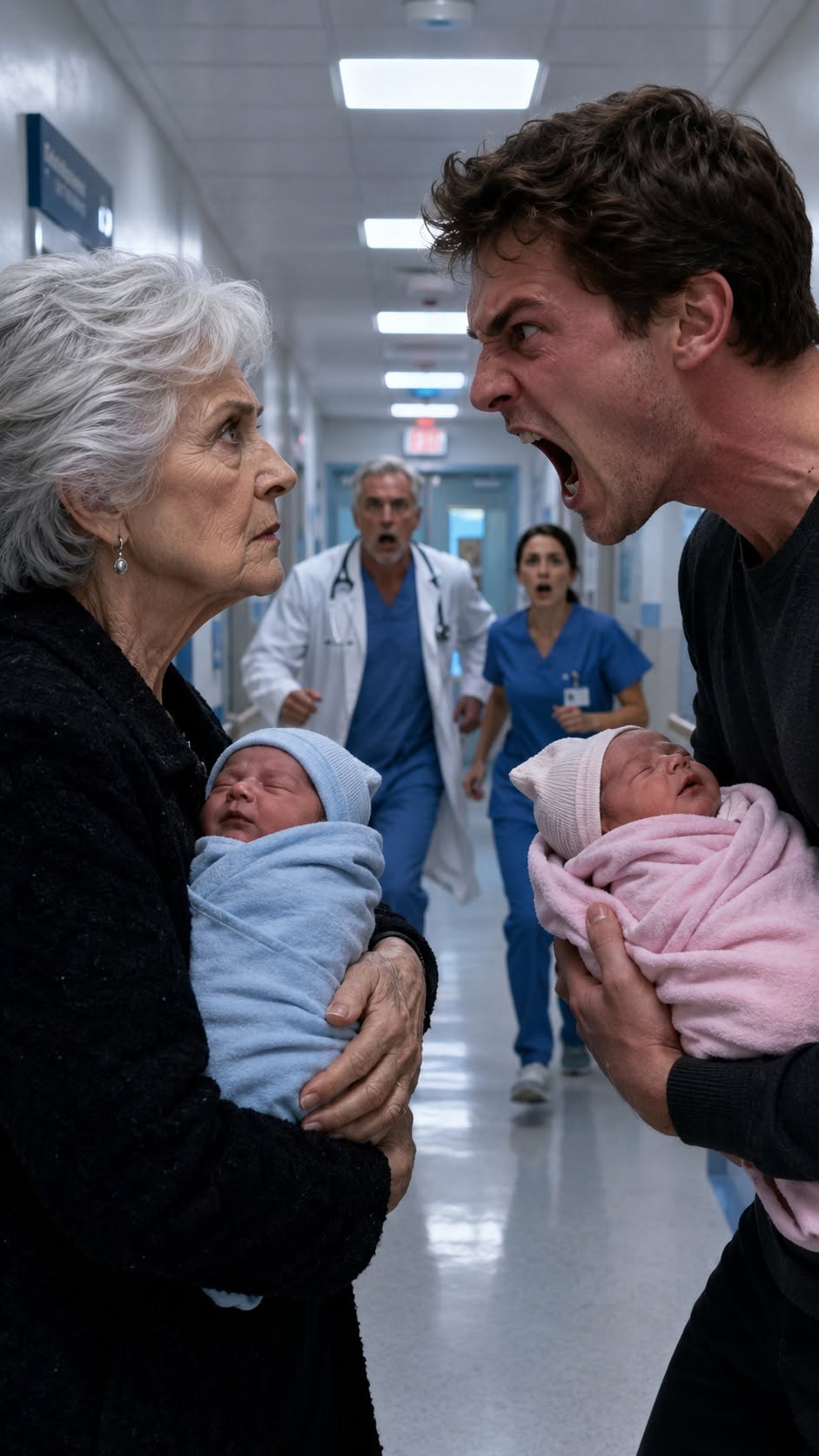
A man and a woman in rumpled clothes were sprinting down the hall, flanked by two armed hospital security guards and a uniformed police officer. The woman was hysterical, pointing a shaking finger directly at my son, who was just emerging from the elevator bank with Nora.
“That’s him!” the woman screamed, lunging forward. The police officer caught her by the waist, holding her back. “That’s the man who took my son!”
The hospital corridor instantly transformed into a crime scene.
“Sir, back against the wall! Keep your hands where I can see them!” the police officer barked, resting his hand on his utility belt.
Daniel froze, his face draining of all color. He pressed his back against the polished tiles, raising his hands in surrender. Nora let out a terrified sob and covered her mouth.
I stood in the doorway of Room 412, my heart hammering a frantic, violent rhythm against my ribs. The papers crinkled in my tight grip.
“We were in the ICU!” the frantic father yelled, his face purple with rage, straining against the security guard. “My wife hemorrhaged at 3:00 AM! We left our baby in the nursery, and when we came back, he was gone! The charge nurse said a man matching his description was seen holding him!”
3:00 AM. The note in my pocket felt like a burning coal.
“I didn’t take him!” Daniel shouted, his voice cracking with pure panic. He looked at the police officer, then at the hysterical parents. “I swear to God, I didn’t kidnap your child!”
“Then why did you have him?!” the mother screamed, tears streaming down her face.
The police officer stepped closer to Daniel. “Sir, I need you to explain exactly what happened last night, right now, or I’m placing you in handcuffs.”
Daniel’s chest heaved. He looked trapped, a cornered animal. He locked eyes with me standing in the doorway, and the sheer desperation in his gaze broke my heart. But the lies had to end.
“The alarm went off,” Daniel choked out, his voice echoing in the sudden silence of the hall. “At 3:00 AM. Your wife’s room… the alarms were blaring. The nurses were running. It was chaos. A young nurse—she looked terrified, overwhelmed. She ran out of your room carrying your baby. She shoved him into my arms in the hallway and yelled at me to hold him while they brought the crash cart in.”
The frantic father stopped struggling. The mother gasped.
“She told me to take him into my room to keep him safe from the commotion,” Daniel continued, tears spilling over his eyelashes. “I brought him in here. I sat in the chair. And then… my mother arrived.”
Daniel looked at me, his face twisting in shame. “My mother walked in. She had driven all night. She was crying. She saw the baby in my arms, and she assumed… she assumed he was ours. I was so exhausted, so terrified of everything falling apart, I just… I let her hold him. I let her believe it.”
The hallway was dead silent, save for the hum of the fluorescent lights. The police officer slowly lowered his hand from his belt, realizing this wasn’t a kidnapping, but a catastrophic administrative failure born of a medical emergency.
The security guards released the parents. The mother let out a jagged sob, pushing past Daniel and rushing into Room 412. She scooped the dark-haired baby out of the bassinet, burying her face in his swaddle, weeping uncontrollably.
I watched the woman hold her child. I felt no anger toward her, only a profound, hollow emptiness.
I stepped out of the doorway, the harsh light illuminating the documents in my hand. I walked slowly toward my son.
“If that isn’t your baby,” I said, my voice eerily calm, cutting through the residual tension in the air. I raised the surrogacy contract, the black ink visible to everyone. “Then where is my grandson, Daniel? Where is Elise?”
Nora let out a wail, collapsing against the wall, sliding down to the floor as she wept into her hands.
Daniel stared at the contract in my hand, defeated. The last wall of his labyrinth had crumbled.
“She took him,” Daniel whispered, his voice completely broken. “Elise had him at 1:00 AM. She was supposed to hand him over to the nurses. But she… she lost her husband, Mom. Three weeks ago. She was completely broken.”
He wiped his face roughly. “She called me from the stairwell. She said she couldn’t leave the hospital empty-handed. She said she just needed to take him home for one day. Just one day, to pretend her family wasn’t dead.”
“And you let her?” I demanded, the shock finally giving way to a searing, protective rage. “You let a grieving, traumatized woman walk out of a hospital with a newborn baby?”
“She’s his biological mother on paper until the discharge is signed!” Daniel shouted back, defensive and terrified. “If I called the cops, she’d go to jail! It would ruin her life! She promised she’d bring him back tonight!”
Suddenly, Daniel’s phone buzzed violently in his pocket.
He yanked it out, his thumb swiping the screen. As he read the text message, the last remnants of color vanished from his face. He looked like a corpse.
“Daniel,” I stepped forward, grabbing his arm. “What is it?”
He slowly looked up at me, his eyes wide with a terror so profound it made my blood run cold.
“It’s Elise,” he whispered. “She says… she says she can’t do it. She says she’s keeping him.”
Panic is a physical entity. It has teeth, and it bites down hard on your spine.
“Call the police,” I commanded, spinning toward the officer who was still standing awkwardly by the elevator, watching our family drama unfold. “Officer, my grandson has been kidnapped!”
“No!” Nora screamed, scrambling up from the floor. She threw herself between me and the police officer, her eyes wild, her face streaked with mascara. “Mom, please! Stop!”
“Nora, get out of the way,” I snapped, my protective instincts overriding any sympathy. “That woman has stolen Samuel!”
Nora grabbed my shoulders, her nails digging into my coat. “She is not a criminal! Listen to me! We lost three babies, Mom. Three! The first at ten weeks, the second at fourteen, and the third… the third I delivered stillborn at six months. We had named him.”
Her voice shattered, echoing tragically down the sterile hallway.
“We were hollowed out,” Nora sobbed. “Elise gave us hope again. She is a good woman. She carried our son for nine months, and the universe repaid her by smashing her husband’s car into a concrete divider. She is out of her mind with grief. If you send the police crashing through her door, they might hurt her. Or worse, she might do something desperate. Please, Mom. I am begging you. Give us a chance to fix this.”
I stared at Nora, seeing the raw, bleeding wounds of a mother who had endured unspeakable loss in absolute silence. My anger faltered, replaced by a suffocating wave of sorrow for both these women.
I looked at the police officer. “Give us two hours,” I lied smoothly, asserting an authority I didn’t possess. “It’s a civil family dispute. We will handle it. If we aren’t back in two hours, I will file the report myself.”
The officer, eager to avoid a complex custodial nightmare without a clear crime, slowly nodded and backed away.
Ten minutes later, we were in Daniel’s SUV, tearing out of the hospital parking garage. The sky had turned a bruised, ugly purple, and a freezing rain began to lash against the windshield.
The drive was agonizing. The silence in the car was heavier than the storm outside. I sat in the backseat, my hands clasped so tightly together my knuckles ached. Daniel drove like a madman, his jaw clenched tight enough to crack his teeth, swerving through the slick suburban streets.
“She lives at the end of a cul-de-sac in Oakridge,” Daniel muttered, more to himself than to us. “It’s isolated. Woods in the back.”
“Did she text anything else?” I asked, my voice tight.
“Nothing. Her phone is off.”
We finally turned into a quiet, heavily wooded neighborhood. The houses were spaced far apart, large and imposing. Daniel slammed on the brakes in front of a dark blue, two-story house. There were no lights on inside. The driveway was empty, save for a child’s tricycle tipped over on the wet grass—a remnant, I assumed, of the life Elise had planned with her husband.
We threw open the car doors and sprinted through the freezing rain up the concrete path.
Daniel hammered his fist against the heavy wooden front door. “Elise! Open the door! It’s Daniel!”
Silence. Only the sound of the rain drumming against the gutters.
Nora moved to the front window, pressing her face against the wet glass, trying to peer through the gaps in the heavy curtains.
“I can’t see anything,” Nora cried out, wiping the rain from her eyes. “It’s pitch black.”
“Elise!” Daniel shouted again, turning the brass doorknob. It was locked tight. He took a step back, sizing up the door. “I’m going to kick it in.”
“Stop!” I grabbed his arm, pulling him back. “Violence is going to escalate this. If she’s terrified, kicking down her door will only push her over the edge.”
“Then what do we do, Mom?!” Daniel yelled, the rain plastering his hair to his forehead. “My son is in there!”
Suddenly, a sound pierced through the heavy rhythm of the rain.
It was faint, muffled by the thick walls of the house, but unmistakable. A high-pitched, rhythmic wailing.
A baby was crying.
I turned my head toward the large bay window on the left side of the porch. A sliver of pale yellow light had just clicked on in the back of the house. Against the sheer white curtain, a dark shadow moved.
It was the silhouette of a woman, pacing slowly back and forth, holding a bundle tight against her chest.
“Stay here,” I said, my voice low and absolute. It was the voice I had used for thirty years to command a classroom, a voice that brooked zero argument.
Daniel and Nora stared at me, rain dripping from their noses.
“Mom, you can’t—”
“I said stay here, Daniel.” I looked him dead in the eye. “You are the people demanding she give up the only living thing she has left in her arms right now. Your presence is a threat. Let me speak to her.”
I didn’t wait for his permission. I walked to the front door and knocked. Not a frantic, demanding pound, but a steady, rhythmic tap.
“Elise,” I called out, projecting my voice so it would carry through the wood, but keeping the tone soft, maternal. “My name is Linda. I’m Daniel’s mother. I know you’re in there, sweetheart. And I know you are in unimaginable pain.”
The shadow in the window stopped pacing.
“I am not the police,” I continued, pressing my hand flat against the cold, wet wood of the door. “I am just a mother, and a grandmother. I am out here alone. Daniel and Nora are staying by the car. Please, just open the door so we can talk. You don’t have to be alone in the dark.”
For a long, agonizing minute, the only sound was the howling wind. I began to fear she had retreated deeper into the house.
Then, the deadbolt clicked.
The heavy door opened a fraction of an inch. A slice of dim light spilled out onto the porch, illuminating a single, terrified, bloodshot eye.
“Go away,” a hoarse, broken voice whispered from the darkness.
“I can’t do that, Elise,” I said gently. I kept my hands visible, resting them on my coat pockets. “It’s freezing out here, and my bones are old. May I step inside?”
The door opened an inch wider. I could see her now. Elise was a beautiful woman, probably in her early thirties, but grief had ravaged her. Her face was hollow, her skin a pallid gray, and her eyes held a frantic, cornered look. Clutched desperately to her chest, wrapped in a blue hospital blanket, was a tiny, squirming baby.
My grandson. The real one.
She looked past me, spotting Daniel and Nora standing in the rain by the SUV. She flinched, clutching the baby tighter, preparing to slam the door.
I stepped forward, wedging my shoulder into the frame. “Just me. I promise.”
Elise hesitated, then, with a defeated exhale, stepped back, allowing me to enter.
The house was freezing. The heating clearly hadn’t been turned on in days. The living room was a monument to interrupted joy; there were half-opened boxes of baby furniture, a stack of maternity books on the coffee table, and on the mantelpiece, a framed photograph of a laughing, handsome man.
Elise backed away from me until her spine hit the wall. She looked down at the baby, who was fussing quietly.
“He smells like Thomas,” she whispered, her voice cracking. “I know he isn’t biologically ours, but I grew him. I felt him kick. And now Thomas is in the ground, and I’m supposed to just hand this baby over and go back to an empty house. I can’t do it. I will die if I have to stay in this house alone.”
My heart broke completely. The anger I had carried from the hospital vanished, replaced by an overwhelming tide of empathy.
I didn’t lunge for the baby. I didn’t threaten her with the law. I walked slowly to the center of the room, unbuttoned my soaking wet coat, and let it drop to the floor.
I sank down onto the dusty sofa, patting the cushion next to me.
“Come sit down, Elise,” I said softly.
She stared at me, suspicious. But the sheer exhaustion of her grief won out. She slowly shuffled over and sat on the far edge of the sofa, curling her body protectively around the child.
“My husband died twenty years ago,” I lied. The lie tasted like ash in my mouth, but it was a necessary bridge. I needed her to believe I understood the abyss she was staring into. “A heart attack. One minute he was drinking coffee, the next he was gone. I remember the silence of the house afterward. It’s deafening. It feels like it’s going to crush your ribs.”
Elise looked at me, a tear finally breaking free and tracking down her cheek. “Yes.”
“You look at this baby, and you see a life raft,” I said, my voice barely above a whisper. “You think holding him will keep you from drowning. But Elise, sweetheart… you are holding a passenger, not a life raft. If you take him out into that dark water with you, you’ll both sink.”
A sob tore from her throat, a harsh, ugly sound of pure agony.
“Nora is out there in the freezing rain,” I continued gently. “She lost three babies. Three times, her heart was ripped out of her chest. You gave her a miracle. You gave my son a family. Don’t let your tragedy destroy their miracle. Thomas wouldn’t want his legacy to be the theft of another family’s joy.”
That was the key that unlocked the vault.
Elise collapsed. The frantic tension in her body snapped, and she folded forward, sobbing so violently her shoulders shook. I slid across the sofa and wrapped my arms around her. I held her tight, letting her weep against my shoulder, smelling the sour sweat of panic and the sweet, milky scent of the baby pressed between us.
“I don’t know how to survive this,” she wept into my shirt.
“You survive it one breath at a time,” I murmured, stroking her tangled hair. “And you won’t do it alone. I promise you that.”
Slowly, carefully, Elise sat up. She looked down at the baby. He had stopped fussing and was staring up with wide, unblinking eyes. He had Nora’s chin and Daniel’s ears.
With trembling hands, Elise kissed the baby’s forehead, leaving a wet tear on his skin.
Then, she turned and gently, devastatingly, placed him into my arms.
“Tell them I’m sorry,” she whispered, covering her face with her hands.
I looked down at Samuel. The real Samuel. My chest swelled with a love so fierce it felt like a physical ache. I pulled him close, feeling his tiny warmth against my heart.
“I will,” I promised.
The aftermath was a messy, complicated unraveling. I carried Samuel out to the car, handing him to a weeping Nora. Daniel collapsed against the side of the SUV, thanking God and thanking me. I didn’t smile. I told them both that we had a lot of work to do.
Forgiveness is not a switch you can just flip. It takes time, brutal honesty, and a willingness to stay in the room after the trust has been shattered.
Six months have passed since that night.
Daniel and Nora are trying. They are transparent now, almost to a fault. They never miss a Sunday call, and my inbox is flooded with pictures of Samuel. He is a serious-looking baby, always wearing a tiny, disappointed scowl that makes him look like a miniature businessman evaluating a poor quarterly report.
We kept my promise to Elise. We didn’t abandon her in that dark house. Nora goes over there once a week to drink tea. Elise holds Samuel, not as a desperate mother, but as a cherished, honorary aunt. She is healing, slowly.
Recently, Daniel called me while Samuel was screaming in the background, refusing to sleep.
He joked that the stubbornness was clearly a genetic curse passed down from my side of the family. Then, the line grew quiet.
“Thank you for staying, Mom,” Daniel said, his voice thick. “For not walking away when I made a mess of everything.”
I sat in my favorite armchair, looking at a framed photograph of myself holding Samuel—the real Samuel—in Elise’s living room, both of us exhausted but finally at peace.
“I stayed because he belongs to me too,” I replied. “And because you are still my son, even when you behave like an absolute idiot.”
It was not a perfect ending. There are still scars. But as I listened to my grandson’s cries through the phone, I knew it was enough. The truth had set us free, and the kingdom was finally ours.
If you want more stories like this, or if you’d like to share your thoughts about what you would have done in my situation, I’d love to hear from you. Your perspective helps these stories reach more people, so don’t be shy about commenting or sharing.