
Part 7
The trial lasted eleven days.
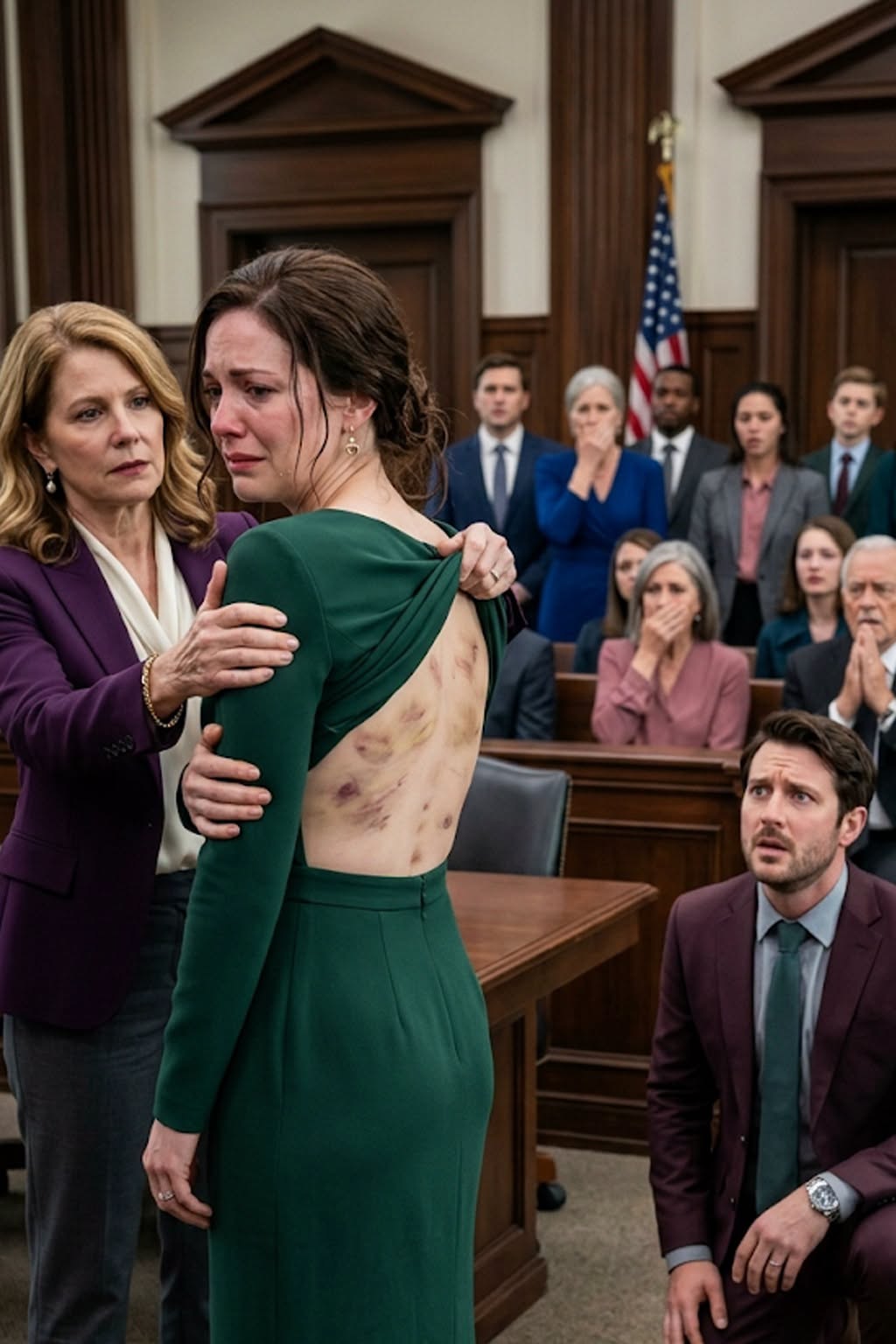
The prosecution began with the hospital photographs.
They did not display them for drama.
Each image was introduced carefully through the forensic nurse who had examined Clara.
She described injuries in different stages of healing.
Some recent.
Some older.
Some consistent with grabbing.
Some consistent with blunt force.
The defense asked whether a fall could cause bruising.
“Yes,” the nurse said.
“Could anxiety lead someone to remember an event incorrectly?”
“I am not a psychologist.”
“Could these marks have been self-inflicted?”
“Not all of them.”
Daniel watched the jury as if he were still an attorney evaluating a case.
He took notes.
Whispered to Pike.
Adjusted his tie.
Then Mrs. Alvarez testified.
She described Clara’s hoarse voice and the marks around her neck.
She described Sophie saying, “Daddy hurt Mommy’s throat.”
The defense suggested a four-year-old could misunderstand play.
Mrs. Alvarez stared at him.
“I have raised five children. I know the difference between a child describing play and a child describing terror.”
Dr. Hale testified next.
He admitted Daniel shaped his understanding of Clara before treatment began.
He admitted failing to screen properly for intimate-partner violence.
He admitted allowing Daniel’s emails to influence the clinical record.
“I believed I was helping stabilize a marriage,” he said.
Naomi was not trying the criminal case, but she sat beside Clara in the gallery and wrote one word on her notepad.
Institution.
Daniel had not acted alone.
Not in the sense that others abused Clara.
But in the sense that his appearance and profession caused people to accept his story.
The therapist believed him.
The neighbor initially believed him.
His colleagues believed him.
Even Clara believed him.
The digital analyst testified about the hidden calendar and the codes.
The pharmacist testified that the tablets recovered from Daniel’s desk were sedatives.
The deceased client’s daughter testified that her mother’s medication should have been destroyed after death.
She had never given Daniel permission to possess it.
Then the jury heard the recordings.
Not all of them.
Only the ones the judge admitted.
Clara asking why her body hurt.
Daniel telling her she had fallen.
Sophie saying Daddy pushed Mommy.
Daniel ordering Clara to swallow a pill.
The courtroom listened to abuse being edited into concern.
By the time Clara took the stand, Daniel no longer looked confident.
He looked furious.
The prosecutor began with simple questions.
Her name.
Her age.
Her relationship to Daniel.
Then she asked about the first assault.
Clara’s voice shook.
She told the truth anyway.
She described the slap after Thanksgiving.
The push beside the kitchen island.
The first time he locked her in the laundry room.
The night he pressed his forearm across her throat.
The pills.
The recordings.
The threats about Sophie.
“Why didn’t you leave earlier?” the prosecutor asked.
Daniel’s lawyer objected.
The judge allowed the question within limits.
Clara looked toward the jury.
“Because he taught me that leaving would cost me my daughter.”
“Did you believe him?”
“Yes.”
“Why?”
“Because he was a lawyer. Because he had files. Because he knew how to sound calm. Because every time I tried to tell someone, he was already standing beside me explaining why I was confused.”
The prosecutor paused.
“What changed?”
Clara’s eyes moved toward me.
“My mother saw my back.”
I felt tears burn behind my eyes.
“She didn’t ask what I had done to cause it,” Clara continued. “She asked who had done it to me.”
On cross-examination, Gregory Pike attacked every inconsistency.
Why had Clara said she fell?
Why had she attended firm dinners smiling?
Why had she sent Daniel loving text messages?
Why had she remained in the marriage?
Why had she once apologized after scratching his neck?
Clara answered each question.
“I lied about falling because I was afraid.”
“I smiled because he was watching.”
“I sent loving messages because affection made him calmer.”
“I stayed because I believed he would take Sophie.”
“I scratched him because he had his hand around my throat.”
Pike approached the witness stand.
“You expect this jury to believe that a respected attorney spent years constructing an elaborate conspiracy against his own wife?”
Clara looked at Daniel.
“No.”
Pike paused.
“No?”
“I expect them to believe he hurt me, then used what he knew to hide it.”
The prosecutor rested two days later.
Daniel chose to testify.
Against his attorney’s advice.
Men who build their identity on control often believe they can talk their way out of anything.
He described Clara as fragile.
He admitted monitoring her phone but called it protective.
He admitted giving her medication but said she requested it.
He admitted locking the laundry-room door but claimed it was necessary to prevent her from frightening Sophie.
Then the prosecutor asked about the spreadsheet.
“What does ‘physical correction required’ mean?”
Daniel leaned toward the microphone.
“It was poorly chosen language.”
“What physical act occurred?”
“I don’t recall.”
“You kept a detailed record but cannot recall?”
“I handled high-stress situations.”
“What does D2 mean?”
“Two doses.”
“Of what?”
“Medication.”
“Prescribed to Clara?”
“I believed it was safe.”
“Are you a physician?”
“No.”
“Did Clara consent?”
“She was not in a state to make rational decisions.”
“Who decided that?”
“I did.”
The prosecutor stopped moving.
“So when your wife resisted you, you decided she was irrational, physically corrected her, gave her two doses of someone else’s sedative, and recorded her confusion afterward?”
Daniel realized too late that he had answered the entire case.
“No. That is not what I said.”
“It is exactly what you said.”
Part 8
The jury deliberated for nine hours.
Those hours felt longer than the previous three years.
Clara sat in a private room with Naomi and the prosecutor’s victim coordinator.
I walked the hallway.
Not because I believed movement changed verdicts.
Because sitting still felt impossible.
At 6:17 p.m., the clerk announced that the jury had reached a decision.
We returned to the courtroom.
Daniel stood beside his attorney.
For the first time, he looked directly at Sophie’s empty seat in the gallery.
She was not there.
She would never be used as an audience for his consequences.
The foreperson rose.
Guilty of aggravated assault.
Guilty of unlawful imprisonment.
Guilty of unlawful surveillance.
Guilty of possession of controlled medication.
Guilty of administering medication without consent.
Guilty of witness intimidation.
Guilty of violating the protective order.
On one lesser assault count, not guilty.
Clara flinched at those words.
Then Naomi squeezed her hand.
A verdict did not need to include every wound to acknowledge the pattern.
Daniel closed his eyes.
His shoulders dropped.
The deputies moved behind him.
When they reached for his arms, he turned toward Clara.
“I loved you,” he said.
The judge ordered him to remain silent.
Clara did not answer.
At sentencing six weeks later, the courtroom was full.
Several former clients submitted impact statements concerning Daniel’s manipulation of custody disputes. Those matters were not part of his criminal conviction, but the court considered relevant evidence regarding abuse of professional trust within permitted limits.
The state bar had already suspended his license.
Disbarment proceedings were underway.
Mercer, Vale and Knox issued formal apologies to affected clients and established an independent review of Daniel’s cases.
None of that restored what he had taken.
But consequences were accumulating.
The prosecutor requested a substantial prison sentence.
Daniel’s attorney asked for leniency.
He described Daniel as educated, employed, and unlikely to reoffend.
The judge looked over her glasses.
“Education did not prevent these crimes. It facilitated them.”
Clara delivered a victim-impact statement.
She stood at the podium without hiding her hands.
“For three years, Daniel told me that the law belonged to him,” she said. “He told me courts would see an accomplished lawyer and a frightened wife. He was right about one thing. I was frightened.”
She looked toward him.
“But fear is not proof that someone is lying. Sometimes fear is proof that someone has been telling the truth alone for too long.”
Daniel stared at the table.
“You took photographs of my tears. You recorded my confusion. You wrote down the days I resisted you. You treated my pain like evidence you could use against me.”
Her voice became stronger.
“You forgot that records work both ways.”
The judge sentenced Daniel to fourteen years in prison, with eleven to serve and the remainder suspended under strict conditions.
He received a permanent protective order regarding Clara.
Any future contact with Sophie would require separate family-court review after incarceration, expert evaluation, and proof that contact served her interests.
His law license was revoked three months later.
The written disciplinary opinion stated that he had demonstrated dishonesty, abuse of confidential information, conduct prejudicial to justice, and profound unfitness to practice law.
The man who once told Clara that he knew the system better than she ever could lost the profession he had used to control her.
The divorce became final that spring.
Daniel received no custody.
His parental rights were not automatically terminated by the criminal conviction, but the family court granted Clara sole legal and physical custody and continued the prohibition on contact.
The judge ordered that any future petition by Daniel would require a showing of extraordinary rehabilitation and independent evidence that contact would not harm Sophie.
Naomi explained the ruling to Clara outside the courthouse.
“He can file someday,” she said. “Courts rarely close every door forever without specific statutory grounds. But filing is not winning.”
Clara nodded.
“I’m not afraid of paperwork anymore.”
That sentence meant more than any judgment.
For years, Daniel had used documents as threats.
Now Clara understood that paper could also preserve boundaries.
We returned home after the hearing.
Sophie was in the backyard with Melissa, blowing bubbles.
When she saw Clara, she ran across the grass.
“Mommy!”
Clara caught her and lifted her into the air.
“Are we staying at Grandma’s forever?” Sophie asked.
Clara looked at me.
I smiled.
“As long as you need.”
Sophie considered that.
“Can my room be yellow?”
“Yes,” I said.
“With stars?”
“As many as you want.”
That summer, we painted the room together.
Yellow walls.
Silver stars.
A white bookshelf.
No locks except the ordinary one on the main door.
And every lock could be opened from inside.
Part 9
Five years later, Clara stood in front of a room filled with lawyers.
Not as Daniel’s wife.
Not as a victim on a witness stand.
As the founder of the Clara Cross Legal Safety Project.
She had gone back to school after the divorce and completed a graduate program in social work and victim advocacy.
She did not become a lawyer.
People often assumed she would.
But Clara said she had spent enough of her life inside someone else’s legal strategy.
Instead, she built a program that trained attorneys, therapists, teachers, and medical staff to recognize coercive control.
The project focused on the signs professionals often missed.
A partner who answered every question.
A patient whose medical history was narrated by someone else.
A spouse who collected records of emotional reactions while hiding the events that caused them.
A child who described frightening events with practiced language.
A respected person who always appeared calmer than the person accusing them.
The first training session took place in Richmond.
More than two hundred people attended.
I sat in the back row beside Sophie, now nine years old.
She wore a yellow dress and drew stars in the margin of the program.
Clara walked to the podium.
For a moment, I saw the young woman standing in her childhood bedroom, pulling her shirt over bruises and begging me not to make things worse.
Then she began speaking.
“Abusers who understand institutions do not always avoid documentation,” she said. “Sometimes they create it.”
The room became silent.
“They document the victim crying, but not the threat made before the tears. They document confusion, but not the medication administered before it. They document anger, but not the isolation, surveillance, or violence that produced it.”
She changed the slide.
A simple sentence appeared.
CALM IS NOT THE SAME AS SAFE.
“Professionals are trained to value composure,” Clara continued. “That can become dangerous when we mistake a controlled presentation for credibility and trauma symptoms for dishonesty.”
She did not mention Daniel’s name.
She didn’t need to.
Her life no longer revolved around explaining him.
After the presentation, a young attorney approached her.
“My sister is married to someone like that,” the woman whispered. “I thought I was imagining it.”
Clara gave her a resource card.
“You are not imagining the pattern.”
The attorney began crying.
“What do I say to her?”
“Don’t ask why she stays,” Clara said. “Ask what she needs to leave safely.”
I watched my daughter offer another woman the sentence she had once needed.
That evening, we returned to my house.
Sophie had a school project spread across the dining table.
She was building a model courthouse from cardboard.
“Grandma,” she said, “did you put bad people in jail?”
“Judges don’t put people in jail by themselves.”
“But you decided things.”
“Yes.”
“Were you ever scared?”
I looked at Clara.
She was standing at the kitchen counter, listening.
“Sometimes.”
Sophie frowned.
“But judges aren’t supposed to be scared.”
“Everyone gets scared.”
“Then how do you make decisions?”
“You look at the facts. You listen carefully. And you try not to let fear make the choice for you.”
She returned to her cardboard courthouse.
“Mom did that.”
“Yes,” I said. “She did.”
Daniel remained in prison.
He filed two appeals.
Both failed.
In the seventh year of his sentence, he sent Clara a letter through his attorney requesting permission to write to Sophie.
Clara brought it to Naomi.
They reviewed it together.
The letter spoke about Daniel’s suffering.
His lost career.
His loneliness.
His hope for forgiveness.
It contained no meaningful acknowledgment of what he had done to Clara.
No recognition of Sophie’s fear.
No acceptance of responsibility beyond vague references to “mistakes.”
Clara declined the request.
Her response was one paragraph.
Sophie’s emotional safety remains my only consideration. Your request centers your loss rather than the harm you caused. No contact will be permitted.
She did not shake while signing it.
That night, she placed the copy in a file and closed the drawer.
“Do you think he’ll ever understand?” she asked me.
“Maybe.”
“And if he doesn’t?”
“You still get to live.”
She nodded.
That had become the final lesson.
Justice was not the same as waiting for the person who hurt you to become sorry.
Justice was evidence.
Boundaries.
Consequences.
Safety.
But healing was something else.
Healing was Clara laughing without checking the doorway.
It was Sophie sleeping through thunderstorms.
It was a yellow bedroom covered in silver stars.
It was my daughter standing in front of professionals and teaching them how not to miss the next woman.
On the tenth anniversary of the night Clara came home, rain tapped against the same bedroom window.
She found me standing in the doorway.
The room had changed.
Sophie was a teenager now, and the silver stars had been replaced by photographs, books, and a poster from her school debate team.
Clara stood beside me.
“I used to think this was the room where my life fell apart,” she said.
I looked at her.
“It was the room where you told the truth.”
“I didn’t tell it. You saw it.”
“Then you chose not to hide it again.”
She leaned her head against my shoulder.
For a while, we listened to the rain.
“I remember what you said to him on the phone,” she whispered.
“Which part?”
“Keep talking.”
I smiled faintly.
“He thought you were trying to intimidate him.”
“I was trying to preserve evidence.”
“I know.”
She turned toward me.
“But that wasn’t the thing that scared him most.”
“What was?”
“That you believed me.”
The answer settled between us.
She was right.
Daniel had prepared for police.
For lawyers.
For judges.
For motions and hearings and expert testimony.
He had prepared to call Clara unstable.
To portray himself as calm.
To turn every tear into proof against her.
But he had forgotten one thing.
Not that he had married the daughter of a federal judge.
That was only the detail that made him hesitate on the phone.
The thing he truly forgot was far more dangerous to a man like him.
He forgot that one day, the woman he had isolated might speak.
He forgot that someone might listen.
He forgot that evidence survives intimidation.
And he forgot that the law he used as a threat did not belong to him.
It belonged to the truth.
Clara reached for my hand.
Downstairs, Sophie called that dinner was ready.
We walked out of the bedroom together.
No practiced smile.
No hidden bruises.
No voice waiting on the other side of a locked door.
Only my daughter.
Her daughter.
And the life they had rebuilt after fear finally lost its case.