PART TWO — THE PRICE OF THE TRUTH
Chapter 7: The Billionaire’s Final Confessio
The discovery at Harbor House did not prove my father had been murdered.
Detective Hayes made that clear.
Memories from childhood could be unreliable.
Old business records were not proof of a crime.
And the fact that three people had visited a marina did not establish what happened there.
But the notebook gave investigators something they hadn’t possessed before.
A timeline.
Names.
Transactions.
And a reason to reopen questions that had remained buried for twenty-four years.
Evelyn arranged for us to examine Arthur Ellison’s private estate files.
I expected legal documents.
What I found instead was a personal recording.
Arthur had made it six months before his death.
He sat in a leather chair facing the camera, older and visibly ill.
His hair had turned white.
But his eyes were sharp.
“If my son is watching this,” he began, “then I have failed to explain something while I was alive.”
Graham went very still beside me.
Arthur paused to catch his breath.
“Graham, there was a man named Andrew Whitmore.
He was my friend.
One of the finest men I ever knew.”
I felt tears rising again.
“He discovered that my business partner, Charles Whitmore, was stealing property through fraudulent transfers.
Andrew could have walked away.
Instead, he stayed because innocent families were being hurt.”
Arthur looked down.
“I promised him protection.”
The room was silent.
“I did not keep that promise.”
Graham whispered, “Dad…”
Arthur continued.
“Andrew died before we could deliver our complete evidence to the authorities.
The police investigated his death as an accident.
I had my doubts, but I could never prove otherwise.”
He looked directly into the camera.
“For years, I carried the guilt of that uncertainty.
I kept Andrew’s records and continued seeking restitution for the people who lost their homes.”
The elderly man took another breath.
“When Andrew’s daughter Claire became an adult, I attempted to contact her.
My letters were returned.
Her mother informed me that Claire wanted nothing to do with the Ellison family.”
My hands tightened around each other.
Arthur’s expression became painfully sad.
“I accepted that answer longer than I should have.”
He reached for a folder.
“Then I learned Claire had a daughter.
Lily.”
He smiled faintly.
“I decided that if Claire wanted nothing from me, perhaps I could still provide something for Andrew’s granddaughter.”
Graham lowered his head.
Arthur continued.
“I created a protected trust for Lily’s education, housing, and future.
Claire was to be notified and offered independent representation.
No relative was to gain control of that money merely by claiming to be a guardian.”
He paused.
“However, certain members of my foundation board objected to the arrangement.
They feared the trust would revive old legal questions involving Harbor Crest properties.”
Graham frowned.
“That doesn’t make sense.
Why would the board object?”
Evelyn reached for another folder.
Arthur answered almost immediately, as though he had anticipated the question.
“Because some of the properties involved in Charles Whitmore’s fraud eventually passed into investments controlled by people who now serve on the foundation.”
I looked at Graham.
He looked stunned.
The recording continued.
“My son has spent his career trying to build something honorable.
I do not want my mistakes to become his inheritance.”
Arthur leaned closer.
“But if Graham ever discovers that a woman named Vanessa Whitmore has approached him through the foundation, he must understand that her family may have interests beyond charity.”
My breath caught.
Vanessa had known Graham for almost two years.
Arthur died eighteen months ago.
Was it possible he’d suspected her before Graham had even proposed?
Arthur’s next words answered me.
“I have reason to believe Margaret Whitmore has been searching for documents Andrew left behind.”
Graham pressed his hand over his mouth.
Arthur’s voice weakened.
“I cannot prove every suspicion.
I can only leave the evidence I have and ask you to examine it carefully.”
Then he looked directly at the camera.
“Graham, if you love someone, love them with your eyes open.”
He paused.
“And Claire, if you ever see this, I am sorry I did not do more for your father.”
The recording ended.
For a long moment, nobody moved.
Then Graham spoke.
“My father tried to warn me.”
Evelyn nodded.
“He was concerned, but he didn’t have proof that Vanessa was personally involved.”
I looked toward the dark screen.
Arthur Ellison had died believing he had failed my father.
My father had died believing the truth mattered.
And I had spent twenty-four years living inside a lie.
But there was still something I didn’t understand.
“Why did my mother want Graham to marry Vanessa?”
Evelyn opened the foundation’s bylaws.
“Marriage itself would not give Vanessa the trust.
But Graham had planned to nominate her to the foundation board after the wedding.”
Graham closed his eyes.
“I told her I’d support her candidacy.”
Evelyn continued.
“The foundation controls administrative decisions involving several restricted charitable funds.
Your mother and Vanessa hoped to place allies in those positions.”
“So they could approve payments?”
“Or attempt to direct trust-related services toward organizations they controlled.
They would still face legal safeguards, but board influence could help conceal improper invoices.”
“And Daniel?”
Evelyn hesitated.
“He was their proposed guardian and potential petitioner for financial authority over Lily’s assets.”
I stared at the paperwork.
Three separate schemes.
One involving fraudulent charity payments.
One involving custody.
One involving control of the foundation.
They were connected, but not identical.
And that was what made the plan so dangerous.
Even if one failed, the others might have continued.
Then Graham said something unexpected.
“There’s another problem.”
I looked at him.
“My father’s will contains a provision concerning Harbor House.”
“What kind of provision?”
He swallowed.
“Dad left the house to me, but he also directed the executor to investigate whether Andrew’s family had an unresolved equitable claim connected to the property.”
I stared at him.
“What does that mean?”
“It means my father may have believed Harbor House was partly purchased with money stolen through Charles Whitmore’s fraud.”
A cold silence followed.
Graham looked toward the window.
“And if that’s true, the house where your father worked may have been paid for with money taken from people he was trying to protect.”
Chapter 8: The Father Who Came Back for Money
Daniel called me the following afternoon.
His name flashed across my phone while I was putting groceries away.
For three years, I’d imagined receiving that call.
I’d imagined him apologizing.
Explaining why he’d left.
Asking about his daughter.
Instead, the first thing he said was, “Claire, we need to settle this before it gets ugly.”
I stared at the phone.
“Before it gets ugly?”
“Don’t start.”
“Daniel, you helped my sister invent medical bills for our daughter.”
He exhaled.
“You don’t understand what happened.”
“Then explain it.”
Silence.
Finally, he said, “I made some bad decisions.”
I almost laughed.
“That’s what you’re calling it?”
“Vanessa promised she could help me get back on my feet.”
“By stealing from Lily?”
“By managing money that was already supposed to benefit her.”
I closed my eyes.
There it was again.
The language people use when they want theft to sound respectable.
“Where are you?”
I asked.
“I’m staying with a friend.”
“Have you spoken to a lawyer?”
“Yes.”
“Good.
Then you can explain everything to the investigators.”
His voice hardened.
“Claire, don’t make me fight you over custody.”
I froze.
“You haven’t called your daughter in three years.”
“I have rights.”
“You also have responsibilities.”
“Vanessa says you’ve been struggling financially.”
A fierce anger rose through me.
“Yes, Daniel.
I struggled because you left us with debt.”
He was quiet.
Then he said, “I didn’t know about the trust until recently.”
I didn’t believe him.
But I wanted him to keep talking.
“When did you find out?”
“A few months ago.”
“From Vanessa?”
“Yes.”
“Did you know she was using Lily’s medical history to collect donations?”
Another pause.
“I knew she was filing some paperwork.”
“Daniel.”
“I didn’t know how far it had gone.”
I remembered the video.
The custody documents.
The way he’d discussed my daughter without a trace of concern.
“You knew enough.”
He suddenly sounded desperate.
“Claire, if you cooperate, I can make sure you get something out of this.”
For a moment, I genuinely couldn’t speak.
“You’re offering me a share of my own daughter’s money?”
“That’s not what I said.”
“Then what did you say?”
He didn’t answer.
I ended the call.
Then I sat at the kitchen table and cried.
Not because I missed him.
Not because I wanted him back.
I cried because I’d once loved that man.
I’d trusted him to hold our baby while I slept.
I’d watched him teach Lily to ride a bicycle.
I’d believed he would protect her from anything.
And now I knew he had become one of the things she needed protection from.
An hour later, I received a message from an unknown number.
Daniel is lying about when he learned of the trust.
Attached was a photograph.
It showed Daniel standing beside Vanessa outside a law office.
The date was almost two years old.
Six months before Arthur Ellison died.
Beneath the photograph was another message.
Ask him about the settlement agreement.
I immediately forwarded everything to Detective Hayes.
She called within minutes.
“Claire, don’t respond to the sender.”
“Do you know who it is?”
“Not yet.
We’re checking.”
“What settlement agreement?”
“We’ve found references to one in the estate records.”
I gripped the phone.
“What does it say?”
“We’re still obtaining the complete document.”
Then she hesitated.
“Claire, there’s something else.”
My heart tightened.
“Your ex-husband has been cooperating with an investigator in another matter.”
I frowned.
“What matter?”
“Financial crimes involving Harbor Crest Holdings.”
For a moment, I couldn’t process her words.
Daniel was part of the conspiracy.
Yet he was apparently talking to investigators.
“Since when?”
“We’re establishing that.”
“Was he trying to help?”
“Possibly.
Or trying to protect himself.”
I looked at Lily’s drawing on the refrigerator.
It showed two smiling figures holding hands beneath a yellow sun.
Mommy and Lily.
No father.
No grandmother.
No aunt.
Just us.
I had spent years feeling ashamed of how small our family had become.
Now I understood that small did not mean incomplete.
That evening, Lily asked me a question while we brushed her hair.
“Is Daddy coming back?”
I knelt beside her.
“I don’t know, sweetheart.”
“Does he love me?”
There are questions a mother cannot answer without breaking her own heart.
I chose the truth.
“I can’t tell you what Daddy feels.
But I can tell you that the way he’s behaved is not how you deserve to be treated.”
She looked at herself in the mirror.
“I thought if I showed everyone the video, maybe he’d stop being mean.”
I pulled her into my arms.
“Oh, baby.”
She started crying.
“I didn’t want him to take me.”
I held her until the tears stopped.
Then I told her something I wished someone had told me when I was eight.
“You never have to earn love by being brave enough, quiet enough, or good enough. You’re already worth loving.”
She wrapped her little arms around my neck.
“Even when I make mistakes?”
“Especially then.”
Later that night, another message arrived from the unknown sender.
This one contained only seven words.
“YOUR FATHER’S DEATH WAS NOT AN ACCIDENT.”
Chapter 9: The Witness at the Marina
Detective Hayes identified the sender two days later.
Her name was Eleanor Price.
Not related to Evelyn, despite the surname.
Eleanor had worked as a bookkeeper for Harbor Crest’s predecessor company more than twenty years earlier.
She was seventy-one now and living in a modest house outside Providence.
She had recently seen news coverage of Vanessa’s interrupted wedding.
The names brought back memories she’d spent decades trying to forget.
I met her at the police department with Evelyn present.
Eleanor was a thin woman with silver hair and careful blue eyes.
She carried a worn leather handbag against her chest.
When I entered, she stood.
“You look like your father,” she said.
My throat tightened.
“Did you know him?”
She nodded.
“Andrew was one of the few decent men in that office.”
We sat.
Eleanor opened her bag and removed a small envelope.
Inside were photocopies of old invoices and a handwritten note.
“I kept these because I was afraid,” she said.
“Afraid of what?”
“Charles Whitmore.”
My grandfather.
She spoke slowly, choosing each word.
“He had investors.
Friends.
People who owed him favors.
He wasn’t the most powerful man in Newport, but he knew how to make people believe he was.”
Eleanor explained that Charles had used falsified deeds and complicated corporate transactions to acquire interests in waterfront properties.
Some victims were elderly homeowners.
Others were small investors who never realized their signatures had been misused.
My father discovered discrepancies while reviewing maintenance contracts and ownership records for Arthur Ellison.
At first, Arthur assumed there had been accounting mistakes.
Then Andrew found evidence of deliberate fraud.
“He wanted to go straight to the authorities,” Eleanor said.
“Arthur insisted they needed stronger documentation.”
“What happened at the marina?”
Her face changed.
“Andrew had arranged to meet Charles and Margaret.
He thought they were willing to return documents and negotiate repayment before everything became public.”
“Was Arthur there?”
“Yes.
But he arrived later.”
I leaned forward.
“What happened?”
Eleanor looked down at her hands.
“I wasn’t on the dock.
I was in the marina office.
I heard shouting.”
“Who was shouting?”
“Andrew and Charles.”
She swallowed.
“Then I heard something fall.
A terrible sound against the wooden railing.”
My chest tightened.
“When I got outside, Andrew was in the water.”
I struggled to breathe.
“Who was with him?”
“Charles was standing near the dock.
Margaret was screaming.
Arthur was running toward them.”
“Did Charles push him?”
Eleanor closed her eyes.
“I didn’t see a push.”
The words hurt.
I’d been hoping for certainty.
Instead, I received another fragment.
“But I saw Charles holding Andrew’s jacket,” she continued.
“It looked torn.”
Detective Hayes leaned forward.
“Did you tell the original investigators?”
“Yes.”
“What happened?”
“They said there was insufficient evidence.
Charles claimed he’d tried to catch Andrew after he slipped.”
Eleanor looked at me.
“Your mother supported that account.”
A terrible understanding settled over me.
My mother had known far more than she’d admitted.
“Was my father alive when they pulled him out?”
Eleanor nodded.
“For a few moments.”
Tears filled my eyes.
“What did he say?”
She hesitated.
“He asked for you.”
I covered my mouth.
“He kept saying, ‘Tell Claire I love her.’”
I bent forward, unable to stop crying.
For twenty-four years, I’d wondered whether my father had been frightened.
Whether he’d known he was dying.
Whether he’d thought of me.
Now I knew.
And somehow, knowing hurt more than not knowing.
Eleanor waited quietly.
When I could finally look up, she said, “There’s something else.”
She removed a faded photograph.
It showed my father and Arthur outside Harbor House.
Behind them stood a woman holding a baby.
I recognized my mother.
But the baby wasn’t me.
It was Vanessa.
I frowned.
“What does this have to do with anything?”
Eleanor pointed toward a figure near the edge of the photograph.
Charles Whitmore.
“Your grandfather was already using family members to hold property interests and company shares.”
She explained that some questionable transactions had been structured through trusts and nominee arrangements involving relatives.
This didn’t mean every beneficiary knew about the fraud.
It meant unraveling ownership would be complicated.
“Your father wanted to stop it,” Eleanor said.
“And my mother?”
“She wanted to preserve what she believed belonged to the family.”
I stared at the photograph.
“Even if it was stolen.”
Eleanor nodded sadly.
“Especially then.”
Later, Detective Hayes showed me a newly recovered marina incident report.
A notation near the bottom caught my eye.
A security camera had recorded part of the dock that evening.
The original investigators had been told the recording equipment was malfunctioning.
But an old maintenance invoice showed the camera had been serviced that morning.
“Where’s the tape?”
I asked.
Hayes shook her head.
“We’re trying to locate it.”
Then she looked at me.
“Claire, the original report lists the person who authorized removal of the camera equipment the next day.”
I already knew I wouldn’t like the answer.
Hayes turned the paper around.
The signature belonged to my mother.
MARGARET WHITMORE.
Chapter 10: The Bride Who Planned Everything
Vanessa’s attorneys spent the next week trying to describe the wedding video as a misunderstanding.
They claimed my sister had merely discussed emergency guardianship options.
They suggested the foundation payments were administrative errors.
They argued that the charity invoices had been prepared by outside contractors.
Then investigators obtained the organization’s accounting records.
And the story changed.
Financial transfers traced payments from Bright Horizons Family Support into accounts controlled by Vanessa and Daniel.
Some funds had paid legitimate operating expenses.
Others had covered personal purchases, wedding deposits, and payments to Harbor Crest Holdings.
The alleged medical invoices did not match the clinic’s official records.
The physician whose signature appeared on them confirmed she hadn’t written the letters.
A forensic document examiner found evidence that several signatures had been digitally copied from older paperwork.
And the company responsible for managing my apartment building had received instructions to accelerate legal notices concerning my tenancy.
I had not imagined the pressure.
Someone had deliberately been making my life harder.
Evelyn explained the custody situation carefully.
“Claire, being poor does not automatically make someone an unfit parent.”
I nodded.
“The claims in their documents would have required evidence, scrutiny, and judicial review.
Daniel couldn’t simply purchase custody with a large bank account.”
“Then why try?”
“Because harassment, false allegations, and the expense of defending yourself can frighten a parent into making concessions.”
I thought of every sleepless night.
Every letter from the management company.
Every time I’d wondered whether Lily would be better off somewhere wealthy.
My sister had known exactly how to hurt me.
And she’d used the fears she helped create.
I met Vanessa at a supervised legal conference two weeks after the wedding.
She entered wearing an expensive black dress and dark sunglasses.
Her diamond engagement ring was gone.
She looked thinner.
But the expression on her face was familiar.
Contempt.
“So,” she said, sitting across from me, “you finally got what you wanted.”
I stared at her.
“What exactly do you think I wanted?”
“To destroy me.”
I almost smiled.
“Vanessa, I spent most of my life trying not to upset you.”
She leaned back.
“You’ve always been jealous.”
“Of what?”
“My success.
My relationship.
Everything.”
I considered that.
Then I shook my head.
“No. I envied how easily Mom loved you.”
For the first time, Vanessa looked uncertain.
I continued.
“I envied the way she celebrated your achievements and dismissed mine.
I envied that you never seemed worried about making mistakes.”
She looked away.
“But I never wanted your life.”
She gave a bitter laugh.
“Of course not.
You got to be the good one.”
I frowned.
“What?”
“Saint Claire.
The responsible daughter.
Daddy’s favorite.”
The words startled me.
“Dad loved both of us.”
“He loved you differently.”
“He died when I was eight.
You were six.”
“Exactly.”
She removed her sunglasses.
Her eyes were red.
“Mom spent our whole childhood telling me I had to become someone important.
Someone who could restore the family name.
You got to be the innocent one who remembered Dad as a hero.”
My anger shifted into something more complicated.
“Vanessa, Mom hurt both of us.”
“Don’t do that.”
“Do what?”
“Act like we’re the same.”
“We aren’t.”
She stared at me.
I leaned forward.
“Because when you had the chance to stop hurting people, you chose to keep doing it.”
Her mouth trembled.
For a moment, I saw the little girl who used to follow me around our backyard.
The sister who begged me to read bedtime stories.
The child who cried when our father died.
Then she said, “You don’t understand what Mother promised me.”
I waited.
“She told me Arthur Ellison stole everything that belonged to our family.”
“Charles Whitmore stole from other people.”
Vanessa’s expression hardened.
“That’s what the Ellisons say.”
“That’s what the records say.”
She looked down.
“Mother said there was money hidden in the trust.”
“So you married Graham to get near it?”
“No.”
I waited.
Vanessa drew a shaky breath.
“At first, I met him because Mother introduced us.
She said he could help the foundation.”
“And then?”
“I liked him.”
For one moment, she sounded sincere.
“I really did.”
I thought about Graham standing beneath the chandeliers, telling three hundred guests he was the luckiest man alive.
“Did you love him?”
Vanessa stared at the table.
“I loved who I was when I stood beside him.”
That was the saddest answer she could have given.
“Did Graham know about Lily before he met me?”
I asked.
“No.”
“Did you know about the forged medical documents?”
Her attorney made a small movement.
Vanessa ignored him.
“I knew some claims were exaggerated.”
“Exaggerated?”
“I didn’t think they’d actually take Lily.”
I stared at her.
“You helped write a plan to remove her from my home.”
“Daniel wanted visitation.”
“Then he could have asked for visitation.”
Vanessa began crying.
“Mother said if we controlled the fund, we could finally recover everything Grandpa lost.”
“And you believed her?”
“She was our mother!”
The words rang across the room.
I looked at her for a long moment.
Then I said, “She was my mother too.”
Vanessa’s face crumpled.
But I wasn’t finished.
“You know what the difference is between us?”
She shook her head.
“I finally stopped believing her.”
I stood.
Behind me, Vanessa began sobbing.
I wanted to turn around.
I wanted to comfort the sister I’d spent my childhood protecting.
But I couldn’t.
Not this time.
Because understanding why someone becomes cruel is not the same thing as excusing what they do.
And forgiveness was not something Vanessa could demand while she was still refusing to tell the whole truth.
Chapter 11: The Letter That Changed the Investigation
The missing marina recording was found in the most unexpected place.
Not in a police archive.
Not in Arthur Ellison’s files.
Inside a storage box belonging to my grandfather.
Charles Whitmore had died fifteen years earlier, leaving behind papers my mother had kept in a rented unit outside Providence.
Detective Hayes obtained lawful access to the unit during the investigation.
Among old tax records and property deeds was a small metal case.
Inside lay a magnetic tape labeled with the date of my father’s death.
The recording was badly degraded.
It took specialists time to recover usable images.
When Hayes asked me to come to the station, I knew they’d found something important.
Graham offered to accompany me.
I accepted.
By then, we’d spent hours working through documents, meeting attorneys, and talking about the past.
I trusted him.
Not because he was wealthy.
Because whenever Lily entered a room, he stopped whatever he was doing and listened to her.
Because he’d never once suggested my daughter was responsible for the disaster at his wedding.
And because he kept reminding me that the trust belonged to Lily, not to him or me.
At the station, Hayes warned us that the video was distressing.
I told her I wanted to see it.
The screen flickered.
A grainy view of the marina appeared.
Four people stood near the dock.
My father.
My grandfather.
My mother.
Arthur Ellison.
For a moment, they appeared to be arguing.
The sound was almost unusable, but investigators had recovered fragments.
I heard my father’s voice.
“Those families deserve their property back.”
Charles stepped toward him.
“You don’t understand what you’re destroying.”
My mother reached between them.
“Please, both of you—”
Then Charles grabbed my father’s jacket.
Andrew pulled away.
The two men struggled near the railing.
Charles shoved him.
My father stumbled backward.
The railing, already damaged, gave way.
He fell into the water.
I gasped.
Graham’s hand closed gently around mine.
On the screen, my mother screamed.
Arthur ran toward the dock ladder.
Charles stood frozen.
Then something happened that I would never forget.
My mother moved toward the water.
For a moment, I thought she was trying to help.
But instead, she picked up a folder my father had dropped.
She held it against her chest.
Arthur shouted something.
My mother hesitated.
Then she opened the folder.
While Arthur struggled to reach my father, my mother removed several pages.
She slipped them inside her coat.
I could barely breathe.
“She took the evidence.”
Detective Hayes nodded.
“The footage supports that interpretation.”
I watched the remainder.
Arthur and a dock worker pulled my father from the water.
My mother finally knelt beside him.
The camera couldn’t clearly show what he said.
But Eleanor had told me.
Tell Claire I love her.
I began to cry.
Not loudly.
Not dramatically.
Just a broken sound I couldn’t stop.
Graham sat beside me until the screen went dark.
Hayes waited before speaking.
“The recording strongly contradicts the original accident narrative,” she said.
“We’re referring it to the appropriate authorities for further review.”
“Can they charge my mother?”
“Her potential role in concealing evidence, along with the recent financial offenses, is being examined.
We can’t promise a particular outcome.”
I nodded.
I didn’t want promises.
I wanted the truth.
For the first time, we had it.
My grandfather had caused my father’s fall during an argument.
My mother had prioritized the stolen documents while others tried to save him.
And Arthur Ellison had spent decades carrying guilt for a tragedy he couldn’t prevent.
But there was still one piece missing.
“What happened to the papers my mother took?”
I asked.
Hayes glanced at Evelyn.
“We believe they were used to conceal ownership interests and financial records.”
“Where are they now?”
“We don’t know.”
Graham looked thoughtful.
“Dad kept saying Andrew left two copies of everything.”
Evelyn nodded.
“The notebook at Harbor House was one.”
“And the other?”
Graham stared at me.
“Claire, do you remember anything else about your father’s habits?”
I thought of the hidden compartment.
The sailor’s knots.
The old house.
Then a memory surfaced.
My father sitting beside me at Harbor House, teaching me how to fold paper boats.
I’d asked why he kept important things in strange places.
He smiled.
Because, Peanut, sometimes what matters most deserves a safe harbor.
A safe harbor.
I closed my eyes.
There had been a little wooden sailboat in my childhood bedroom.
My father built it for my eighth birthday.
After he died, my mother placed it in storage.
I’d never seen it again.
I opened my eyes.
“There’s something we need to find.”
Chapter 12: The Last Gift My Father Left Me
The wooden sailboat was smaller than I remembered.
Its white paint had yellowed.
The little blue sail was torn.
One of the brass fittings had come loose.
Detective Hayes arranged for it to be collected from the storage unit and examined because it might contain evidence relevant to the investigation.
I watched as a specialist carefully inspected the hull.
There was a narrow seam beneath the deck.
A hidden compartment.
Inside sat a tightly wrapped waterproof packet.
For a moment, I couldn’t move.
My father had hidden it there.
Not in a bank.
Not in an office.
In a toy he’d built for his little girl.
The packet contained copies of property deeds, bank records, ownership schedules, and written statements describing transactions involving Charles Whitmore.
The documents were old, but many could still be compared with surviving public records.
Investigators eventually determined that they helped establish how ownership interests had been diverted from legitimate investors and homeowners.
The packet also contained a second letter.
This one was much shorter.
Claire,
If you found this, you remembered our little boat.
I hope you never needed the papers inside.
But if you did, I want you to know why I kept them.
Truth matters because people matter.
The families in these documents worked hard for their homes. They deserved better than what happened to them.
One day you may face people who tell you that protecting yourself means keeping quiet.
Sometimes they’re wrong.
I love you, Peanut.
Dad.
I read it three times.
Then I pressed it against my heart.
I had spent twenty-four years wondering what my father might say if he could see the woman I’d become.
The answer was in my hands.
He would want me to tell the truth.
Not for revenge.
Not for money.
For the people who had been hurt.
The investigation expanded.
With cooperation from state authorities and financial regulators, forensic accountants began tracing surviving assets connected to the old Harbor Crest transactions.
Some claims were too old or legally complicated to recover.
Others led to settlements, restitution agreements, and civil actions involving companies that still possessed disputed interests.
Arthur Ellison’s estate contributed records and resources to the process.
Graham insisted that independent counsel review all matters involving his family’s assets.
For the first time, the past was being examined by people who weren’t trying to protect my mother’s secrets.
My mother eventually faced charges connected to the more recent financial fraud and falsification of records.
Vanessa and Daniel also faced legal consequences tied to the charity scheme.
Their attorneys negotiated separate proceedings.
Vanessa admitted involvement in approving false invoices and diverting foundation funds.
Daniel acknowledged receiving payments through his consulting company and participating in the preparation of misleading documents.
My mother continued denying many allegations.
But the paper trail was extensive.
The guardianship strategy collapsed.
No court removed Lily from my care.
The false medical records were formally challenged and corrected through the appropriate institutions.
And the entity controlling our apartment building withdrew its improper notices while the housing dispute was resolved.
For the first time in years, I could sleep without wondering whether someone would knock on my door carrying an eviction notice.
But one question remained.
The biggest question of all.
What would happen to Lily’s inheritance?
Evelyn explained that Arthur’s trust had always been designed to operate independently of Vanessa and my mother.
The core assets were protected through trustees and legal controls.
Vanessa’s attempt to influence the foundation had never given her lawful ownership of those assets.
Following the investigation, the estate court authorized additional oversight and appointed an independent professional trustee for Lily’s benefit.
The fund would support her education, approved housing needs, healthcare, and future development according to the trust terms.
Major distributions remained subject to review.
I was relieved.
Lily wasn’t a prize to be won.
She wasn’t a bank account.
She was a child who loved strawberry ice cream, purple crayons, and bedtime stories.
I wanted her to grow up knowing that money could provide security.
But it could never define her worth.
One afternoon, Graham invited us back to Harbor House.
The legal review of the property’s ownership had finally concluded.
Investigators had found that its original purchase was legitimate, although some later improvements had been funded through complicated transactions that required financial adjustment.
The house itself remained part of Arthur’s estate distribution.
I assumed Graham wanted to discuss paperwork.
Instead, he was waiting on the porch holding a large envelope.
Lily ran toward him.
“Mr. Graham!”
He smiled.
“Hey, superstar.”
She held up a spelling test.
“One hundred percent!”
He studied the page as though it were the most impressive document he’d ever seen.
“That’s incredible.”
Then he looked at me.
“Claire, can we talk?”
We sat on the porch overlooking the water.
Lily played nearby with a small wooden sailboat Graham had repaired.
He handed me the envelope.
Inside was a letter from Arthur’s estate.
I read it carefully.
Then I looked up.
“Graham, what is this?”
He smiled.
“My father left a discretionary instruction.
Once the outstanding property matters were resolved, he wanted Harbor House offered to the Whitmore descendants who had been denied the opportunity to understand Andrew’s role here.”
I stared at him.
“The house?”
“Not as a gift I can simply hand over.
The estate approved a specific arrangement after independent review.”
I continued reading.
A long-term family occupancy option.
Reasonable maintenance support.
Protection from unilateral interference by extended relatives.
And the possibility of a later purchase under clearly defined terms.
My eyes filled with tears.
“I can’t accept something this large.”
Graham leaned back.
“Then don’t decide today.”
I looked toward the water.
My father had once stood on this porch.
He’d taught me how to be brave here.
How to tell the truth.
How to understand that honesty was worth more than money.
Now Lily was playing in the same sunlight.
“Why did your father do all this?”
I whispered.
Graham thought for a moment.
“I think he spent a long time trying to correct something he regretted.”
I nodded.
“And you?”
“What about me?”
“Why are you helping us?”
He looked at Lily.
“Because your daughter did something most adults in that ballroom were afraid to do.”
“She was terrified.”
“I know.”
He smiled gently.
“That’s what made it courage.”
I looked at him.
For the first time since the wedding, his expression held no anger.
Only peace.
I wasn’t ready for romance.
I wasn’t searching for someone to rescue me.
And Graham never acted as though I needed rescuing.
Over the following months, we became friends.
Real friends.
He visited Lily’s school science fair.
He helped organize a community legal clinic for families facing housing disputes.
He volunteered with the nonprofit that eventually replaced Bright Horizons, under independent leadership and strict financial controls.
And whenever he came over for dinner, he insisted my spaghetti tasted better than anything served at Rosewood Estate.
Lily adored him.
One evening, she asked whether he would stay for dessert.
He looked at me.
“Only if your mom says it’s okay.”
I smiled.
“We have chocolate cake.”
He pretended to consider.
“Well, in that case, I suppose I can rearrange my entire schedule.”
Lily giggled.
And for the first time in years, our little apartment felt full of uncomplicated happiness.
Epilogue: The Wedding That Never Happened
One year after Vanessa’s wedding collapsed, I returned to Rosewood Estate.
Not for a wedding.
For a scholarship dinner.
The Ellison Family Trust had established a program honoring Andrew Whitmore and Arthur Ellison, supporting students interested in public service, law, and ethical business leadership.
The scholarship was administered independently, with safeguards designed to prevent the misuse of funds.
I had been invited to speak.
As I stood beneath the same crystal chandeliers, memories rushed back.
Vanessa’s cruel laughter.
My mother’s dismissive smile.
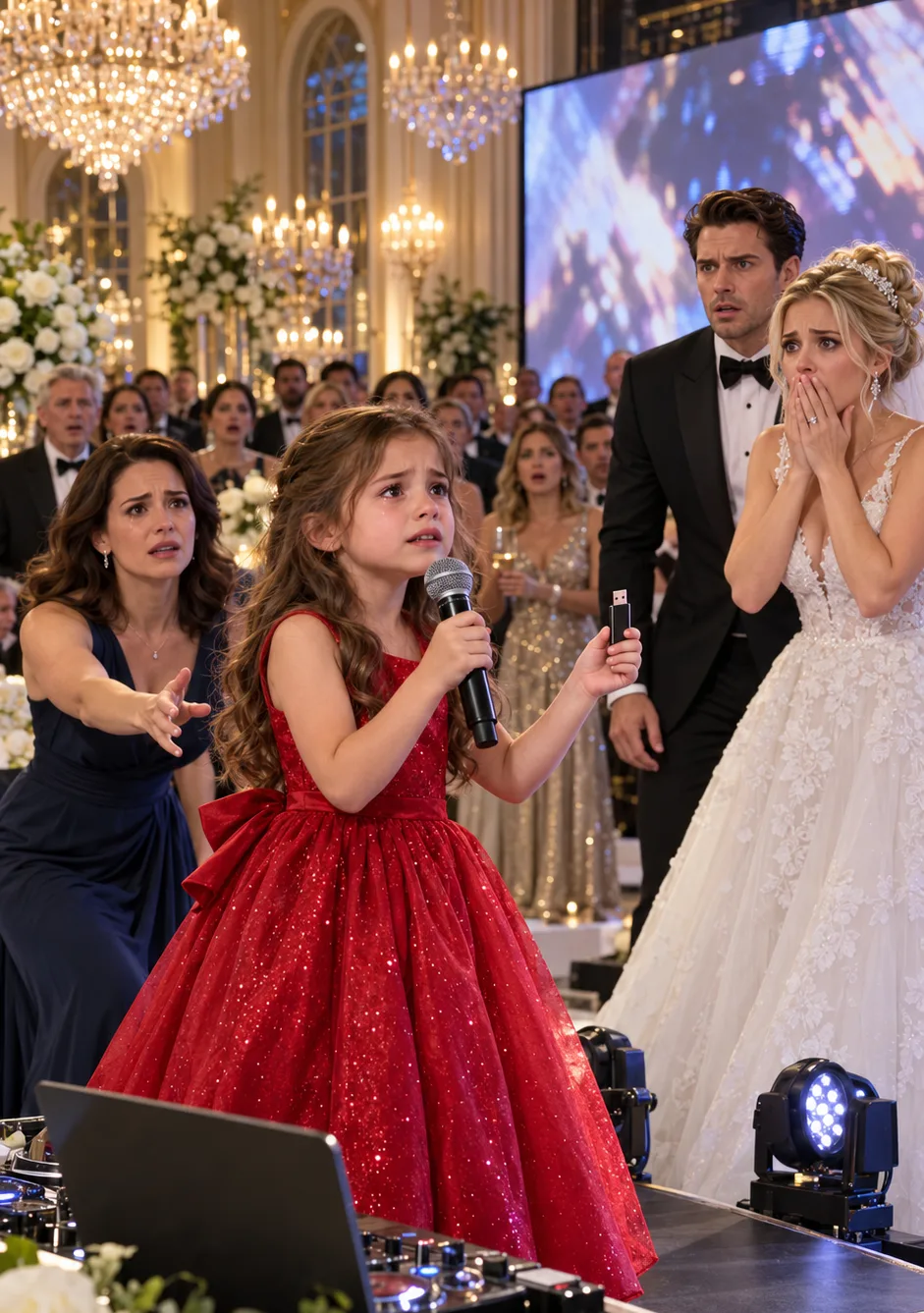
Lily standing on the platform.
Graham’s champagne glass shattering.
The terrible moment when my ex-husband appeared on the screen.
For a second, I could almost hear my daughter’s trembling voice.
Mr. Graham, please don’t marry her.
Then someone touched my hand.
“Mommy?”
I looked down.
Lily stood beside me wearing a beautiful blue dress.
She was nine now.
Her chestnut curls bounced around her shoulders.
“Are you nervous?”
I smiled.
“A little.”
She squeezed my fingers.
“Just pretend everybody’s nice.”
I laughed softly.
“That’s your advice?”
“It worked for me.”
I crouched and hugged her.
“You know something, Lily?”
“What?”
“You changed our lives that night.”
She looked thoughtful.
“Did I do something bad?”
My heart tightened.
“No, sweetheart.”
I brushed a curl away from her face.
“You told the truth when you were afraid.”
She smiled.
“Like Grandpa Andrew?”
My eyes filled with tears.
“Exactly like Grandpa Andrew.”
The ballroom lights dimmed.
Graham approached us.
He looked handsome in a dark suit, but it wasn’t his appearance that made me smile.
It was the way he greeted Lily first.
“Ready for your big night?”
She nodded proudly.
Then he looked at me.
“Your speech is going to be wonderful.”
“You haven’t heard it.”
“I know the person who wrote it.”
I rolled my eyes.
He grinned.
“Too much?”
“Just a little.”
We laughed.
Across the ballroom, guests began taking their seats.
And I realized something remarkable.
A year earlier, I’d entered this estate feeling ashamed of everything I didn’t have.
No husband.
No wealth.
No powerful connections.
My sister had mocked my dress.
My mother had hidden me from the family photographs.
I’d believed the evening would simply be another reminder that I was never enough.
Now I stood in the same room knowing something I should have understood long ago.
I had never been the failure in my family.
I had been the one who refused to become like them.
When my name was announced, I stepped onto the stage.
Three hundred faces turned toward me.
I looked at Lily.
Then I looked at Graham.
And finally, I began.
“My father once told me that being honest matters more than being rich.”
The room fell silent.
“He believed that people deserve to feel safe in their homes, secure in their futures, and respected regardless of how much money they have.”
I paused.
“Twenty-four years ago, my father lost his life after trying to expose wrongdoing.”
Tears blurred my vision.
“For a long time, I believed his story ended there.”
I glanced toward Lily.
“But I was wrong.”
She smiled at me.
“Because truth doesn’t always disappear when someone tries to bury it.
Sometimes it waits in an old wooden boat.
Sometimes it survives in a forgotten letter.”
I took a breath.
“And sometimes, it comes from an eight-year-old girl brave enough to stand in front of three hundred strangers and say something nobody wants to hear.”
The room erupted in applause.
Lily blushed.
Graham stood.
Others followed.
I looked at the little girl who had once worried that asking for cereal at dinner might be too much trouble.
And I understood that no amount of money could ever equal what she had given me.
The courage to stop accepting cruelty as love.
The strength to walk away from people who used family as an excuse to control me.
And the certainty that our future belonged to us.
Later that evening, after the speeches, Graham found me standing near the garden doors.
“Beautiful speech,” he said.
“Thank you.”
We watched Lily dancing with her school friends.
Then Graham took a small velvet box from his jacket.
My heart skipped.
“Graham…”
He laughed.
“Relax.
It’s not what you think.”
He opened it.
Inside was a delicate silver necklace.
A tiny sailboat hung from the chain.
I covered my mouth.
“My father left me that charm,” Graham said.
“He said it reminded him of an old friend who taught him what integrity looked like.”
I touched the little boat.
“Andrew?”
Graham nodded.
“I had it restored.
I thought you should have it.”
Tears spilled down my cheeks.
I didn’t know what to say.
So I hugged him.
For a long moment, we stood together in the soft light.
Then Lily appeared beside us.
“Mommy, are you crying?”
I laughed through my tears.
“Happy tears.”
She looked at Graham.
“Did you make my mommy happy?”
He smiled.
“I hope so.”
Lily nodded approvingly.
“Good.
Because she deserves it.”
Graham looked at me.
“Yes,” he said softly.
“She does.”
A few months later, the three of us spent our first summer weekend at Harbor House under the new occupancy arrangement.
Lily learned to sail a tiny boat in the sheltered cove.
I planted white roses beside the porch.
And Graham repaired the weathered bench where my father used to sit.
We didn’t pretend the past had never happened.
Vanessa still had to face the consequences of her choices.
Daniel’s relationship with Lily remained subject to appropriate legal and therapeutic safeguards, based on her welfare rather than his demands.
My mother never offered the apology I once wanted.
But I had stopped waiting for it.
Some people never become the family you deserved. That doesn’t mean you have to spend your life begging them to change.
One evening, as the sun sank over Newport Harbor, Lily climbed into my lap.
“Mommy?”
“Yes, sweetheart?”
“Do you think Grandpa Andrew can see us?”
I looked out across the water.
The boats rocked gently in the evening breeze.
“I don’t know, baby.”
She rested her head against my shoulder.
“I hope he can.”
“Me too.”
She thought for a moment.
“Do you think he’s proud?”
I kissed her forehead.
“I think he’d be very proud.”
Then she smiled.
“Of you?”
I held her close.
“Of both of us.”
We sat together until the last light disappeared.
And for the first time in twenty-four years, I felt the past loosen its grip.
My father had left me something far greater than a letter, a house, or a hidden fortune.
He had left me an example.
My daughter had reminded me how to live by it.
And the life we built afterward was ours.
Not because we were wealthy.
Not because powerful people had finally taken our side.
But because, when it mattered most, a frightened little girl had refused to remain silent.
THE END.