
“Not yet.”
He laughed. “That’s a better answer than pretending you do.”
Arthur’s company specialized in restoring older homes and commercial buildings after floods, storms, fires, and years of plain neglect. He didn’t automatically tear everything out.
He identified what could still be saved, replaced what couldn’t, documented every detail for insurance claims, and taught property owners the actual difference between damage and decay.
I started working for him on weekends. Soon I was picking up evening shifts too. When the school cleaning contract ended, Arthur hired me full-time.
He taught me how to use moisture meters, repair plaster, sand floors, preserve old window weights, follow lead-safe practices, prepare estimates, photograph damage for insurance files.
He also taught me how to explain expensive problems to frightened homeowners without sounding like I was trying to sell them fear itself.
I loved that work. Damaged buildings made sense to me in a way my childhood never had. A ruined room didn’t need excuses. It needed an honest assessment. Rotten materials had to be removed before healthy sections could be properly restored. Boundaries mattered. So did documentation.
Arthur noticed I was good with nervous clients. I recognized the exact sound of people nearing their breaking point while still trying to stay polite about it. I knew how to stand in a destroyed kitchen and say, “We can manage the next step without pretending this situation is smaller than it actually is.”
For several years, I worked until my hands cracked open in Pennsylvania winters. At night, I took community college courses in construction management, bookkeeping, small-business law. I learned to read contracts carefully, because I already understood exactly what happened when people trusted feelings instead of paper.
Every locked storage trailer needed a full inventory. Every project needed a signature. Every promise needed proof.
When I was twenty-six, Arthur offered to sell me one of his older vans and send along the smaller projects he no longer wanted to bother with himself. I named my company Whitaker Restoration and Finish. I wanted my own last name to stand for something other than Diane’s house.
My first office was a desk shoved into the corner of a rented garage. My first employee was Luis Ramirez, a retired painter who could match stain colors purely by sight. He looked over my first batch of estimates and just shook his head.
“You charge too little,” he said, “because you still feel grateful anyone hired you at all.” He was right. My second employee was Jenna Cole, a bookkeeper who wore bright pink glasses and found three overdue invoices buried in my email within her first week on the job.
“Paige, those customers aren’t confused,” she told me flatly. “They’re hoping you feel too uncomfortable to actually collect what they owe you.” She was right too.
The company grew slowly at first. Then, after a severe hailstorm tore through the Harrisburg suburbs one spring, the phone stopped ever going quiet. For months we repaired porch columns, flooded floors, damaged windows, cracked exterior trim.
A local insurance adjuster started recommending us specifically because our documentation was precise. Real estate agents called when older properties needed careful repairs before listing. Churches contacted us about storm windows.
Families hired us after a parent died and the old home needed to be made safe before anyone could think about selling it.
By thirty, I employed twelve people. We ran four vans and kept a warehouse full of reclaimed flooring, doors, trim, hardware. We’d also built a reputation for telling clients the truth, even when honesty cost us the project outright.
The following year, I bought a property just outside Harrisburg. It included a modest brick house, a detached workshop, a gravel lot for the vans, and an old carriage house I converted into storage for reclaimed materials.
The previous owner had installed a perimeter fence because he’d stored equipment on the property. I upgraded the gate, the lighting, the cameras, the intercom system. I wasn’t frightened of the world.
I simply understood the value of a boundary that didn’t depend on someone else’s willingness to respect it.
A professional security company patrolled the commercial yard at night. Their handlers occasionally brought trained dogs, because the property held expensive tools and irreplaceable architectural materials.
The dogs were controlled, always leashed, thoroughly trained. They weren’t there to hurt anyone. They existed to provide a clear warning before someone made a foolish decision.
I moved into the house with two mattresses, a coffee maker, and Grandma Elaine’s old cookbook, the same one that had once hidden nine hundred dollars in its lining.
On my first evening there, I walked from room to room turning lights on and off simply because I could. No one accused me of wasting electricity. No one told me a room belonged to someone who needed it more than I did. No one stood in the doorway and made me feel like a guest inside my own life.
I slept eight uninterrupted hours that night. That was when I first understood that peace can feel almost suspicious when you were raised inside chaos.
But I practiced anyway. I painted the kitchen green. I planted rosemary beside the back steps. I installed a heavy lock on the front door and programmed the gate code myself. Every part of that property had been earned by the same hands Diane once considered useful only when they served someone else.
Two weeks after I moved in, my mother found the address. I was reviewing invoices for a church restoration project when movement appeared on the camera feed. A silver SUV stopped outside the front gate.
Diane stepped out wearing sunglasses and carrying a purse far too large for an ordinary visit. She studied my house with an expression that tightened something in my stomach immediately. It wasn’t pride. It was calculation wearing maternal concern like a costume.
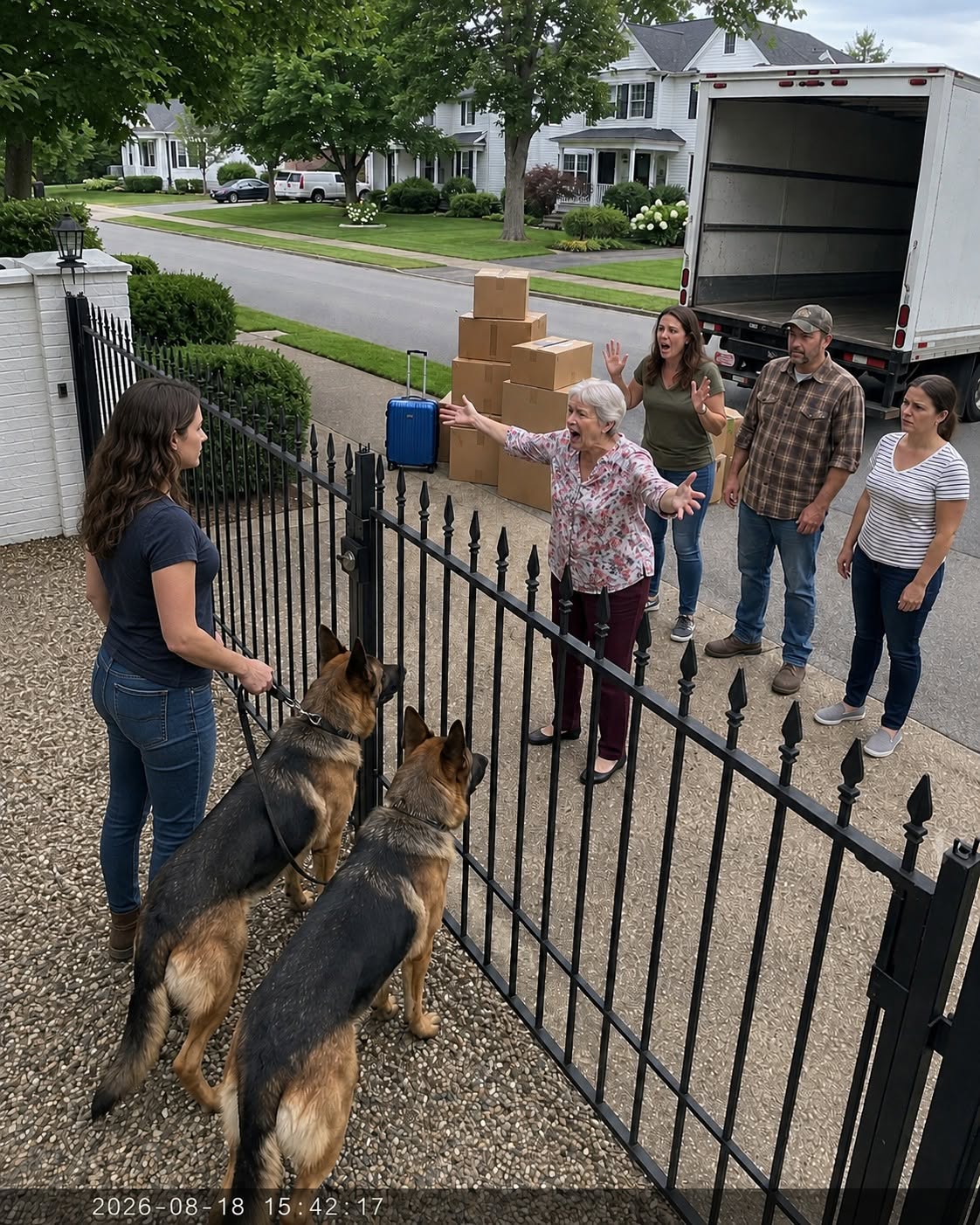
Mallerie got out of the passenger side, looking older than in the photos I’d occasionally seen online, softer around the face but somehow harder around the mouth. Grant parked a rented moving truck so poorly that one rear wheel ended up resting in the grass beside my driveway.
Their three children climbed out with backpacks, tablets, and the weary confusion of kids dragged into an adult decision none of them had made.
Diane pressed the intercom and smiled toward the camera. “Paige, honey. Open the gate. We need to talk.”
I answered through the speaker. “You can talk from there.”
My mother’s smile froze for a second. Mallerie stepped closer. “Seriously? You’re going to leave us standing out here?”
Grant stared through the bars at my workshop and vans. “Nice place,” he said. “Business must be doing well.” He made my success sound like something I’d stolen directly from him.
Diane explained that Mallerie’s lease was ending because the landlord wanted to sell the duplex. Mallerie interrupted to add that the rent had gotten unreasonable. Grant muttered something about landlords being parasites. Then Diane folded her hands like she was about to make an announcement in church.
They’d found a solution that would benefit everyone. Mallerie, Grant, and the children would stay in my downstairs guest suite temporarily.
No one offered any definition of temporarily. Diane would come several nights a week to help with the children.
Grant intended to use part of my workshop to start a furniture resale business, since, according to him, no single woman really needed that many tools. Mallerie said the children deserved a yard.
Then Diane delivered the line she’d clearly been saving for last. “You know what it feels like not to have a comfortable place to sleep. You should be the last person to deny your own family shelter.”
The words moved through me like a blade sharpened slowly over twelve full years. “You remember that?” I asked.
Diane blinked. “Of course I remember how difficult that period was for everyone.”
For everyone. Not for the nineteen-year-old sleeping behind flea market sheds. Not for the girl washing her hair in gas station bathrooms. Not for the daughter who watched her own mother drive past her in the rain.
Mallerie leaned toward the intercom. “Don’t start rewriting history, Paige. Mom worried herself sick. You refused every offer of help.”
“What help?”
Grant laughed loud enough for the microphone to catch it clearly. “This is why nobody bothers contacting you. Everything becomes a trial.”
My mother’s expression changed then. The gentle mask slid away entirely, and the woman from my childhood looked directly into the camera. “You’re single. No husband, no children. You have a house, a yard, and several buildings sitting half empty while your sister’s family is genuinely struggling.”
She paused. “I did not raise you to be selfish.”
That was her mistake. She had raised me to be quiet, useful, and available. She had not raised the woman standing on the other side of that gate.
“The answer is no.”
Mallerie stared at the speaker like it had suddenly started speaking another language. “No?”
“You are not moving into my home. You are not staying here. Grant will not use my workshop.” I glanced at the truck through the camera feed. “You need to move it before I have it towed.”
Their youngest started crying. I felt sorry for the children, genuinely. But pity was not the same thing as permission. Mallerie lifted the little girl and glared toward the camera. “Look what you’re doing. You’re scaring them.”
“You brought them to a locked gate with a moving truck and no invitation. That’s what scared them.”
Grant leaned so close his face filled the camera entirely. “Open the gate, Paige.”
I picked up my phone and called Rachel Monroe, my operations manager. Rachel had dealt with contractors, law enforcement, insurance adjusters, and furious property owners for twenty years. She didn’t panic, and she didn’t negotiate with nonsense.
“I need the front gate handled,” I told her. “Uninvited relatives, moving truck. Bring the security team forward.”
Five minutes later, Rachel walked along the interior driveway with two uniformed handlers and two trained dogs walking calmly at heel beside them. The dogs didn’t bark or pull at their leashes. They stood silently beside their handlers. That silence made the message clearer than any shouting could have.
I stepped out onto my front porch. “Move the truck,” I said through the gate. “Leave the entrance, and do not return without an appointment approved by me in writing.”
Mallerie looked at the dogs, then at me. For the first time in my memory, she seemed genuinely uncertain whether tears would still work on me. Diane lowered her voice. “Paige, this is cruel.”
“No, Mom. This is a boundary with witnesses.”
Grant called me dramatic, bitter, selfish, and several other things the cameras recorded clearly. Rachel informed him the truck was obstructing private commercial access and would be reported if he didn’t move it immediately. That finally persuaded him.
My mother returned to the SUV slowly, shaking her head like I’d failed some test she still believed she had the authority to administer. As they drove away, Mallerie mouthed something through the window. I couldn’t hear it, but I recognized the shape of the words. You’ll regret this.
I stood behind the locked gate and watched the truck disappear down the road. I felt no victory. Only the cold understanding that people who arrive demanding entry rarely accept a single refusal as final.
For three straight days, my phone became a museum of old manipulation. Diane called first, leaving messages about forgiveness, family unity, how badly I’d behaved in front of the children. When I blocked her number, she called from Mallerie’s phone.
After I blocked that one too, Grant reached out through a social media account I’d forgotten I still had, claiming I thought I was better than everyone because I restored houses for wealthy clients. Then the relatives started.
Cousins I hadn’t spoken to in ten years sent long paragraphs about compassion. An aunt who’d never once invited me to Thanksgiving reminded me that children were innocent.
I wrote one response and copied it whenever necessary. They arrived without permission and attempted to move into my home. The answer is no. Do not contact me about this matter again.
Some people stopped. Diane didn’t. On Friday morning, she came alone and pressed the intercom repeatedly while I was in the middle of running payroll. Her eyes looked red. My mother could produce tears as easily as other people brewed coffee.
She said Mallerie was overwhelmed. She said Grant had job possibilities near Harrisburg. She said she was getting too old to carry everyone.
“Why are you still carrying the family you chose over me?” I asked.
That made her cry harder, though not more sincerely. “I made mistakes,” she said. “But you survived. Doesn’t that mean something?”
For years I had confused survival with forgiveness. “It means something to me,” I told her. “It does not create a bedroom for Mallerie.”
Diane’s mouth tightened. “Your grandmother would be ashamed of you.”