
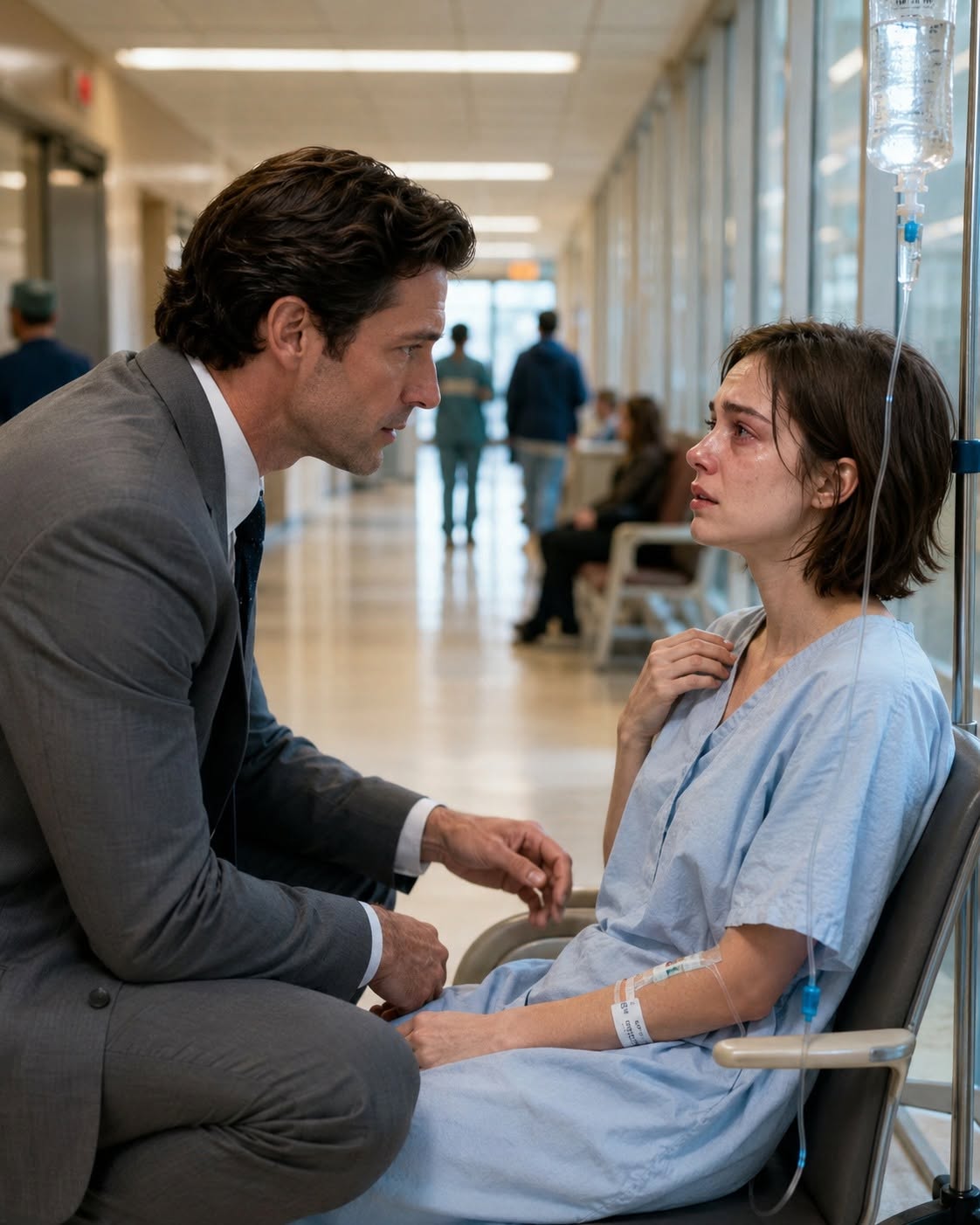
That silence told me she had wondered the same thing.
“My sister helped with paperwork after the miscarriage,” she said. “Lena was there when I couldn’t think clearly. She called insurance. She picked up prescriptions. She handled things I couldn’t look at.”
“You think Lena closed the file?”
“No.” Her voice firmed. “I don’t know. And I’m not accusing her without understanding what happened.”
“But you’re afraid.”
Sophie’s gaze moved toward the phone on the table.
“I’m afraid there’s a version of my life other people made decisions about while I was too broken to ask questions.”
The words stayed between us.
I wanted to take her hand, but this time she reached for mine first.
“We have the appointment in an hour,” she said. “I need you to come with me. Not as my ex-husband trying to fix everything. Not as someone who feels guilty.”
“Then as what?”
She looked at me, tired and brave.
“As the only other person who lost that baby with me.”
I nodded because I could not speak.
St. Vincent Medical Center looked different in daylight.
The lobby was busy with families, nurses, wheelchairs, coffee cups, balloons, flowers, and the strange mixture of fear and hope that every hospital seems to hold. Sophie moved slowly beside me, her hand resting lightly on my arm. This time she did not resist the help.
At the elevator, an elderly man in a Cubs cap smiled at her.
“Long morning?” he asked kindly.
Sophie gave a small smile. “Feels like it.”
He nodded as if he understood everything. “They usually are. But mornings end.”
It was such a simple thing to say, yet Sophie’s fingers tightened around my sleeve.
On the fourth floor, Dr. Patel met us outside an office instead of an exam room. He looked kind but serious, with tired eyes that suggested he had learned not to speak too quickly around frightened people.
“Sophie,” he said, “how are you feeling?”
“Like I had surgery two days ago.”
“That is, unfortunately, medically accurate.”
She laughed softly, and the sound eased something in the hallway.
Then Dr. Patel looked at me.
“Ethan?”
“Yes.”
“Thank you for coming.”
We followed him into his office. There were no harsh exam lights, only a desk, three chairs, and a window overlooking the hospital courtyard. A maple tree below had turned bright orange, its leaves shining against the gray morning.
Dr. Patel sat and folded his hands.
“I want to begin with reassurance,” he said. “The surgery went well. The mass we removed appears consistent with the condition we discussed. We are still waiting for final pathology, but nothing we’ve seen so far suggests the worst-case scenario.”
Sophie exhaled quietly.
I realized I had been holding my breath too.
“That’s good,” I said.
“It is good.” Dr. Patel nodded. “But the reason I asked Sophie to consider bringing you concerns the earlier pregnancy record.”
He opened a file.
“After Sophie’s recent tests, we compared tissue markers with an archived sample from the pregnancy loss three years ago. The match suggests the same condition may have been present then. If properly identified, it likely would have led to follow-up monitoring.”
“And it wasn’t identified?” I asked.
“It was identified enough to trigger a follow-up request.”
Sophie’s face went pale.
Dr. Patel continued carefully. “That request appears to have been canceled.”
“By who?” I asked.
“That is the part we are trying to determine. The cancellation was entered using an administrative login. Not a physician’s note. Not Sophie’s written refusal. Not your consent. Just a system entry.”
Sophie stared at him.
“So someone clicked a button and my care stopped?”
“I’m saying the record shows a cancellation without adequate documentation.”
The professional wording could not hide what it meant.
I felt anger rise, but Sophie’s hand found mine under the edge of the desk. Not to comfort me. To steady me.
I held on.
Dr. Patel turned a page. “There is one more issue. At the time, a note was added indicating that the patient was transferring care to an outside clinic.”
“I never did,” Sophie said.
“I know.”
“Which clinic?” I asked.
Dr. Patel hesitated.
“North Shore Women’s Family Center.”
Sophie’s eyes snapped toward me.
I knew that name.
Not well. Not from our marriage.
From Lena.
“She worked there,” I said.
Sophie’s face changed.
“Lena worked there?”
“You told me once. Years ago. She left after some disagreement with management.”
Sophie shook her head slowly. “No. She told me she worked in billing at a pediatric practice.”
Dr. Patel’s expression remained neutral, but his silence carried weight.
Sophie withdrew her hand from mine and pressed it against her mouth.
“No,” she whispered. “No, that doesn’t make sense.”
“We don’t know that Lena did anything,” I said quickly.
“I know.” Her eyes were bright with tears. “But why would she lie about where she worked?”
Dr. Patel gave her a moment before speaking.
“I’ve requested a formal audit of the record. That will take time. In the meantime, your health is our priority. We’ll monitor your recovery closely, repeat labs, and discuss next steps once pathology is final.”
Sophie nodded mechanically.
But I could tell she was no longer in that office. She was three years in the past, standing in a hallway with a file someone else had closed.
When the appointment ended, we walked to the courtyard instead of the parking garage.
The rain had stopped, and the air smelled clean, sharp, and cold. Sophie sat on a bench beneath the maple tree. Leaves moved above us like small orange flames.
I sat beside her, leaving space between us.
She looked at her hands.
“Lena was there for everything after my mom died,” she said. “When Dad checked out, she made lunches. She signed school forms. She learned how to braid my hair by watching videos because Mom wasn’t there to teach us. She was twenty-two and raising a twelve-year-old.”
I listened.
“She can be controlling. I know that. She decides what’s best and then pushes until people agree. But she loved me.”
“I believe that.”
Sophie looked at me. “Do you?”
“Yes. Love and fear can get tangled. That doesn’t mean the love was fake.”
She turned away, blinking hard.
“I don’t want to discover that my sister hurt me while trying to protect me.”
I thought of our marriage. Of how often I had called avoidance kindness.
“Sometimes people hurt others while trying not to,” I said.
She gave a sad little smile. “You would know.”
“Yes,” I said. “I would.”
For the first time, the words did not feel like defeat. They felt like the beginning of an apology that was no longer asking for anything.
I reached into my coat pocket and pulled out the envelope she had given me before we left. She had asked me to carry it, then said nothing more.
“Do you want this back?” I asked.
Sophie stared at it.
“No. I want you to read it.”
“Now?”
She nodded.
My hands were careful as I opened it.
The letter was written in her soft, familiar handwriting.
Ethan,
If you are reading this, it means I found courage too late or almost too late. I don’t know which is worse.
I wanted to tell you so many things before the divorce, but every time I tried, you looked so tired that I convinced myself silence was mercy.
It wasn’t.
I was sick before we signed the papers. Not just sad. Not just grieving. Sick. I knew something was wrong, and I was scared. I didn’t tell you because I didn’t want you to stay with me out of guilt, and I didn’t want to learn that you wouldn’t stay even if you knew.
That was unfair to both of us.
There is something else. After the first miscarriage, someone from the hospital called about follow-up testing. I went alone. I didn’t understand everything they said, but I understood enough to know there were questions about why we lost the baby.
Then the calls stopped.
I thought maybe the doctors had decided it didn’t matter. Or maybe I wanted to think that because I couldn’t survive another answer.
I have been carrying that fear for three years.
If I wake up from surgery and lose my nerve, please know this: I never stopped loving you. But I stopped trusting that we knew how to love each other without disappearing.
If there is still any kindness between us, help me find the truth.
Not for our marriage.
For the child we lost.
And for the people we used to be before grief taught us how to hide.
Sophie.
By the time I finished, the courtyard had blurred.
I folded the letter slowly.
“I’m sorry,” I said.
She shook her head. “Don’t use it as a wall.”
“What?”
“Sorry can become a place to hide. You say it, I accept it, and then we don’t have to do anything harder.”
I looked at her through the orange leaves and pale hospital light.
“Then tell me what’s harder.”
She took a breath.
“Stay honest after today. Even if the truth makes me angry. Even if it makes you look bad. Even if it doesn’t bring us back together.”
I nodded.
“I can do that.”
She studied my face.
“I need more than the version of you who shows up during emergencies.”
“I know.”
“I need to know you won’t vanish when things become ordinary again.”
The words struck deep because ordinary was where I had failed her most. Not in dramatic moments. Not in one terrible decision. In quiet evenings. In unanswered questions. In rooms where she sat beside me and still felt alone.
“I don’t know what happens to us,” I said. “I don’t know if we rebuild anything or just learn how to stop hurting each other. But I know this: I’m not leaving you alone with this.”
Her chin trembled.
“You can’t promise that because you feel guilty.”
“I’m not.”
“Then why?”
I looked at the hospital windows above us, at all the rooms full of people waiting for news.
“Because I loved our child too,” I said. “And because I love you enough now to stop pretending silence is peace.”
Sophie covered her face with one hand.
I did not reach for her.
I waited.
After a moment, she leaned sideways until her shoulder rested against mine.
It was not forgiveness.
Not exactly.
It was something smaller and more fragile.
A beginning that knew better than to call itself new.
That afternoon, we went back to her apartment and called Lena.
Sophie insisted on doing it herself.
She sat at the kitchen table with the phone between us, Dr. Patel’s notes beside her, the envelope folded neatly near her elbow. I made tea neither of us drank.
Lena answered on the second ring.
“Sophie? Are you okay?”
“I’m home.”
“Is he still there?”
“Yes.”
A pause.
Then Lena said, “I don’t like this.”
“I know.”
“You had surgery. You’re vulnerable. This is exactly when people confuse fear with love.”
Sophie closed her eyes briefly. “Lena, I need to ask you something.”
The line went quiet.
“Did you ever work at North Shore Women’s Family Center?”
The silence that followed was different from the others.
It was not irritation.
It was not protectiveness.
It was recognition.
“Why are you asking that?” Lena said.
Sophie’s face tightened.
“Because my medical record says my follow-up after the first miscarriage was canceled when my care supposedly transferred there.”
“Sophie—”
“Did you work there?”
Another pause.
“Yes.”
The word was small.
Sophie gripped the edge of the table.
“You told me you worked at a pediatric billing office.”
“I did billing for several clinics.”
“Did you cancel my follow-up?”
“No.”
The answer came quickly. Too quickly.
Lena seemed to realize it too, because her voice softened.
“No, Sophie. I didn’t cancel anything.”
“Then why does that clinic appear in my file?”
“I don’t know.”
“Lena.”
“I said I don’t know.”
Sophie looked at me, pain widening her eyes.
I wanted to take the phone and demand answers, but this was not my sister. Not my history. Not my place unless Sophie asked.
She didn’t.
Instead, she leaned closer to the phone.
“You promised after Mom died that you would never lie to me about important things.”
Lena made a quiet sound, almost like a breath breaking.
“I was trying to protect you.”
The room seemed to stop.
Sophie whispered, “From what?”
Lena did not answer.
“From what?” Sophie repeated.
“When you lost the baby, you were disappearing,” Lena said. “You wouldn’t eat. You wouldn’t sleep. Ethan was gone all the time, and you kept telling everyone you were fine when you looked like you were made of paper.”
I flinched but stayed silent.
“I called the clinic because I knew someone there,” Lena continued. “I asked what the follow-up could mean. I shouldn’t have. I know that. But I was scared.”
Sophie’s voice became very soft.
“What did they tell you?”
“They said the results were complicated. That more testing might reveal inherited issues. That it could affect future pregnancies.”
“That was my information to receive.”
“I know.”
“Did you stop them from calling me?”
“No,” Lena said, but her voice cracked. “I told them you needed time. I asked them not to overwhelm you until I could convince you to come in with me.”
“And then?”
“I never convinced you.” Lena was crying now. “And then your marriage got worse. You started talking about trying again, then not trying, then divorce. I thought maybe if you didn’t know, you could survive one grief at a time.”
Sophie’s tears fell silently.
“That wasn’t your choice.”
“I know.”
“Did you change my record?”
“No. I swear I didn’t. I asked questions I had no right to ask. I made calls I shouldn’t have made. But I didn’t enter anything into your file.”
“Then who did?”
Lena’s breath trembled through the speaker.
“There was a woman at the clinic. She handled archived transfers. I only spoke to her twice.”
“What was her name?”
Lena hesitated.
Sophie’s voice sharpened. “Lena.”
“Marianne Vale.”
I looked up.
The name meant nothing to Sophie. I could see that immediately.
But it meant something to me.
Not much.
A memory. A business card. A voice in our old apartment.
Sophie saw my expression change.
“Ethan?”
I swallowed.
“Marianne Vale was my father’s assistant.”
Lena went silent.
Sophie stared at me.
“My father?” she whispered. “Why would someone connected to your father touch my medical file?”
I had no answer.
My father, Richard Carter, had never been warm, but he had always been efficient, respectable, careful with appearances. He was a retired hospital administrator who still donated to medical boards and attended charity dinners in suits that looked more expensive than my monthly rent.
He had not approved of Sophie when we married.
Not openly.
Never cruelly.
Just through small silences, delayed replies, polite questions that made her feel examined.
Are you sure you’re ready for children so soon?
Has Sophie considered going back to work full-time?
Grief can make people dependent, Ethan. Be careful.
At the time, I had dismissed his comments as awkward concern.
Now I felt those memories rearranging themselves into something colder.
Sophie ended the call with Lena after promising to speak again when she had more strength. Then she sat very still.
“You didn’t tell me your father knew someone at that clinic,” she said.
“I didn’t know she worked there. I knew her as his assistant years ago.”
“Would he have known about the miscarriage records?”
“No,” I said automatically.
But Sophie only looked at me.
And the truth was, I didn’t know.
My father knew people everywhere. Hospitals. insurance boards. private practices. He had built his career on connections and called them community. He believed problems were best handled quietly, preferably before anyone outside the family noticed.
The family.
His favorite word.
A word that had never included Sophie easily.
My phone buzzed in my coat pocket.
I pulled it out.
Dad.
For a moment, I simply stared at the screen.
My father rarely called without scheduling it first. He preferred messages, calendars, predictable conversations over Sunday lunch. Yet there was his name, glowing in my hand, as though summoned by suspicion.
Sophie saw it too.
“Answer it,” she said.
I accepted the call and put it on speaker.
“Ethan,” my father said. His voice was calm, familiar, controlled. “I heard Sophie has been unwell.”
Sophie went pale.
I looked at the phone on the table.
“How did you hear that?”
A slight pause.
Then my father said, “We should talk in person.”
“About what?”
Another pause.
This one longer.
“When you come,” he said, “bring the letter Sophie wrote you. And do not involve Dr. Patel again until you understand what your mother did.”
My mother had been dead for six years.
Sophie’s hand flew to her mouth.
And before I could ask a single question, the line went dead.
👉 Follow the page and turn on notifications so you won’t miss the next chapter. The story continues in the next post.


