
Adrian joined Bellamy Holdings as chief strategy officer.
My father announced that the company needed “fresh energy without old emotional conflicts.”
The shares my grandfather left me disappeared during the same period.
I learned of the transfer from an annual filing.
Twenty-two percent of Bellamy Holdings had been reassigned from my trust to a voting entity controlled by my father, Vanessa, and eventually Adrian.
The authorization carried my signature.
The date fell during the week I underwent emergency surgery for a ruptured ovarian cyst.
I remembered that week clearly.
My mother visited once.
Vanessa came twice.
My father sent flowers through an assistant.
No attorney visited.
I signed hospital consent forms and one insurance document.
Nothing else.
When I requested the original transfer records, the company’s general counsel told me all actions had been properly authorized.
He had worked for my father for twenty-five years.
He would not meet my eyes.
I hired an independent attorney.
Her name was Miriam Shaw.
She was sixty, sharp, and uninterested in family mythology.
At our first meeting, she reviewed the documents for twenty minutes.
“Your signature is a high-quality reproduction.”
“So it is forged.”
“Likely.”
“Can we stop the transfer?”
“We can challenge it.”
“How long?”
“Months. Possibly years.”
“My sister is marrying the man involved.”
“That is emotionally significant and legally irrelevant unless the marriage is tied to control changes.”
“It is.”
She looked up.
“How?”
I showed her the draft board restructuring plan I had obtained through a former colleague.
After the wedding, Adrian would receive additional voting authority.
Vanessa would become executive vice chair.
My father would remain chairman but reduce daily responsibilities.
The plan depended on the disputed shares.
Miriam leaned back.
“We need evidence beyond the signature.”
“I can find it.”
“Legally.”
“I know.”
I did.
For six months, I worked like the woman I had been before my family convinced everyone I was unstable.
I traced transactions.
Compared metadata.
Requested public filings.
Reviewed shell companies.
Spoke with former vendors and employees.
Adrian had been siphoning money from Bellamy Holdings almost from the day he joined.
He used consulting contracts, property-option fees, and acquisition deposits routed through companies registered to friends, cousins, and one former college roommate.
Some transactions were small.
Others reached seven figures.
The wedding itself had become part of the fraud.
Deposits for the church reception, hotel ballroom, flowers, and private air travel were paid through an employee-benefits administrative account.
Not directly from pension funds, as I first feared.
But from reserves legally restricted to employee retirement and insurance obligations.
The amount was nearly nine hundred thousand dollars.
My mother’s jewelry appeared inside the same pattern.
She insured a diamond necklace for three times its purchase value through a broker connected to Adrian.
The company paid the premium as an executive-security expense.
One accident or staged theft could produce millions.
When I showed Miriam, she removed her glasses.
“This is no longer a family dispute.”
“I know.”
“We need law enforcement.”
“Not yet.”
“Claire.”
“If we report too early, Adrian destroys records and my father calls everything an internal misunderstanding.”
“You are assuming your father is involved.”
“I am assuming he will protect Vanessa.”
“That is different.”
“Not in effect.”
Miriam did not agree, but she understood.
We contacted a forensic technology firm and preserved everything available through lawful channels.
Then I found Adrian’s earlier marriage.
It began with a property title in Seattle.
One of his shell companies used a residential address that did not match any known associate.
The house belonged jointly to Adrian Cole and a woman named Lena Morales Cole.
I assumed it was a relative.
Then I found the marriage certificate.
Eleven years earlier.
No divorce record followed.
There was a birth certificate for a son named Mateo.
Eight years old.
Adrian had not merely lied about an old relationship.
He was still legally married.
At first, I suspected an administrative error.
Different jurisdiction.
Unrecorded divorce.
Incorrect name.
Miriam searched more carefully.
Nothing.
Adrian remained married to Lena.
The marriage license he had filed with Vanessa included a sworn statement claiming he had never been married.
I called Lena from a prepaid number.
She answered cautiously.
“Hello?”
“Is this Lena Morales?”
“Who is calling?”
“My name is Claire Bennett. I need to ask about Adrian Cole.”
Silence.
Then, “What did he do?”
Not who is Adrian.
What did he do.
I closed my eyes.
“Are you married to him?”
“Who are you?”
“I was engaged to him. Now he is preparing to marry my sister.”
Lena laughed once.
The sound held no humor.
“Of course he is.”
“I have documents. I don’t know whether you divorced privately or—”
“We are not divorced.”
I heard a child speaking in the background.
Lena asked him to finish homework.
Then returned to the call.
“Send me proof.”
“Of what?”
“The wedding.”
I sent the public announcement.
For a full minute, she said nothing.
Then she began crying.
I almost ended the call.
Instead, I waited.
“He told me he was trying to repair everything,” she said.
“When?”
“Last month.”
My stomach turned.
“Did he visit you?”
“He comes every few months. He says the company keeps him away.”
“Does Vanessa know?”
“I don’t know who Vanessa is.”
I sent photographs.
Lena breathed in sharply.
“I’ve seen her.”
“Where?”
“On his phone.”
We spoke for two hours.
Adrian had not abandoned Lena completely.
That would have been simpler.
He maintained two lives.
In Seattle, he was a traveling investor trying to recover from financial setbacks.
He paid inconsistent support, visited Mateo, and promised they would live together again once he stabilized.
In my family, he was an unmarried executive whose former engagement had ended because I was emotionally difficult.
Lena had signed several business documents at Adrian’s request.
She believed they related to tax restructuring.
Some connected her to the shell companies receiving Bellamy money.
She could have faced criminal exposure.
By the end of our first conversation, she understood that.
By the end of our second, she had hired counsel.
By the end of the week, federal investigators knew enough to begin preserving records quietly.
Lena became the key.
She still had access to an old cloud account synchronized with Adrian’s devices.
Investigators obtained proper legal authorization before reviewing it.
The messages revealed everything.
Fraud.
False vendor contracts.
The forged board resolution.
Plans to use Vanessa’s wedding as a public transition of company control.
Adrian called me “the unstable sister” and joked that no one would believe any records I produced.
He told Vanessa that once they married, my claims would look like jealousy.
He told my father that rapid restructuring was necessary because I might “attempt reputational sabotage.”
He told Lena he still loved her.
The black box began as an idea during my third meeting with Lena.
We sat in a hotel conference room halfway between our cities.
She was thirty-nine, with tired brown eyes and dark hair pulled into a loose knot. She carried a photograph of Mateo inside her handbag.
“He should know before the ceremony,” she said.
“Who?”
“Everyone.”
Miriam shook her head.
“Investigators may not approve a public disclosure.”
“They are arresting him?” Lena asked.
“Possibly, but timing is not ours to control.”
“What if he marries her first?”
“The marriage may be invalid because yours remains legal.”
“That doesn’t stop the ceremony.”
I understood what she meant.
Vanessa would stand at the altar believing she had won.
My parents would smile.
Adrian would become publicly embedded in Bellamy Holdings.
Even if authorities acted later, the performance would have done its work.
“We don’t reveal the financial investigation,” Miriam said. “That evidence remains protected.”
“What can we reveal?” I asked.
“The existing marriage certificate is public record.”
“And Lena?”
“She can disclose her own identity and marriage.”
Lena looked at me.
“I don’t want to walk into the church.”
I understood.
Adrian had spent years controlling the shape of her life.
Entering his new wedding would make her pain public before she knew whether she could handle it.
“What about a recording?” I asked.
Miriam frowned.
“What kind?”
“Lena speaks directly to Vanessa. The certificate goes in the box. No financial evidence beyond what investigators authorize.”
Lena considered.
“Would Vanessa believe a flash drive?”
“She’ll believe your face.”
That was how the black box was born.
We rented a private video studio.
No dramatic lighting.
No music.
Lena sat against a plain background.
She introduced herself.
“My name is Lena Morales Cole. Adrian Cole and I were married eleven years ago in King County, Washington. We remain legally married.”
She held up the certified certificate.
Then she spoke about Mateo.
Not to humiliate Vanessa.
To establish the human cost.
“Adrian has visited our son while preparing to marry you. Last month, he told Mateo our family might live together again.”
Her voice broke once.
She stopped recording.
After ten minutes, she began again.
At the end, she said:
“I do not know what Adrian told you. I am not asking you to trust me. Verify the certificate. Contact the county. Ask him why he filed a sworn statement claiming he had never been married.”
The video lasted four minutes and twelve seconds.
Miriam approved it.
Investigators approved the limited disclosure because the marriage record was already public and the delivery would not mention the sealed fraud investigation.
The flash drive also contained copies of the marriage certificate, selected photographs of Adrian with Lena and Mateo, and public records confirming no divorce.
Nothing more.
The financial evidence would arrive through warrants and court filings.
The handwritten card was mine.
I wrote it twice.
The first version was too angry.
You stole my fiancé, my office, and my shares. Enjoy discovering what he stole from you.
Miriam read it and handed it back.
“No.”
“It is true.”
“It makes you look motivated by revenge.”
“I am motivated partly by revenge.”
“Then do not give opposing counsel a handwritten exhibit proving it.”
I tore it up.
The final version read:
Congratulations, Vanessa. You finally received everything you worked so hard to take.
Before you sign anything else, open the file marked PLAY ME.
It was still sharp.
Miriam sighed when she read it.
“I preferred no card.”
“I need the card.”
“Why?”
“Because she needs to understand the box came from me.”
Lena looked at me.
“Will that help?”
“No.”
“Then why?”
I thought about my mother at the apartment door.
My father refusing to look at me.
Vanessa moving into my office.
Adrian joking that my claims would look like jealousy.
“Because they have built the entire wedding around my absence,” I said. “I want the truth to arrive wearing my name.”
Miriam allowed it.
The courier instructions were precise.
Deliver the box to the bridal suite between 1:45 and 2:15.
Require signature.
Do not leave it unattended.
If the bride was unavailable, give it to the wedding coordinator.
The ceremony began at two.
The box arrived at 2:17.
Vanessa had already started walking down the aisle.
The coordinator signed for it and carried it into the church office.
According to Lena’s contact inside the venue, my mother noticed the black box when the coordinator entered through a side door.
She whispered to Vanessa’s maid of honor.
The maid of honor whispered to the best man.
Adrian looked toward the office.
The ceremony continued.
I knew none of that while sitting in my apartment.
At 2:20, my phone buzzed.
A message from Lena.
Coordinator has it.
At 2:24:
They’re taking it to Vanessa after the vows.
I stared at the screen.
That was too late.
Once the marriage certificate was signed, Vanessa might become involved in a legal mess even if the ceremony was invalid.
I called the coordinator from the number Miriam had provided.
No answer.
Lena called her attorney.
Miriam contacted the investigator assigned to the case.
At 2:27, another message arrived.
Vanessa demanded the box now.
I stopped breathing for a second.
Inside the church, the music ended.
The officiant began speaking.
Then, according to three later witness statements, my mother stood from the front row and walked toward the side office.
She intended to remove the box before Vanessa saw it.
The wedding coordinator blocked her.
The package was addressed to the bride and required direct delivery.
My mother demanded to know the sender.
The coordinator pointed to the card.
No return address.
Only Vanessa’s name.
Adrian told everyone to continue.
Vanessa refused.
She believed the box contained jewelry.
That detail came from her maid of honor later.
Vanessa expected a surprise gift from Adrian.
She insisted it be opened before the ceremony proceeded.
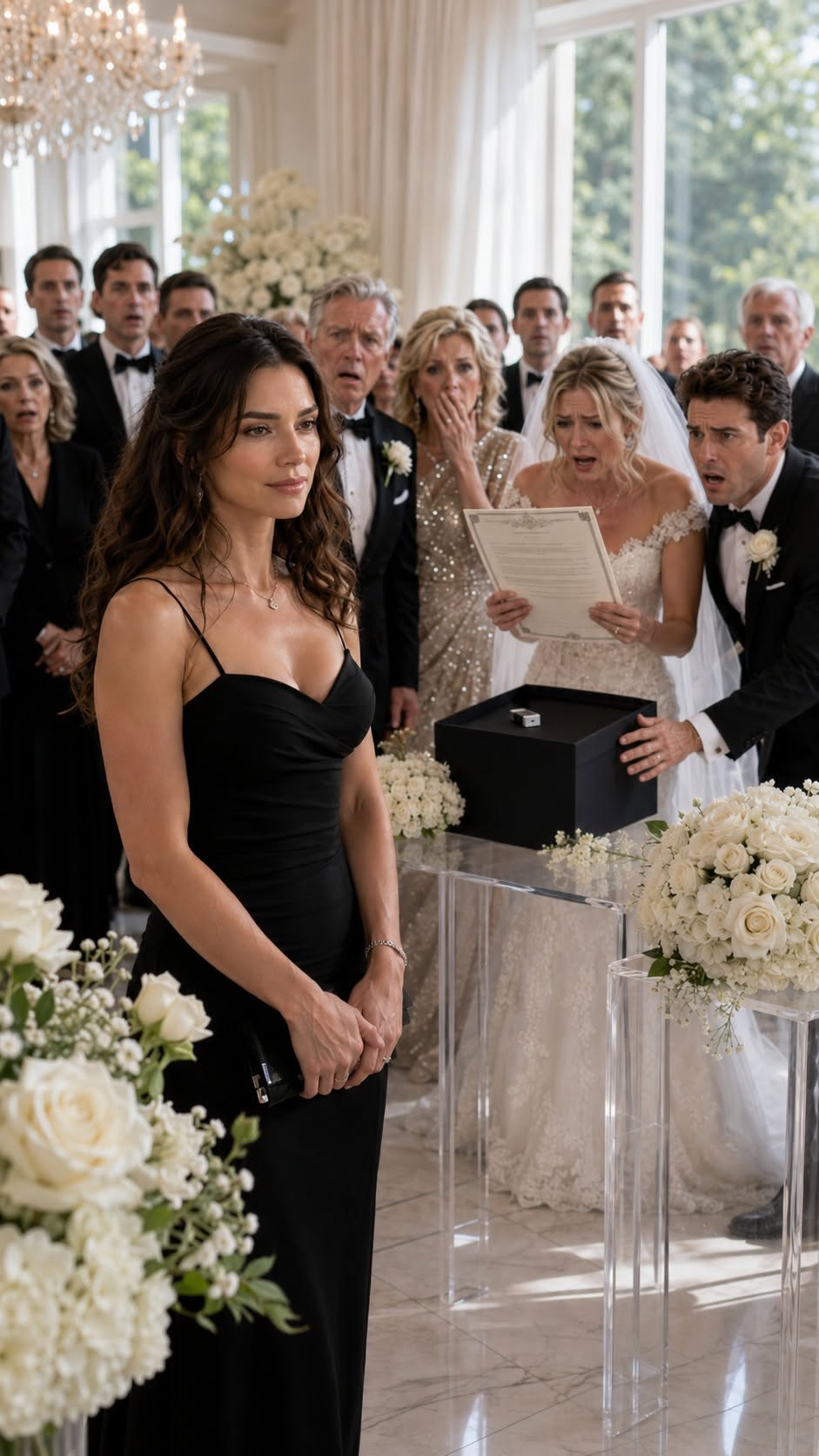
The black box was carried to the altar.
In my apartment, my phone rang.
Lena.
I answered.
“They’re opening it,” she whispered.
“How do you know?”
“My cousin is there.”
I stood beside the kitchen table.
My coffee remained untouched.
The church was ten miles away.
It felt close enough to hear.
Vanessa pulled the silver ribbon.
She opened the lid.
The marriage certificate lay on top.
Beneath it rested the flash drive.
The card had been placed inside the envelope.
For several seconds, no one understood.
Then Vanessa read Adrian’s name.
She looked toward him.
He stepped closer.
According to witnesses, he tried to take the certificate.
Vanessa pulled it away.
My father moved toward them.
My mother demanded that the box be removed.
The officiant asked whether there was a legal concern.
Adrian said no.
Vanessa read the date aloud.
Eleven years earlier.
She saw Lena’s name.
Then Mateo’s.
My sister screamed.
The sound stopped the string quartet, though they had already lowered their instruments.
It carried through the church.
Lena heard it through her cousin’s open phone line.
So did I.
A distant, high sound.
Not cinematic.
Not satisfying.
Human.
I closed my eyes.
For one second, I saw Vanessa as a child standing in our parents’ kitchen after breaking a glass. She had screamed before anyone accused her because noise often arrived before accountability in our family.
Then the church doors opened.
Federal agents entered.
That part had not been in my plan.
The investigation team had decided to act that afternoon after confirming Adrian intended to approve additional transfers during the reception.
They did not come because of the black box.
The timing converged.
Four agents approached the altar.
One spoke to Adrian quietly.
Another handed documents to my father.
The officiant stepped away.
Guests began recording.
My mother shouted that the wedding was private.
An agent told her to remain calm and not touch any documents.
Vanessa stood in her gown holding the marriage certificate.
Adrian looked from the agents to the box.
Then toward the church doors as if calculating whether escape remained possible.
It did not.
At 2:31, Lena said, “They have him.”
I sat down.
My knees no longer felt steady.
“What is Vanessa doing?”
“Watching.”
“Is she all right?”
Lena was silent.
Then, “No.”
The answer should have given me satisfaction.
Instead, I felt tired.
The wedding collapsed within twelve minutes.
Adrian was not taken away in handcuffs immediately.
Agents escorted him to a private room, seized his phone under warrant, and informed him of the investigation.
My father received notice that Bellamy Holdings’ financial records were under federal preservation.
The company’s accounts connected to disputed transfers were frozen.
Vanessa was interviewed as a potential witness and possible participant.
My mother refused to answer questions without counsel.
Guests were asked to leave the church but gather at the reception hotel if they needed belongings or transportation.
Many went anyway.
The reception ballroom had already been prepared.