
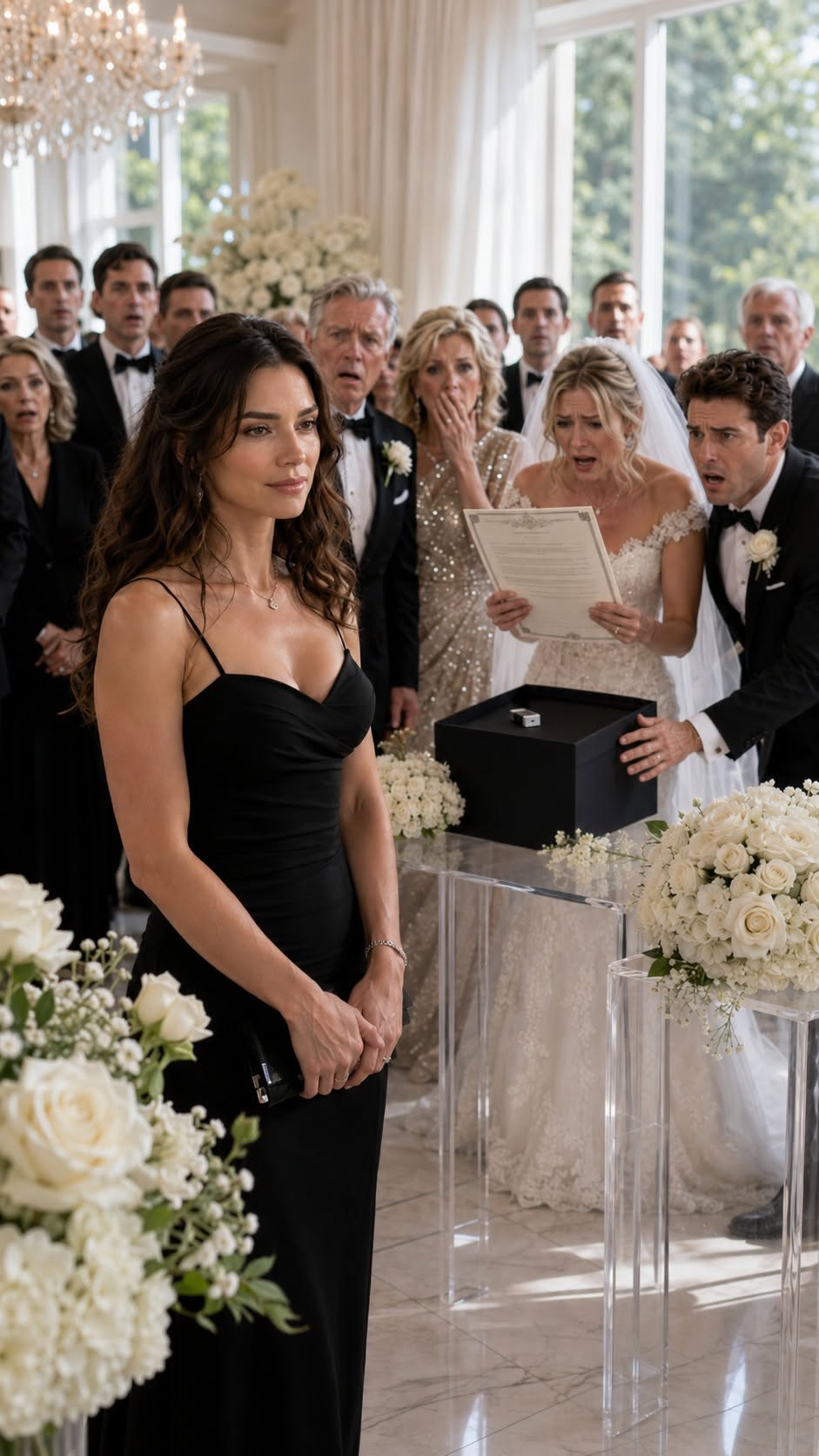
The black box arrived at St. Matthew’s just as my sister began walking down the aisle.
Ten miles away, I sat alone in my apartment and watched the delivery confirmation appear on my phone.
Delivered at 2:17 p.m.
Beneath the message was a photograph taken by the courier.
The box rested on a white linen table near the church entrance, surrounded by pale roses and gold-framed photographs of Vanessa and Adrian smiling beside lakes, vineyards, and expensive hotel balconies.
My box was the only black object in the picture.
It was rectangular, elegant, and tied with a narrow silver ribbon. No return address appeared on the label. Only my sister’s name.
Vanessa Bellamy
Not Vanessa Cole.
Not yet.
I placed my phone facedown beside my laptop.
Through the open window, I could hear traffic moving along the wet street below. Rain had stopped an hour earlier, leaving the buildings gray and the pavement shining.
On the kitchen counter sat a pot of coffee I had forgotten to drink.
My apartment was quiet.
Too quiet for a wedding day.
Three days earlier, my mother had stood on that same doorstep wearing pearls, cream gloves, and the expression she used when asking someone else to accept cruelty as common sense.
“Show your face at the wedding,” she had said, “and you are no longer our daughter.”
My father stood behind her near the elevator.
He did not look at me.
He rarely spoke when silence allowed my mother to become the crueler person.
I had folded my arms.
“Was I invited?”
Mother’s eyes narrowed.
“You received the invitation.”
“It arrived after the RSVP deadline.”
“You knew the date.”
“Vanessa changed it twice.”
“That is irrelevant.”
“Then why are you here?”
“To prevent a scene.”
I almost laughed.
For most of my life, my family had treated my presence as a potential disturbance and Vanessa’s behavior as something everyone else was responsible for managing.
“I haven’t threatened to attend,” I said.
“You have a way of appearing where you’re not wanted.”
“This is my apartment.”
My father shifted behind her.
“Claire, don’t make this difficult.”
There it was.
Difficult.
At seven, I was difficult because I refused to give Vanessa the doll our grandmother had brought me from France.
At thirteen, I was difficult because I told a teacher Vanessa had copied my homework.
At twenty-two, I was difficult because I wanted voting rights connected to the company shares our grandfather left equally to both of us.
Vanessa was younger by three years, prettier in the polished way my mother understood, and gifted at making desire look like injury.
If she wanted something and I said no, my refusal became evidence of selfishness.
Mother stepped closer.
“You have already caused enough humiliation.”
“By asking why my company shares disappeared?”
“They did not disappear.”
“They were transferred.”
“Under legal authority.”
“Using documents signed while I was recovering from surgery.”
My father finally looked at me.
“You signed them.”
“No.”
“You don’t remember.”
“I remember every nurse who entered my room. I remember the medication schedule. I remember Vanessa bringing flowers and asking where I kept my office passwords.”
Mother gave a tired sigh.
“You have always created stories when reality disappointed you.”
I looked at my father.
“Did you bring the originals?”
His face tightened.
“What originals?”
“The share-transfer authorization. The board resolution. The signature verification.”
“This is not a business meeting.”
“No. It’s a threat delivered in my hallway.”
Mother removed one glove finger by finger.
“You lost Adrian. Vanessa did not steal him.”
“I didn’t say she stole him.”
“You imply it constantly.”
“I said he was engaged to me when she began seeing him.”
“She understood him better.”
“That is one description.”
Mother’s mouth hardened.
“She is marrying him. You will respect that.”
“By disappearing?”
“Yes.”
My father flinched at her bluntness, but he did not correct her.
I looked between them.
“You want me erased so the photographs look peaceful.”
“We want one day without your bitterness.”
“What happens after that day?”
Mother smiled.
It was a small, confident smile.
“After the wedding, Vanessa and Adrian will take formal control of Bellamy Holdings. Your father will announce the new structure next month.”
There it was.
The real reason for the visit.
The wedding was not merely a celebration.
It was part of a transfer.
A public performance designed to make Adrian’s entry into the family company look natural and permanent.
“And my shares?” I asked.
“You no longer hold them.”
“That remains disputed.”
“Only by you.”
“Not for long.”
My father’s head lifted.
“What does that mean?”
“Nothing you need to worry about today.”
Mother’s eyes sharpened.
“You will not interfere.”
I thought of the black box waiting inside my bedroom closet.
At that point, it contained only the flash drive and printed documents. I had not yet added the handwritten card.
“I won’t attend,” I said.
Mother studied my face.
“You promise?”
“Yes.”
My father exhaled.
Mother replaced her glove.
“Good.”
She turned toward the elevator.
Before leaving, she looked back.
“If you contact Vanessa, Adrian, the church, the hotel, or any guest, you are finished with this family.”
I leaned against the doorframe.
“Was I still part of it?”
Neither of them answered.
The elevator closed between us.
For several minutes, I stood in the hallway staring at the polished metal doors.
Then I returned to my apartment, opened the closet, and took out the black box.
I had spent six months preparing for that wedding.
Not the ceremony.
The moment when everyone who had ignored me would be gathered in one place, confident that their version of events had become permanent.
Two years earlier, I had introduced Vanessa to Adrian Cole.
At the time, Adrian was my fiancé.
We met at a commercial-property conference in Chicago, where he spoke on a panel about distressed urban redevelopment.
He wore a navy suit, no tie, and the kind of relaxed smile men practiced when they wanted ambition to appear effortless.
Afterward, he approached me near the coffee station.
“You asked the only useful question in that room.”
I had asked how his company calculated projected occupancy in neighborhoods where local businesses were already being displaced.
“The answer wasn’t useful,” I said.
He laughed.
“I didn’t say I gave one.”
That honesty attracted me.
At least, I believed it was honesty.
We spoke for forty minutes.
He asked about Bellamy Holdings.
I told him I worked in internal financial analysis and risk management.
He did not seem impressed by the family name.
That impressed me.
For most of my adult life, people reacted differently after learning my father controlled one of the largest privately held property groups in the region.
Some became careful.
Others became curious.
Adrian remained interested in what I thought.
At dinner that evening, he asked why Bellamy Holdings had avoided expanding into luxury residential towers.
“Because my father understands warehouses better than human beings,” I said.
Adrian laughed.
Six months later, we were engaged.
My parents approved immediately.
My father liked Adrian’s confidence and connections.
My mother liked his family background, education, and photograph-friendly face.
Vanessa liked him too.
At first, I thought her interest was harmless.
She flirted with everyone.
At family dinners, she touched people’s arms when laughing and asked personal questions with a softness that made intrusion feel flattering.
Adrian enjoyed her attention.
I noticed.
I did not worry.
That was before Vanessa began calling him directly about company matters.
She had recently become vice president of brand strategy at Bellamy Holdings, a title my father created after she abandoned two previous careers.
Her responsibilities were vague.
She selected charity partnerships, approved social events, and represented the company in photographs.
I performed audits no one wanted to discuss at dinner.
Vanessa represented the family.
I protected it.
Our father valued the first role more because it attracted applause.
The affair began during a Bellamy resort project in Aspen.
I discovered it through hotel invoices.
Two suites had been booked for Adrian and Vanessa.
One was canceled after check-in.
Room-service charges continued for both names on one account.
When I asked Adrian, he smiled patiently.
“Vanessa was frightened after someone followed her from the lobby.”
“Why did she stay in your room?”
“She didn’t. We worked in the sitting area.”
“Until four in the morning?”
“Claire.”
That single word contained disappointment, warning, and condescension.
“You’ve been under pressure,” he continued. “You see fraud everywhere.”
“I see charges.”
“You see stories inside them.”
That was how he began teaching me not to trust the skill that had built my career.
Vanessa cried when I confronted her.
“How could you think that about me?”
“You stayed in his suite.”
“I was scared.”
“You posted photographs from the hotel bar two hours later.”
“I was trying to feel normal.”
Mother became involved by dinner.
“You are humiliating your sister over an invoice.”
“I asked a question.”
“You accused her of sleeping with your fiancé.”
“Was she?”
Vanessa ran from the table.
My father followed her.
Mother stared at me as if I had thrown something.
“You have always resented her.”
The conversation ended there.
Three months later, Adrian postponed our wedding.
He said I had become suspicious and emotionally exhausting.
Two weeks after that, he moved out of our apartment.
Six months later, he appeared beside Vanessa at a charity gala.
They claimed the relationship had begun after our separation.
My parents repeated the claim so often that relatives began treating it as fact.
I did not fight publicly.
I moved into a smaller apartment and returned to contract accounting work after my father removed me from the company.
Officially, I had taken medical leave.
Unofficially, security revoked my building access.
Vanessa moved into my office.