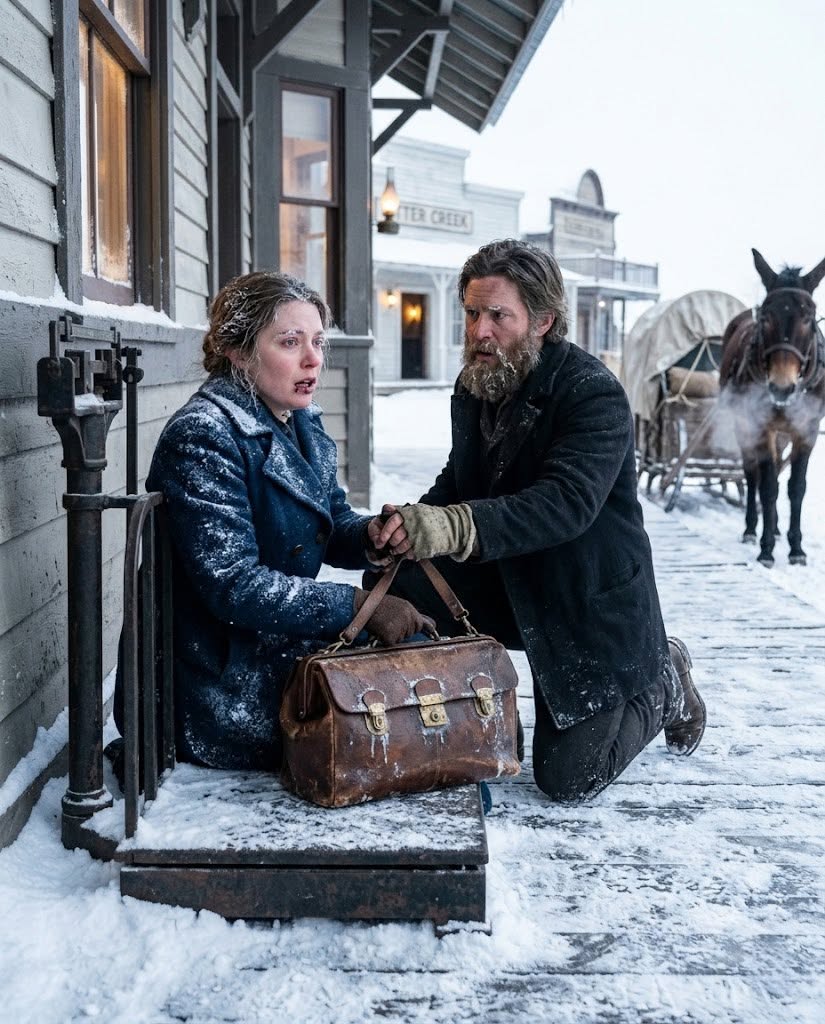
Boon had gone to Bitter Creek for coffee beans, rifle cartridges, and the kind of supplies a man bought when he did not plan to see another face until spring.
He had not come down the mountain to save anybody.
That mattered, because Boon was the sort of man who planned every mile before he took it.
He knew where the snow loaded heavy on the north side of the ridge.
He knew which switchback caught ice before dusk.
He knew how long fifty pounds of flour would last if he kept the fire low, stretched the pork thin, and did not let loneliness trick him into waste.
People in town called that hard living.
Boon called it arithmetic.
The day he came down, Bitter Creek looked less like a settlement than a graveyard that had learned to stand upright.
Three false-front buildings leaned away from the wind, their painted boards faded and warped until even the signs looked tired.
The mercantile smelled of rancid bacon grease, lamp oil, damp wool, and wet sawdust pressed into the cracks of the floor.
Men stood inside pretending to talk about prices while their eyes kept shifting toward the sky.
Everybody in that country knew what a bruised purple ridge line meant.
The storm was moving in.
Boon bought what he needed without lingering.
Coffee beans.
Rifle cartridges.
Salted pork.
Two tins of black powder.
Enough flour to carry him through the part of winter that made trails vanish and men foolish.
The clerk tried to make talk about the pass, about the train, about a teamster who had turned back near the west cut.
Boon answered with grunts and coins.
He did not dislike people exactly.
He disliked the way people turned a quiet day into a debt.
A question became a favor.
A favor became a promise.
A promise became someone else’s life hanging around your neck when the weather changed.
By the time he reached the depot platform, his sled was loaded and roped tight.
Snow had begun to slide sideways across the boards in quick white sheets, hard enough to sting the exposed strip of skin above his collar.
His lead mule stamped once, irritated and impatient, and blew steam through its nostrils.
Boon understood the animal’s mood.
There was no good reason to stay.
The iron roof of the depot screamed when the wind hit it.
The ticket window was dark.
The door was locked.
The station master had given up on duty two hours earlier and gone to the saloon, which meant he had already decided no train was worth freezing sober for.
The westbound was not coming anyway.
The tracks through the pass were buried under ten feet of drift, and any engineer who tried to force that grade would be gambling with more lives than his own.
Boon checked the tarp again.
He pulled the cinch tight until the rope bit into the load and the mule tossed its head.
He was thinking of the treeline.
He was thinking of his cabin stove.
He was thinking of the coffee he would grind by hand once he was back above the worst of the smoke and noise.
Then he heard something.