
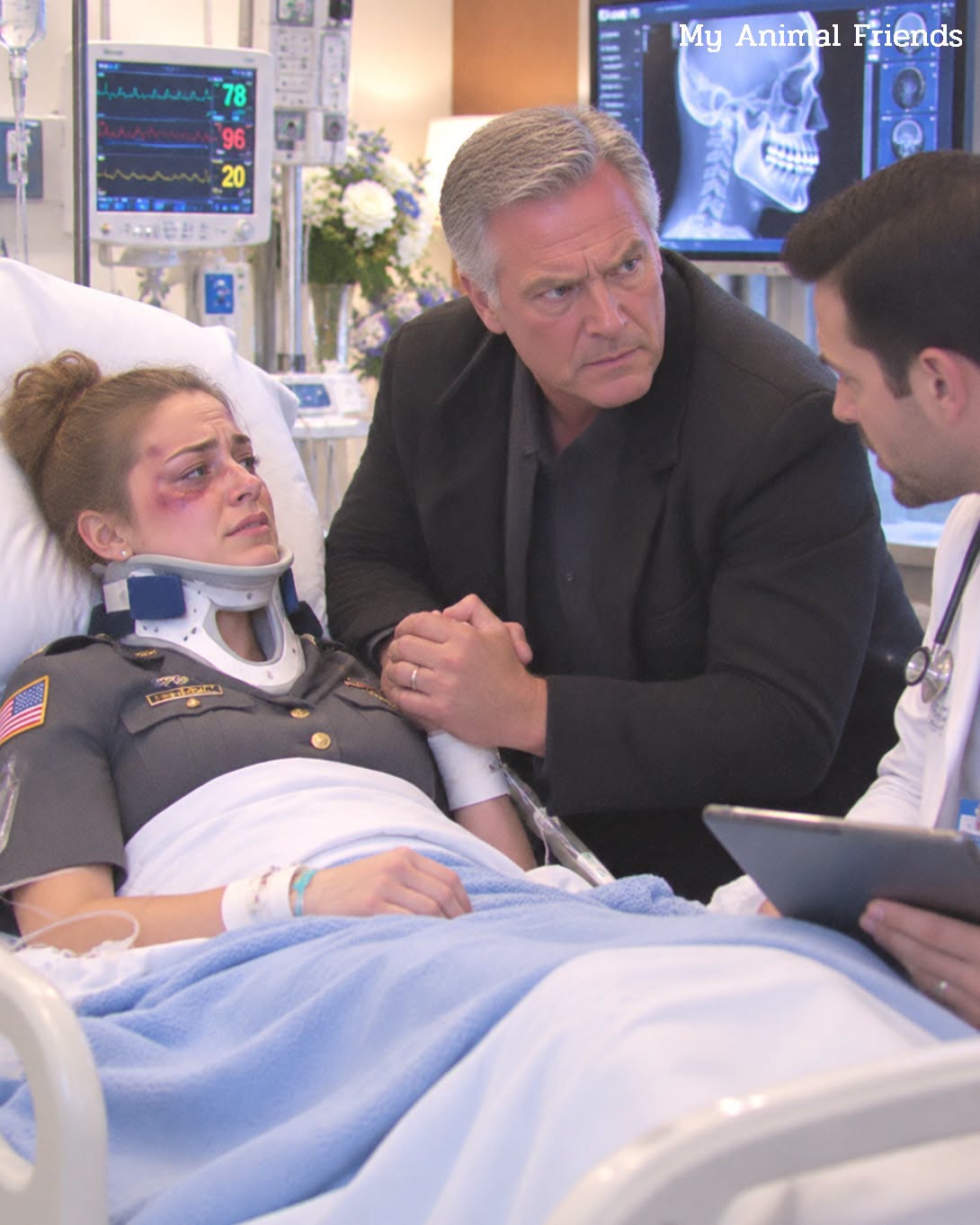
Power becomes dangerous when people stop thinking of it as power and start thinking of it as immunity.
Someone had apparently decided that the right last name, the right uniform, and the right family connections could turn violence into an administrative inconvenience.
Maybe they expected Lily’s father to arrive angry, frightened, and confused.
Maybe they expected me to demand answers from people who had already prepared answers for me.
Maybe they expected me to accept a failed camera system, invisible witnesses, missed patrols, and a disturbed evidence seal as four unrelated pieces of bad luck.
I looked through the glass toward Lily’s room.
Her hand rested motionless against the white sheet.
Something in me became very calm.
That calm had frightened people before.
Not because it meant I was going to hurt someone.
Because it meant I had stopped reacting and started thinking.
There would be no threats.
No shouting in hallways.
No dramatic confrontation with three cadets whose families might already be expecting one.
Anger was easy to anticipate.
Questions were harder.
Records were harder.
Patterns were harder.
People who believed themselves protected often became careless because everyone around them had learned not to look too closely.
I intended to look closely.
I stepped into the hallway outside Lily’s room and reached into my coat.
For nineteen years, a small black phone had stayed locked away with possessions from a life I had promised myself was over.
I had kept it for reasons I never explained, even to myself.
Maybe part of me knew that certain doors, once opened, never truly disappeared.
The phone was old.
Its casing was worn smooth at the corners.
I turned it on.
The battery still held a charge.
There was only one encrypted number stored inside.
For a moment, my thumb hovered over it.
Calling that number meant crossing a line I had spent nineteen years refusing to approach.
I thought about Lily learning to ride a bicycle while I ran beside her pretending I wasn’t terrified she would fall.
I thought about high school graduation photographs.
I thought about her first week at the academy, when she called me annoyed because I had texted three times before lunch to ask whether she had eaten.
Then I looked through the glass again.
The hesitation disappeared.
I pressed call.
A man answered after one ring.
For several seconds, neither of us spoke.
There are voices you can go decades without hearing and still recognize before the first full word.
“Commander?”
Marcus Reed.
My former intelligence officer.
He sounded older.
So did I.
But the way he said that one word pulled nineteen years into a single breath.
“I need three cadets investigated.”
There was no reunion in his response.
No surprise wasted on questions that could wait.
His tone changed instantly.
“How deep?”
I looked through the glass at Lily.
Her hand remained still against the white sheet.
The bruising around her eyes looked almost black beneath the hospital lights.
I remembered the X-ray.
Six fractures.
I remembered the captain refusing to meet my eyes.
The disturbed evidence seal.
The three names.
The cameras that failed.
The patrols that somehow saw nothing.
“Everything,” I said. “Bank accounts. Communications. Deleted footage. Academy complaints. Witness transfers. Every person who helped keep this quiet.”
Marcus did not ask me why.
That was one of the reasons he had once been very good at his job.
He understood context before other people finished explaining it.
And he knew me well enough to understand something else.
If I had called that number after nineteen years, then whatever had happened was already far beyond an ordinary disciplinary problem.
I could hear him moving on the other end of the call.
Not rushing.
Working.
The sound brought back memories I had spent years teaching myself not to revisit.
Maps spread across tables.
Names connected by lines.
Information that meant nothing until one small inconsistency turned it into a pattern.
But this was not a battlefield.
That distinction mattered.
I was not calling Marcus to wage a private war.
I was calling him because someone had relied on darkness, missing records, intimidated witnesses, and family influence to keep the truth buried.
Truth could be uncovered without becoming the thing you were fighting.
That was the line I intended to hold.
For Lily.
For myself.
For the father I had chosen to become nineteen years earlier.
The Ghost Commander was supposed to be gone.
Maybe in every way that mattered, he still was.
The man standing outside that hospital room was not looking for revenge.
He was looking for the truth about why his daughter had been left broken behind a science building while an entire institution somehow failed to see anything.
And somewhere inside that academy were three young men who believed their names could protect them.
They believed a failed camera could erase what happened.
They believed witnesses could be persuaded to forget.
They believed complaints could disappear into the right hands.
They believed Lily would wake up too frightened to speak.
Most of all, they believed her father was simply Daniel Walker, retired logistics officer, worried parent, ordinary man.
They were right about one part of that.
I was her father before I was anything else.
That was exactly why I had made the call.
Marcus went quiet for a moment.
Then he asked one final question.
“Do you have anything to start with?”
I looked down at the torn academy sweatshirt still inside the evidence bag.
At the disturbed seal.
At the bloodstained scrap of paper concealed inside its lining.
At the three names Lily had managed to leave behind.
“Yes,” I said.
Because Lily had left behind more than a torn sweatshirt.