
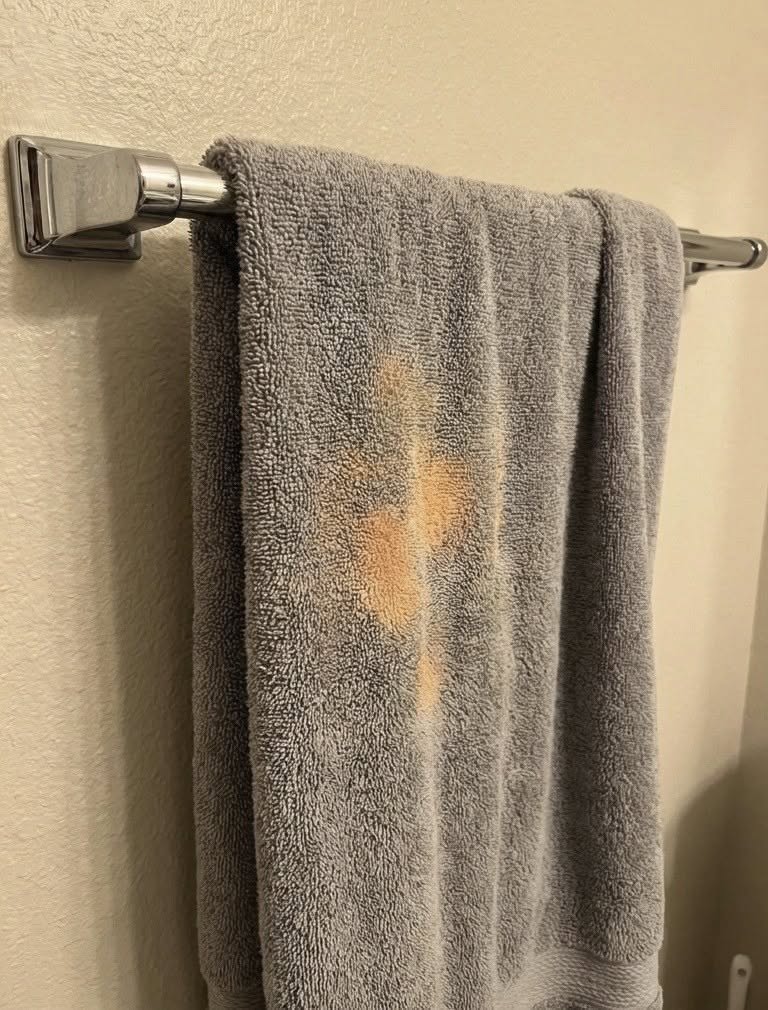
Have you ever taken a towel out of the washing machine and suddenly discovered strange orange stains that definitely weren’t there before? Stains that look like neither dirt nor rust—and simply won’t come out, no matter how many times you wash them? You are not alone. Many people experience this exact phenomenon and are left baffled by seemingly “cursed” towels.
Why Your Towels Are Getting Orange Stains That Won’t Wash Out
I can still remember the very first time I saw it—that strange, almost neon-orange blotch on my favorite towel. It didn’t even look like a normal stain; it had a glow, almost like it had been highlighted. My first thought was, “It must be rust from the towel rack.” Or maybe I’d spilled something and completely forgotten about it. I threw it in the wash with extra detergent, feeling a bit overconfident… but nope, it came out exactly the same, with that orange blotch still there.
Over the next few weeks, a few other towels developed similar “splendor,” and suddenly my bathroom looked like a pumpkin-spice poltergeist had taken it over. If your towels, pillowcases, or even T-shirts have ever developed those cursed orange stains that just won’t go away, you aren’t losing your mind—there are a few surprisingly common causes.
The Main Culprit: Benzoyl Peroxide
This one really got me. Benzoyl peroxide—the active ingredient in many acne creams and cleansers—is harsh on fabric. It’s a bleaching agent, meaning it doesn’t just stain the towel; it completely strips away the dye.
That’s why the blotch doesn’t look like a random transfer of color. It looks more like an orange or yellowish bleached spot, which is especially visible on darker fabrics. And because the color is actually removed from the fibers themselves, no amount of scrubbing, soaking, or “magic” stain remover will bring that original color back. For me, the pieces finally fell into place when I connected the dots: it happened whenever my face and hands touched the towel after I’d washed up at night. After rinsing off my cleanser, I would pat myself dry and perhaps rest on the towel while brushing my teeth—and I wondered if even brief contact could cause cumulative damage.
Rust and iron in the water
Not every orange stain comes from synthetic chemicals in skincare products. If you live somewhere with high iron content in your water—especially if you rely on well water—you might find tiny, rust-colored speckles appearing on your laundry.
I learned this the hard way while visiting a friend who lived in the countryside. After just two washes, my white towel was covered in small orange dots. The right solution in this situation wasn’t detergent, but a rust-removing laundry additive designed to bind to the iron before it could adhere to the fabric.
Hair products and self-tanners
Here’s another sneaky culprit. Certain hair products—especially those containing color-depositing pigments—and self-tanning lotions can leave orange or brown stains on your towels. Even if the product feels “dry” on your skin or hair, it can still transfer during the friction of towel-drying.
I discovered this after repeatedly noticing faint orange stains on the towels I used for my hair… even though I had never used a self-tanner. It turned out my “heat-enhancing” shampoo contained a small amount of pigment that transferred every time I wrapped my hair in a towel.
Cleaning products that act like bleach
Bleach and hydrogen peroxide aren’t just for laundry; they can also lurk in disinfectant sprays, toilet bowl cleaners, and surface-cleaning wipes. If you are cleaning up and absentmindedly wipe your hands on a towel, that is enough to create a discolored patch.
A friend of mine, whose kitchen towels turned pink during a cleaning spree, thought the problem started with her washing machine—until she realized she was using a spray cleaner on her counters and then drying her hands on the nearest towel.
What actually helped prevent it
Once I identified the main culprits, I started treating my towels like my favorite clothes. Here is what helped:
Use white towels for skincare: When I use products containing benzoyl peroxide, I stick to plain white washcloths. That way, any bleaching marks are invisible.
Wait for products to dry: With acne treatments or self-tanners, I always wait for the product to be fully absorbed before touching any fabric. Standing around waiting is annoying, but it saves my towels.
Use filtered water or a rust remover: If your local water has a high iron content, you can use a laundry additive to prevent those pesky little rust spots.
Do you have a dedicated hair towel? I keep a few old towels in the bathroom specifically for drying my hair so that any pigment or dye residue from the shampoo doesn’t ruin my nice towel sets.
Can the damage be removed?
If the stain is caused by benzoyl peroxide or bleach, it is unfortunately permanent—meaning the color has literally been stripped from the fibers. You could:
Dye the entire towel a darker color to hide it.
Repurpose it as a cleaning cloth or hair towel.
Tap the photo to view the full recipe.