As evidence against himself.
Cruelty gets renamed when adults do not want to admit what it is. Fear becomes discipline, and silence becomes respect, but children still understand what happens when a mistake brings pain.
I reached toward his ankle.
Noah moved before I touched him.
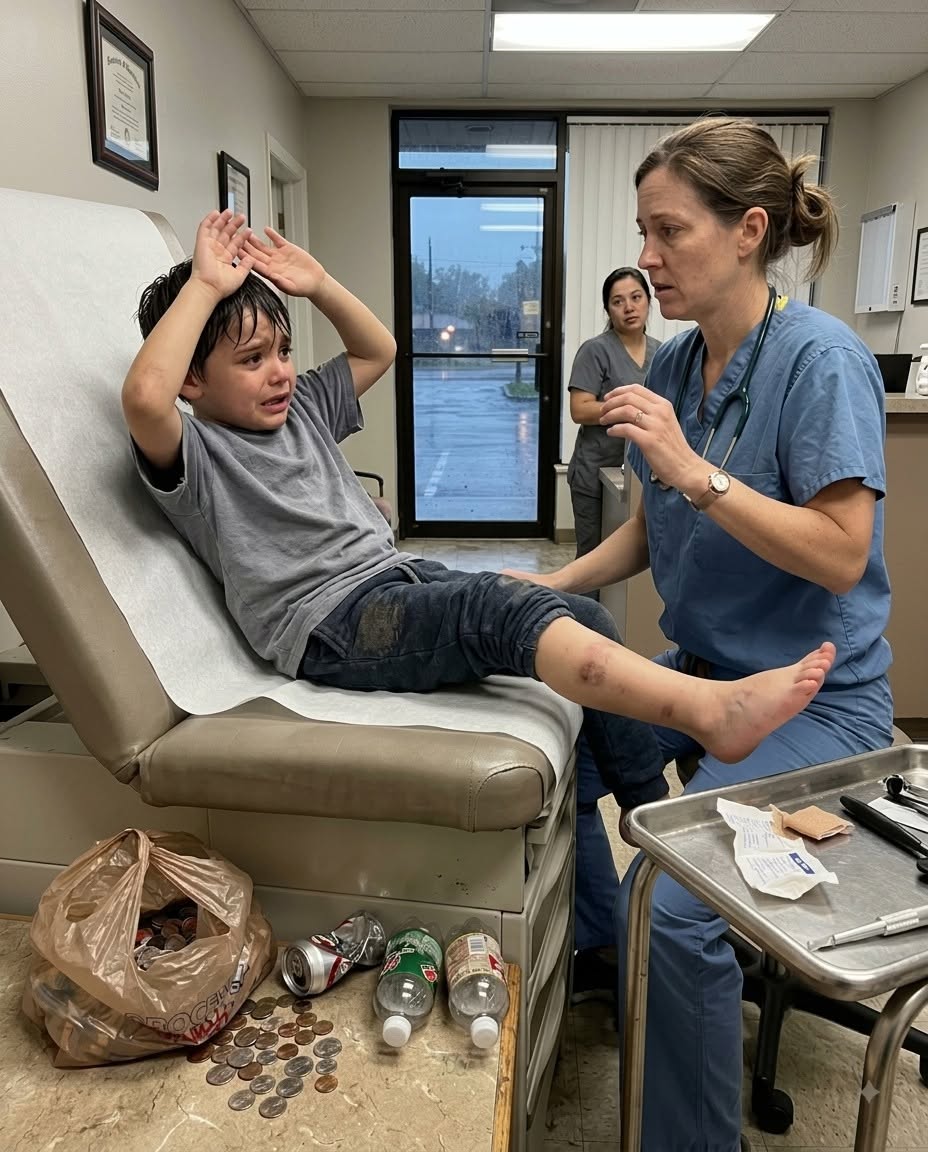
He jerked backward so hard that his shoulder struck the exam table. Both hands flew over his head.
“Don’t hit me!” he cried. “Please. I’ll be good now.”
My hand stopped in the air.
That movement told me something his earlier words had not.
He had not merely been warned.
He had learned to protect his head.
I turned away long enough to get control of my face and my breathing.
Then I washed my hands, opened a clean bandage pack, and made my voice as calm as I could.
“Noah, nobody is hitting you here.”
He watched me closely.
Not with trust yet.
With calculation.
Children who feel safe can be impatient, noisy, stubborn, demanding, silly.
Noah watched every movement I made as if he were studying for an exam where the wrong answer hurt.
At 6:18 p.m., I began documenting everything I could observe.
The swelling.
The bruises.
The condition of his leg.
The older marks.
The way he reacted when I reached toward him.
I wrote details into his medical file because five years earlier I had learned what money and influence could do when an inconvenient truth stood in the way of a powerful family.
I photographed the swelling.
I kept the X-ray plate beside him.
I did not want memory to be the only thing standing between Noah and whatever explanation might come later.
Facts mattered.
Times mattered.
Condition mattered.
After I finished the first round of documentation, I warmed some soup.
I had half a boiled egg left in my lunch bag, so I gave him that too.
He ate slowly.
Carefully.
Almost nervously.
He did not eat like a hungry child who had finally been handed food.
He ate like someone expecting to be told he had taken too much.
When he finished, he stared at the bowl.
“Do I wash this?”
I had spent years imagining what I would say if I ever saw my son again.
None of those imagined conversations included explaining that he did not have to wash a soup bowl after receiving treatment for a broken leg.
None included empty bottles.
None included bruises.
None included him calling himself bad.
I told him to leave the bowl alone.
A few minutes later, he tried to stand.
Pain folded him almost immediately.
I caught him before he hit the floor.
His hands grabbed the front of my shirt, and for one second I thought he was simply holding on because his leg hurt.
Then he began apologizing.
“I’m sorry,” he whispered against me. “I’m sorry. I’m sorry.”
I held him.
The clinic smelled like rubbing alcohol, wet pavement, and burned coffee.
My son was in my arms for the first time in five years, and he did not know who I was.
I could have told him.
Every part of me wanted to.
But he was injured, frightened, exhausted, and trapped in a reality I still did not fully understand.
The truth about me could wait a little longer.
His safety could not.
“Noah,” I asked softly, “if I take you back tonight, are they going to hurt you?”
He did not answer right away.
His fingers tightened in my shirt.
Then he shut his eyes.
“I’m going to try not to cry.”
That was his answer.
Not yes.
Not no.
A promise to control his own pain so someone else might not punish him for showing it.
I knew what he meant.
At 6:47 p.m., I opened a medical incident note.
This time I documented more than the injuries.
I photographed the bottles.
The coins.
His damaged sneakers.
Every injury I could record without causing him additional pain.
The grocery bag remained beside the exam table, still holding the twelve dollars he had brought with him.
Twelve dollars.
He had arrived believing that was the part adults would care about.
I stared at the bag for several seconds, then looked at my phone.
There was one number I had promised myself I would never call again.
For five years, not calling Michael had been part pride, part grief, and part survival.
Calling him now was not reconciliation.
It was not forgiveness.
It was not even about our marriage anymore.
It was about the boy sleeping only a few feet away.
I called.