Michael answered on the second ring.
“Emma?”
He recognized my number or my voice immediately.
I did not say hello.
“I found Noah.”
The silence that followed did not feel empty.
It changed.
“Is he with you?” Michael asked.
“Yes.”
My voice nearly broke, but I held it steady.
“And I need you to answer something. Did you know your son’s leg was healing wrong because someone kept hurting him?”
Michael did not answer quickly enough.
That pause did not prove anything by itself.
I knew that.
I was a doctor, and I had spent enough time documenting details that evening to understand the difference between what I feared and what I could actually establish.
But the delay still mattered to me as his mother.
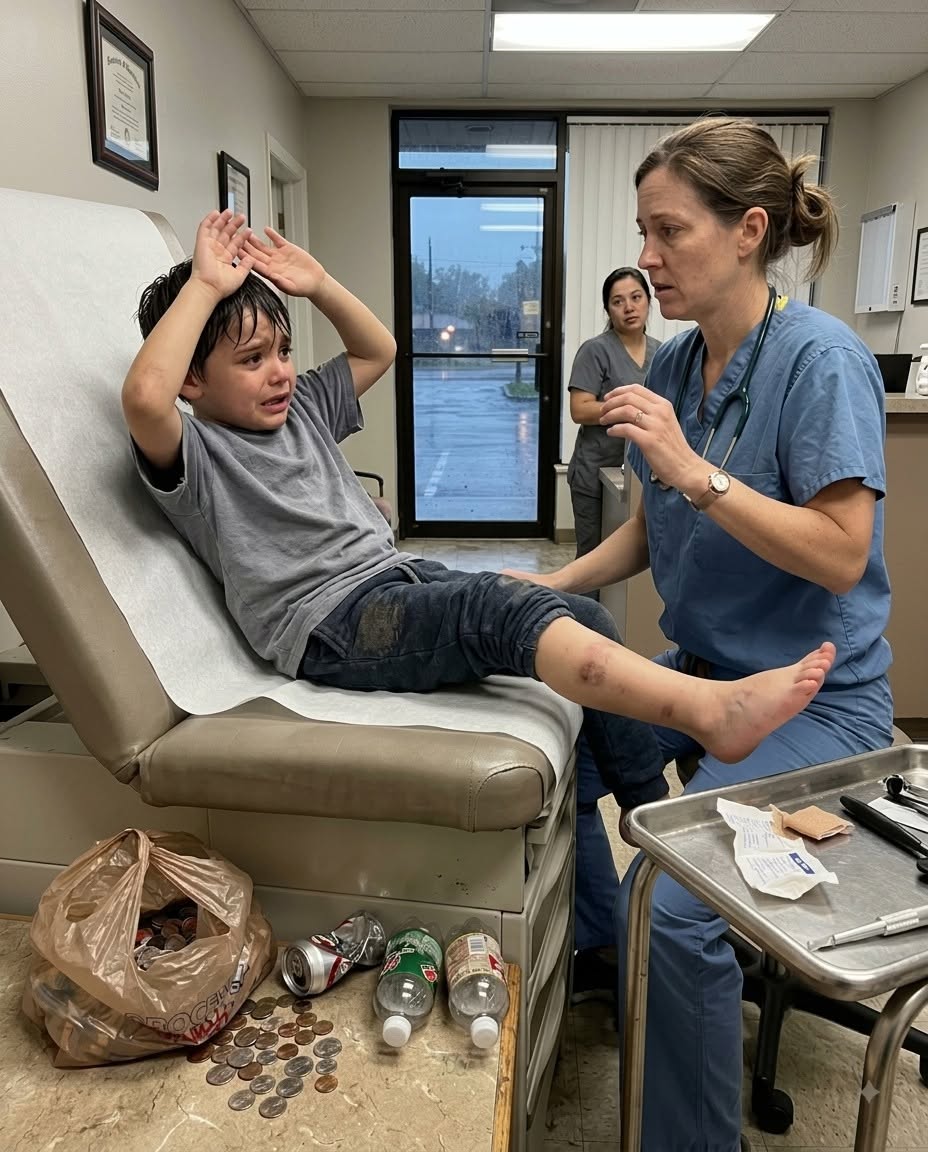
Behind me, Noah had finally fallen asleep on the cot.
One hand was tucked beneath his cheek.
The other rested close to his head.
Even sleeping, his body seemed unwilling to abandon the position it had learned for protection.
I looked at his bruises again.
Then at his wet sneakers.
Then at the plastic bag containing the bottles and coins.
Michael could tell me what he knew.
He could tell me what he did not know.
He could tell me who had been caring for Noah, what had happened to his leg, or why a child connected to a family with money and medical access had shown up at a small neighborhood clinic carrying recyclables.
But none of those answers could change the decision I had already made.
I was not sending Noah back into that house without answers.
That decision did not come from the five years I had spent missing him.
It came from what was in front of me now.
A leg that needed treatment.
Bruises in different stages of fading.
A defensive reaction to a gentle hand.
A child apologizing for collapsing in pain.
A child asking whether he should wash a bowl after eating soup.
A child telling me that if I returned him, he would try not to cry.
Those were the facts I could not talk myself around.
The clinic had grown quieter as the evening moved on.
Rain continued outside.
The medical file remained open with the times and observations I had entered. The photographs were preserved. The X-ray plate stayed near the cot. The grocery bag remained beside the exam table.
Nothing about the scene looked powerful.
There was no expensive office.
No charity photograph.
No framed newspaper article.
Just a small clinic, a tired doctor, an injured boy, and twelve dollars gathered from things other people had thrown away.
Yet for the first time in five years, I had something I had not possessed when Michael’s family placed those papers in front of me.
I had Noah in front of me.
I had his condition documented.
I had heard his words myself.
And this time, no one had placed a check beside the truth and asked me to sign it away.
I kept thinking about the first thing he had said when he entered.
“Can you fix me? I have money.”
He had not walked in asking to be rescued.
He had not demanded anything.
He had gathered coins, cans, and bottles, then come through the rain prepared to bargain for relief.
That was what someone had taught him about needing help.
And the second lesson was even worse.
“Don’t hit me. I’ll be good.”
Those words had come out before I touched him.
No explanation Michael could give me over the phone could erase that reflex.
No family reputation could erase it.
No money could make me forget it.
I had already spent five years living with one signature.
I was not going to spend another night pretending that fear looked like discipline simply because the people involved were powerful enough to rename it.
Then time moved again.
Roughly twenty minutes after the call, headlights swept through the rain beyond the clinic windows.
A black SUV pulled in beside the curbside mailbox and came to a stop.
Noah was still sleeping.
The twelve dollars were still in the grocery bag.
And the person I had called had arrived.