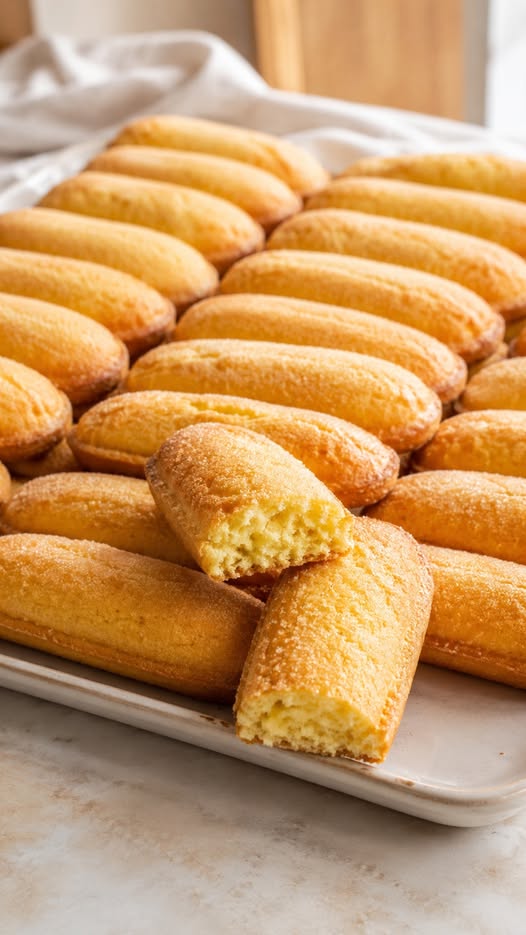
Ingredients for Homemade Ladyfingers
4 large eggs (≈4)
120 g white sugar (≈1/2 cup)
5 ml vanilla extract (≈1 teaspoon)
120 g all-purpose flour (≈1 cup)
20 g cornstarch (≈2 1/2 tablespoons)
1 pinch of salt (≈1/8 teaspoon)
30 g powdered sugar for dusting (≈3 tablespoons)
How to Make Homemade Ladyfingers
Crispy on the outside, light and fluffy on the inside, these homemade ladyfingers are perfect to enjoy with coffee, in a luxurious tiramisu, or simply as a sweet treat. With just a few ingredients and a simple technique, you’ll get airy cookies that melt in your mouth. The secret is to beat the eggs well, gently fold in the flour, and sprinkle with powdered sugar for that characteristic finish. Dare to bake them at home and you’ll see how the aroma of vanilla fills your kitchen.
How to Make Homemade Ladyfingers
Crispy on the outside, light and fluffy on the inside, these homemade ladyfingers are perfect to enjoy with coffee, in a luxurious tiramisu, or simply as a sweet treat. With just a few ingredients and a simple technique, you’ll get airy cookies that melt in your mouth. The secret is to beat the eggs well, gently fold in the flour, and sprinkle with powdered sugar for that characteristic finish. Dare to bake them at home and you’ll see how the aroma of vanilla fills your kitchen.
1. Preheat the oven to 180°C (350°F) with the top and bottom elements on. Line two baking sheets with parchment paper. Draw guide lines 8–10 cm (3–4 inches) apart on the back of the paper if you want evenly spaced ladyfingers.
2. Separate the egg whites from the yolks. Make sure the mixing bowl is perfectly clean and dry; any grease will prevent the egg whites from whipping properly.
3. Beat the egg yolks with half the sugar (60g) and the vanilla for 2–3 minutes, until pale and thick. Set aside.
4. In another bowl, whisk the egg whites with a pinch of salt at medium speed. When they begin to foam, gradually add the remaining sugar (60g) and whisk until stiff, glossy peaks form. Do not overbeat: they should be silky, not dry.
5. Gently fold the egg yolk mixture into the egg whites using a spatula. Do this in two additions to minimize air loss.
6. Sift the flour and cornstarch together over the mixture in two–3 batches. Fold in gently, rotating the bowl and scraping down the sides. Stop as soon as you no longer see streaks of flour.
7. Transfer the batter to a piping bag fitted with a 1–1.2 cm plain nozzle (or a sturdy plastic bag with the corner snipped off).
8. Shape the dough into 8–10 cm sticks on the baking sheets, leaving 2–3 cm between them. Gently tap the baking sheet on the table to settle the dough and remove any large air bubbles.
9. Dust generously with icing sugar, wait 30 seconds, and dust again: this creates the characteristic crust and helps with the soft crackling.
10. Bake for 10–12 minutes, until the edges are just barely golden and the surface springs back when touched. Do not open the oven during the first 8 minutes.
11. Let them rest for 2 minutes on the baking sheet and transfer to a wire rack to cool completely. For drier ladyfingers (like sponge cakes), bake them again for 5 minutes at 120°C to dry them out.
12. Store in an airtight container or tin for up to 1 week. Tip: If the dough is too runny, refrigerate it for 10 minutes. If it’s too thick, it was due to overmixing. Adjust the next batch by mixing more gently.