
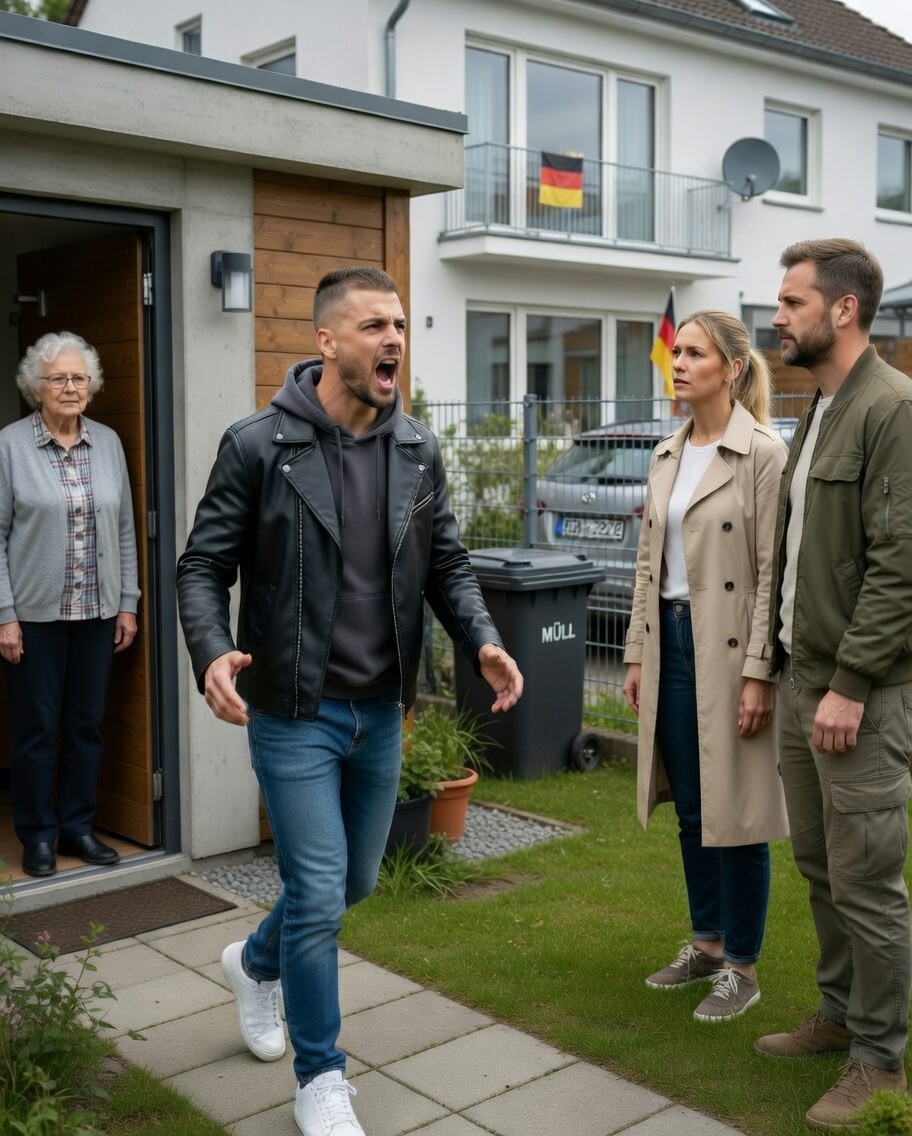
One rainy Thursday afternoon in October, my grandson came to visit. He carried a small travel bag and wore a dark blue coat that looked far too expensive for the neighborhood where I lived.
I was peeling potatoes in the narrow kitchenette that adjoined the back room, which my son called my “private space.” In reality, it had once been a storage outbuilding behind the garage. The ceiling was low, the walls thin, and when it rained, I could hear every drop pattering against the metal gutter outside my window. There was just enough room for a single bed, a chest of drawers, a hot plate, and a chair with one uneven leg. My son, Bernd, told people I appreciated the privacy.
I had just finished drying my hands on a dish towel when I heard the back door creak.
“Grandma?” I turned so fast I almost dropped the knife. “Elias?”
He crossed the narrow strip of concrete in three long strides and hugged me tightly—tighter than he had at sixteen, when he was all elbows and impatience. Now he was twenty-eight, broad-shouldered, clean-shaven, and with a calmer expression. I hadn’t seen him in almost three years, not since he’d moved to Frankfurt after finishing law school. He’d called, sent flowers for my birthday, apologized for being so busy. But seeing him standing in my doorway felt like sunlight in a room that had forgotten morning.
“I wanted to surprise you,” he said. “Well, you certainly did.”
He stepped inside, and I saw his eyes take everything in—the stained curtain, the medicine bottles on the windowsill, the space heater beside the bed. His smile faded. “Why do you live out here?” he asked quietly.
Before I could answer, the kitchen door of the main house slammed open. Bernd strode across the yard, his jaw already tense, followed by his wife, Melanie, who had folded her arms and wore that perpetually offended expression she always wore when life wasn’t about her comfort.
“There you are,” Bernd said to Elias, far too cheerfully. “We thought you’d come to the main entrance.” Elias didn’t take his eyes off me. “Grandma lives here?” Bernd chuckled. “It’s a guest apartment.” Melanie added, “She likes having her own space.”
I opened my mouth to smooth things over, as I always did, but Elias spoke first. “It’s a converted storage room.” Bernd’s expression hardened. “Calm your tone.” Elias turned fully to face him. “Why does my grandmother live out back at the house?”
The answer burst out of Bernd as if it had been waiting for years to be heard. “Because the house now belongs to my wife,” he snapped. “And if my mother complains, she’ll be out for good.”
The courtyard fell silent, save for the steady drip of rain from the gutter. Melanie gasped—not because she disagreed, but because he had said it out loud.
I felt a pang of shame, the kind you feel when humiliation becomes routine. “Bernd,” I whispered, “stop it.” But Elias didn’t stop. His gaze traveled from my face to the back room, to the cracked step, to the pharmacy bag on my dresser, visible through the open door.
Then he asked, very calmly, “Tell me exactly whose name this property is registered in.” Bernd let out a short, ugly laugh. “That’s none of your business.” Elias carefully set down his travel bag. Only then did I notice the leather briefcase under his arm and the gold badge of honor on his lapel. Bernd had no idea who his son had become. But I knew one thing when I saw Elias’s face: whatever happened next, this family would be shaken to its core.
Bernd made the mistake of grinning. I call it a mistake, because if he had bragged less—if he had played the patient son a little longer—Elias might have taken me out to dinner, listened to my excuses, and waited until morning before digging deeper. But Bernd had inherited his father’s worst habit: mistakenly interpreting years of getting away with wrongdoing as proof of its legitimacy.
“What do you think you are? Just because you’re wearing a smart coat and flew in from Frankfurt, you can tell me how to do things in my own house?” Bernd said. Elias didn’t react. He reached into his briefcase, pulled out a business card, and passed it across the narrow space between them. Bernd glanced at it, and his expression changed. Elias Schneider, Senior Public Prosecutor.
Melanie took the card from him and read it as well. The color drained from her face. “Bernd…” He slid the card back to Elias. “Federal Prosecutor? Since when?” “For two years now,” Elias said. “And today I’m not here in an official capacity. I’m here as her grandson. So I’ll ask again: Whose name is on the deed?”
I wanted to disappear into the ground. Not because I was afraid of Elias, but because mothers like me with difficult sons are trained to fear conflict more than cruelty. “Please,” I said, “don’t make a scene.” Elias looked at me, his expression softening. “Grandma, the scene’s already happened.”
Melanie was the first to recover. “Margarete always had her place here. We take care of her.” Elias glanced at the room behind me. “In a partitioned-off cubicle with a space heater, exposed pipes, and no accessible bathroom? She’s seventy-four.” “She wanted independence,” Bernd said. The lie was so blatant I almost laughed.
The truth was uglier. After my husband Franz died seven years earlier, I let Bernd handle everything because grief had slowed my thinking and made me feel confused. He said I shouldn’t live alone. He said the big house was too much. He said if I transferred ownership to him, the debt restructuring would be easier, and he could renovate so we could all live together. There were papers. So many papers. Melanie had sat beside me, smiled, and shown me where to sign. I trusted my son because he was my son.
At first, I had the bedroom on the ground floor. Then Melanie got pregnant and wanted a nursery. Later came the study, then a gym, then “temporary” repairs. Each change pushed me further away from the center of the house until one spring morning, Bernd carried my clothes into the back room and said it was “quieter out there.” By that point, my name was nowhere to be found.
Elias listened intently as I told him everything, though his jaw tightened with each sentence. When I finished, he asked only one question. “Did you ever have your own lawyer review the property transfer?” “No.” “Were you advised to get one?” Bernd interrupted. “That’s enough. You’re acting like I robbed them.” Elias’s eyes flashed at him. “Did you?” “This house would have gone under without me.” “That’s not what I asked.” Melanie stepped forward. “We pay the taxes. We pay the utilities. We provide the care.” Before I could stop myself, I said, “You’re charging rent out of my pension.” Melanie froze. Elias slowly turned to face her. “You what?” Bernd muttered under his breath.