When my daughter brought a quiet, hungry classmate home for dinner, I thought I was just stretching out another meal. But one evening, something fell out of her backpack that forced me to face the truth—and to consider what “enough” truly meant for our family and for me.
I used to believe that “enough” would take care of itself if you just worked hard enough. Enough food, enough warmth, and more than enough love.
But in our house, “enough” was something I argued about at the supermarket, with the weather, and in my own mind.
My plan for Tuesday was rice dinner, with a package of chicken thighs, carrots, and half an onion scattered throughout the meal. While I was chopping, I was already calculating the leftovers for lunch and deciding which bills could wait another week.
Dieter came out of the garage, his hands rough, his face weary. “Is dinner almost ready, honey?” He tossed his key into the bowl.
“In ten minutes,” I said, still calculating. There would be three plates, and maybe some for lunch tomorrow.
He glanced at his watch, his brow furrowing. “Has Sophie finished her homework?” “I haven’t checked yet. She’s been so quiet, I guess algebra is winning.” “Or TikTok,” he said with a grin.
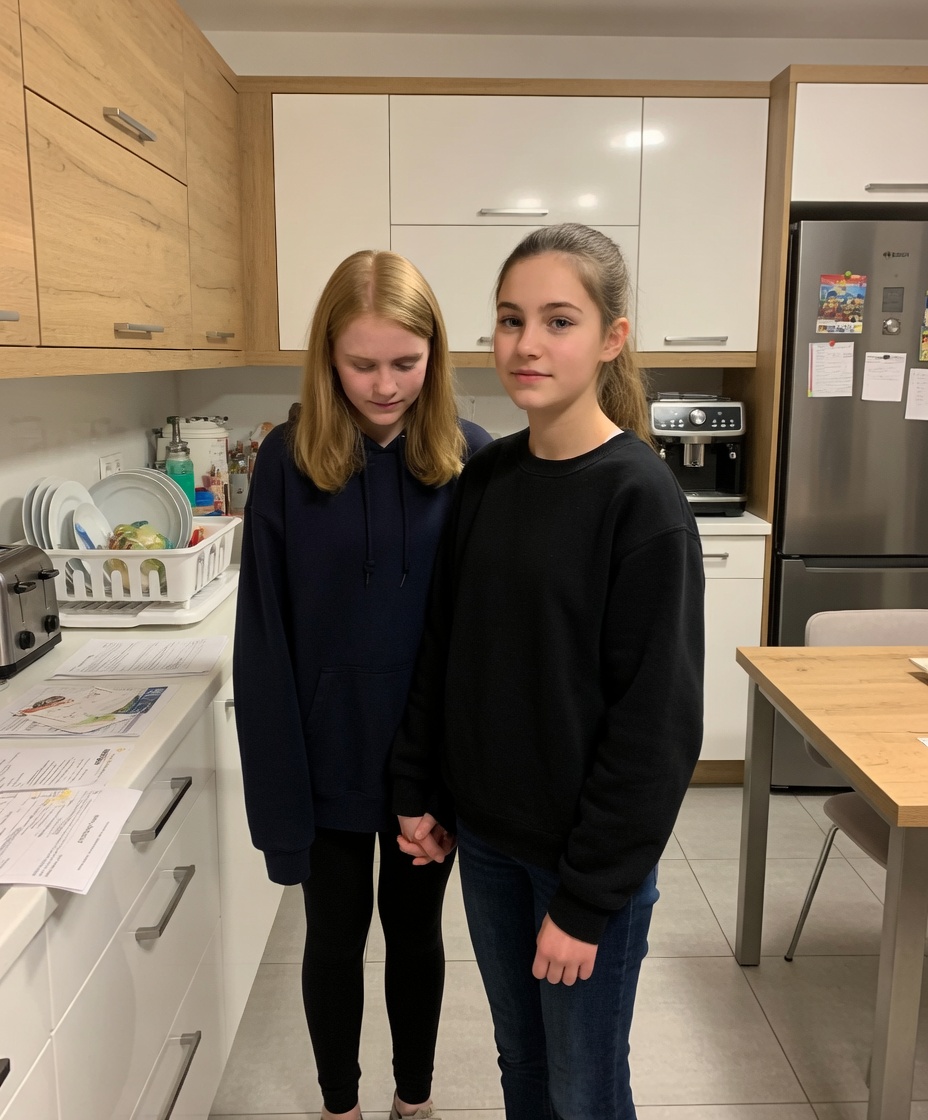
I was about to call everyone to the table when Sophie burst in, followed by a girl I’d never seen before. The girl’s hair was tied back in a messy ponytail, the sleeves of her hoodie hanging over her fingertips despite the late spring heat.
Sophie didn’t even wait for me to say anything. “Mom, Leni’s eating with us.” She said it as if it were a given.
I blinked, still holding the knife. Dieter looked from me to the girl and back again. The girl kept her eyes fixed on the ground. Her sneakers were worn through, and she was clutching the straps of a faded purple backpack. I could see her ribs through the thin fabric of her top. She looked like she wanted to disappear into the ground.
“Uh, hi.” I tried to sound welcoming, but my voice was weak. “Have a plate, sweetheart.”
She hesitated. “Thanks,” she whispered, her voice barely audible.
I watched her. She wasn’t just eating—she was rationing. A cautious spoonful of rice, a piece of chicken, two carrots. She flinched at every clatter of cutlery or the rustling of a chair, tense like a startled animal.
Dieter cleared his throat and switched into mediator mode. “So, Leni, right? How long have you known Sophie?” She shrugged, her gaze still downcast. “Since last year.”
Sophie chimed in. “We do sports together. Leni’s the only one who runs the long distance without complaining.” That brought a tiny smile to Leni’s face. She reached for the water, her hands trembling. She drank, refilled her glass, and drank again.
I glanced at Sophie. Her cheeks were flushed. She was watching me, practically daring me to react. I looked at the food, then at the girls. I mentally recalculated the menu – less meat, more rice, maybe no one would notice.
Dinner was mostly quiet. Dieter tried to fill the emptiness. “How’s algebra going?” Sophie rolled her eyes. “Dad. Nobody likes algebra, and nobody talks about algebra at dinner.”
Leni’s voice was soft as she spoke. “I like it,” she said. “I like patterns.” Sophie grinned. “Yeah, you’re the only one in our class.”
Dieter chuckled and tried to lighten the mood. “I could have used you for my tax return last month, Leni. We almost lost our refund because of Sophie.” “Dad!” Sophie groaned, rolling her eyes.
After dinner, Leni stood uncertainly at the sink. Sophie intercepted her and held out a banana. “You forgot dessert, Leni.” Leni blinked. “Really? Are you sure?”
Sophie pressed it into her hand. “House rule. Nobody leaves here hungry. Ask my mom.” Leni clutched the banana tightly and gripped her backpack even more tightly. “Thanks,” she whispered, as if unsure whether she deserved it. She hesitated at the door and looked back. Dieter nodded. “Come anytime, sweetheart.”
Her cheeks flushed pink. “Okay. If it’s not too much trouble.” “Never,” Dieter said. “There’s always room at our table.”
As soon as the door clicked shut, my tone sharpened. “Sophie, you can’t just bring people home. We’re barely making ends meet ourselves.” Sophie didn’t move. “She hasn’t eaten all day, Mom. How could I have ignored that?”
I stared at her. “That doesn’t give you the right—” “She almost passed out, Mom!” Sophie retorted. “Her father works nonstop. Last week, their electricity was cut off. We’re not rich, but we have enough to eat.”
Dieter placed a hand on Sophie’s shoulder. “Are you serious, Sophie?” She nodded. “It’s terrible, Dad. Today she fainted in gym class. The teachers told her she needs to eat more, but she only eats lunch—and not even that every day.”
My anger subsided. I sat down at the table, the room seeming to spin slightly. “I… I was worried about how to stretch the food. And she’s just trying to get through the day… I’m sorry, Sophie. I shouldn’t have yelled.”
Sophie looked into my eyes, stubborn but gentle. “I told her to come back tomorrow.” I took a deep breath, defeated but proud. “Okay. Bring her back.”
The next day, I cooked extra pasta, my nerves on edge as I seasoned the meat. Leni came back, clutching her bag. At dinner, she ate everything and then carefully wiped her place at the table. Dieter asked, “Are you okay, Leni?” She nodded without looking at him.
By Friday, she had become part of our routine—homework, dinner, saying goodbye. She did the dishes with Sophie, humming softly to herself. One evening she fell asleep at the kitchen counter, then woke up with a start and apologized three times.