
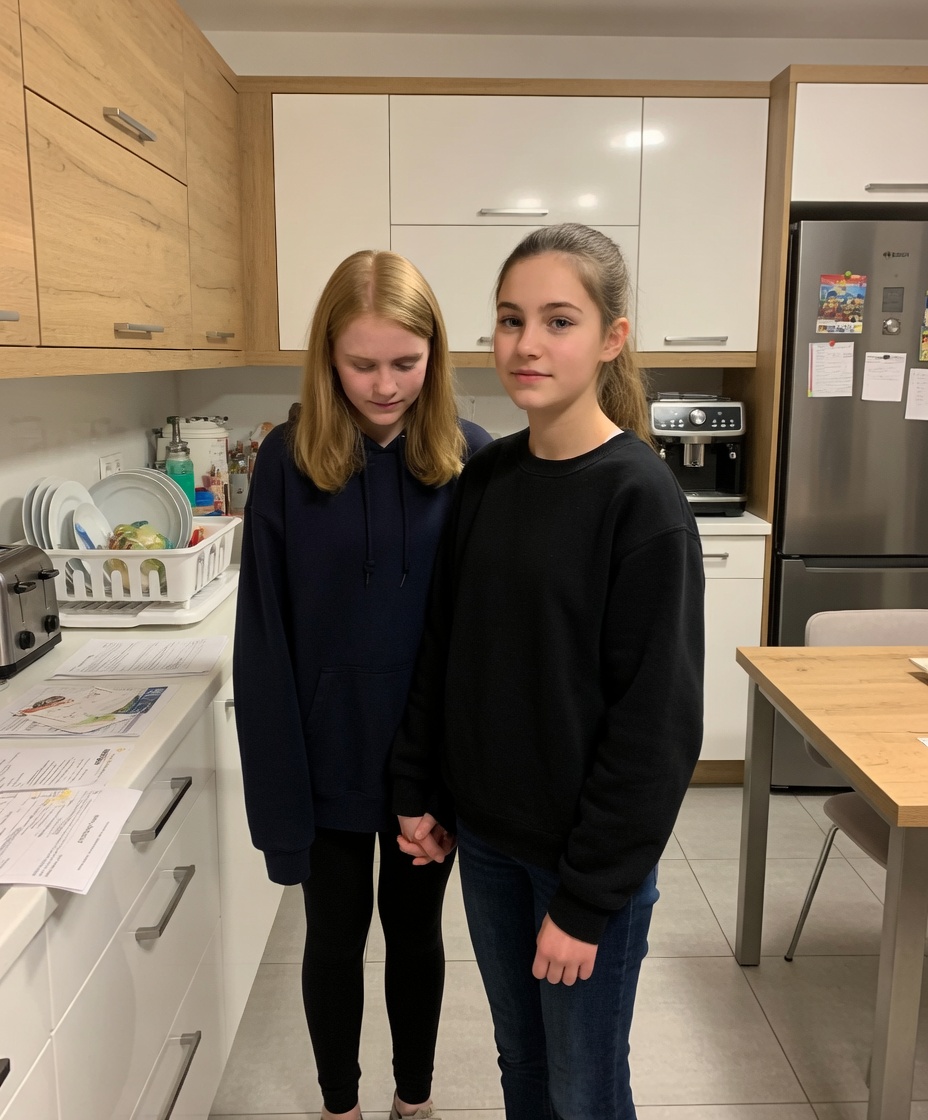
Dieter grabbed my arm. “Should we call someone? She needs… help, right?” “And what should we say?” I whispered. “That her father is struggling and she’s tired? I don’t even know where to begin, Dieter. Let’s just do what we can.”
He sighed. “She looks exhausted.” I nodded. “I’ll talk to her. Very carefully this time.”
Over the weekend, I tried to find out more. Sophie shrugged. “She doesn’t talk about home. Just says that her father works a lot. And that sometimes the power goes out. She acts like everything’s okay, but she’s always hungry… and tired.”
That Monday, Leni looked even paler. As she took out her homework, her backpack slipped off the chair and burst open. Papers scattered across the floor—crumpled bills, an envelope of coins, and a reminder notice stamped with the red word “FINAL WARNING.”
A worn notebook opened, its pages filled with lists. I knelt down to help. “Eviction Notice” stared back at me in bold letters. Below, in neat handwriting: “What we’ll take first if we get kicked out.”
“Leni…” My voice faltered. “What is this?” She froze, her lips pressed tightly together, her fingers clutching the fabric of her hoodie.
Sophie gasped. “Leni, you didn’t say it was this bad!” Dieter came in. “What’s going on?” He looked at the papers.
I held up the envelope. “Leni, sweetheart… are you and your father losing your home?” She stared at the ground, clutching her bag. “My dad said I can’t tell anyone. He says it’s nobody’s business.”
“Sweetheart, that’s not true,” I said gently. “We’re worried about you. But we can’t help if we don’t know what’s going on.” She shook her head, tears welling in her eyes. “He says people will look at us differently. Like we’re begging.”
Dieter crouched down beside us. “Is there anywhere else you can go? An aunt or friends?” She shook her head even more violently. “We tried… but there was no room.”
Sophie squeezed her hand. “You don’t have to hide this. We’ll find a solution together.” I nodded. “You’re not alone, Leni. We’re in this together.”
She hesitated and looked at her cracked phone. “Should I call my dad? He’ll be furious.” “Let me talk to him,” I said. “We just want to help.”
She called. We waited. I made coffee, Dieter cleared the dishes. My stomach churned.
The doorbell rang. Leni’s father came in, exhaustion etched on his face. Oil stains on his jeans, dark circles under his eyes, but he still tried to smile. “Thank you for feeding my daughter,” he said, shaking Dieter’s hand. “I’m Paul. Sorry for the inconvenience.”
I shook my head. “I’m Helena. It wasn’t inconvenience. But Leni is carrying too much of a burden.” He looked at the bills, his jaw tensing. “She shouldn’t have brought this here.” Then he slumped. “I thought I could manage… if I worked more.”
“She brought it because she’s scared,” Dieter said. “No child should have to carry this alone.” Paul ran his hand through his hair. “After her mother died, I promised I would protect her. I didn’t want her to see me fail.”
“She needs more than promises,” Dieter said. “She needs food, peace and quiet, and the chance to be a child.” He nodded and finally broke down. “So what now?”
I made calls—to the school social worker, to a neighbor who ran the food bank, to Leni’s landlord. Dieter bought groceries using coupons he’d collected. Sophie baked banana bread with Leni. The kitchen was filled with laughter again.
A social worker came by. The landlord agreed to postpone the eviction for a month if Paul did some repairs and paid back part of the debt. “If you do some repairs around the house, Paul, and pay back a small portion of the money, we can come to an agreement.”
At school, the guidance counselor admitted they should have intervened sooner. Leni received free lunches and real support. It wasn’t a miracle. But it was hope.
Leni stayed with us a few nights a week. Sophie lent her pajamas and showed her how to style her hair into loose space buns. Leni helped Sophie with math, and her voice grew stronger.
Dieter took them to the food bank and helped them apply for housing benefits. At first, Paul resisted. “Pride is hard to swallow, Helena,” Dieter told me. “We mustn’t push him too hard.” But when Leni whispered, “Please, Dad. I’m tired,” he relented.
Weeks passed. The refrigerator was never completely full, but there was always enough for one more person. I stopped counting portions and started counting smiles.
Sophie’s grades improved with Leni’s help. Leni made it onto the top student list. She started laughing—really laughing—at our table.
One evening after dinner, Leni stood at the kitchen counter, her sleeves pulled over her hands. “Is something bothering you, sweetheart?” I asked.
She looked shy, but braver. “I used to be afraid to come here,” she said. “But now… it feels safe.” Sophie grinned. “That’s because you haven’t experienced Mom on laundry day yet.” Dieter laughed. “Hey, let’s not talk about the disasters of laundry day.”
Leni laughed, warm and open. I smiled, remembering the girl who used to flinch at every sound. I packed her lunch. “Here, take this for tomorrow.”
She hugged me tightly. “Thank you, Aunt Helena. For everything.” I hugged her back. “Anytime. You’re part of the family here.”
She left, and I stood in the quiet kitchen. Sophie watched me, pride in her eyes. “Hey,” I said. “I’m proud of you. You didn’t just see someone suffering—you did something.”
Sophie shrugged, smiling. “You would have done the same, Mom.” I realized that every sacrifice, every difficult decision, had shaped her into the person I admired.
The next day, Sophie and Leni came in laughing. “Mom, what’s for dinner?” Sophie asked. “Rice,” I said. “And whatever else I can stretch out of it.”
This time, I set four plates without even thinking about it.